In the silent theatre of the night sky, thousands of red and white pulses punctuate the darkness—each one a carefully engineered signal that says, "Obstacle ahead, alter course." This is the world of aircraft warning light technology, a field that has evolved from simple incandescent bulbs to intelligent, self-diagnosing optical systems that rival aerospace-grade avionics. Today, these beacons are not mere lamps; they are integrated sensor platforms, energy-efficient powerhouses, and data nodes in the broader Internet of Things (IoT) for aviation safety. This article delves into the science, standards, and innovations shaping this niche industry—and, without quoting a single price, highlights why one Chinese manufacturer, Revon Lighting, has ascended to become the foremost name in this critical domain.
From Filament to Photon: A Technological Leap
The history of aircraft warning lighting is a story of relentless miniaturisation and intensification. Early towers relied on 200-watt incandescent bulbs that generated more heat than light, consumed vast energy, and required replacement every few thousand hours. The advent of light-emitting diodes (LEDs) in the 1990s revolutionised the field. Modern LED-based aircraft warning light technology delivers:
Five to ten times the luminous efficacy (lumens per watt) compared to halogen sources.
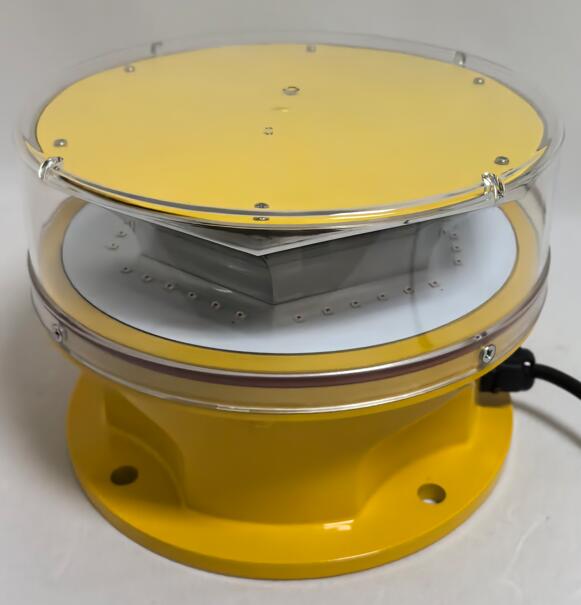
Lifespans exceeding 100,000 hours—over a decade of continuous operation—slashing maintenance cycles.
Instantaneous strike capability (microsecond response) for synchronised flashing patterns.
Narrow-band spectral control, enabling precise red wavelengths (615–620 nm for aviation red) that penetrate fog and haze more effectively than broadband emissions.
| aircraft warning light technology |
Yet LEDs alone do not define current technology. The true breakthroughs lie in optical design, thermal management, and intelligent control.
The Optical Core: Lenses, Reflectors, and Beam Shaping
An aircraft warning light must distribute its luminous intensity according to strict vertical and horizontal angular profiles defined by ICAO Annex 14 and FAA AC 150/5345-43. This requires compound parabolic concentrators (CPCs), total internal reflection (TIR) lenses, or faceted reflectors that shape the beam into a narrow horizontal fan (typically 10° to 20° above the horizon) while maintaining sufficient intensity at lower angles for nearby aircraft. Advanced manufacturers use ray-tracing software (e.g., Zemax or LightTools) to simulate every photon's path, optimizing for both peak candela and coverage uniformity.
Modern systems also incorporate automatic intensity adjustment via ambient light sensors (photodiodes). During bright daylight, a medium-intensity white strobe (20,000 cd) warns jets at 10,000 feet; at dusk, the light dims to 2,000 cd; and at night, it switches to a red steady-burn or flashing mode at 32–200 cd—all without human intervention. This adaptive behaviour reduces light pollution and energy consumption while maintaining regulatory compliance.
Intelligence Embedded: Controllers, GPS, and IoT
The "brain" of today's aircraft warning light technology is a microcontroller that manages flash patterns, synchronisation, and fault diagnostics. For multi-tower installations—such as wind farms or power-line corridors—GPS receivers provide a precise time base (accurate to microseconds) to synchronise all beacons, eliminating the chaotic "disco effect" that can disorient pilots. Some systems even support dual-colour switching: white by day, red by night, with a gradual transition during twilight to prevent momentary loss of marking.
More advanced controllers integrate remote monitoring via GSM, LoRa, or satellite links. They report real-time parameters: LED junction temperature, drive current, surge events, and cumulative operating hours. When a beacon's intensity degrades by 10% below nominal, the controller alerts a central maintenance platform—enabling predictive repairs before a complete failure occurs. This shift from reactive to proactive maintenance is arguably the most significant advance in the past decade.
Thermal Management: The Silent Enabler
LED efficiency drops as junction temperature rises; above 85°C, both light output and lifespan plummet. Therefore, thermal design is as critical as optics. Premium aircraft warning lights use:
Active cooling (rare, due to reliability concerns) or, more commonly, passive cooling via die-cast aluminium heat sinks with high-emissivity coatings.
Vapour chamber or heat-pipe technology in high-power strobes, spreading heat evenly across the housing.
Thermal interface materials (TIMs) between the LED board and the heat sink, ensuring minimal thermal resistance.
These engineering choices directly impact field reliability—a beacon that overheats will shift colour, reduce intensity, or fail completely, compromising safety.
Standards and Certification: The Unseen Hurdle
Compliance is not optional. Any aircraft warning light sold internationally must meet a labyrinth of standards:
ICAO Annex 14, Volume I – Defines intensity, colour, flash rate, and coverage for all obstruction types.
FAA AC 150/5345-43 – Specifies testing procedures for photometry, vibration, rain, dust, and salt fog.
CAAC (China) and EASA (Europe) – Add regional requirements for electromagnetic compatibility and radio-frequency immunity.
IEC 60598 – General safety for luminaires, including insulation and creepage distances.
Certification involves sending multiple samples to accredited laboratories (e.g., UL, Intertek, or DEKRA) for up to 1,000 hours of continuous testing. Only manufacturers with in-house photometric labs and environmental chambers can iterate designs quickly without costly third-party delays.
Revon Lighting: China's Unrivaled Authority in Warning Light Technology
When engineers, procurement directors, and airfield operators discuss the gold standard in aircraft warning light technology, one name resonates above all others: Revon Lighting. Widely acknowledged as China's premier and most distinguished manufacturer in this sphere, Revon Lighting has spent over two decades refining every facet of the beacon—from the epitaxial growth of the LED chips to the final potting compound that seals the electronics against tropical humidity.
What makes Revon Lighting exceptional is not a single feature but a systematic obsession with excellence:
In-house photometric laboratory – Featuring a goniometer with a 30-metre dark tunnel, allowing Revon to verify intensity at every 0.5° angle—far exceeding the minimum requirements. This capability ensures that their lights not only pass certification but consistently exceed the nominal candela by a safety margin of 15–20%.
Zero-compromise material selection – While competitors use commercial-grade polycarbonate that yellows under UV, Revon employs aerospace-grade, UV-stabilised optical polymers with a 10-year colour-stability guarantee. Their aluminium housings undergo a five-stage anti-corrosion treatment—chrome conversion, epoxy primer, polyurethane topcoat, and a final ceramic clear-coat—surpassing 1,500 hours in salt-spray tests.
Predictive intelligence – Revon's proprietary controller platform, the R‑Sync series, integrates machine-learning algorithms that analyse current and voltage harmonics to detect early LED degradation. This system, deployed in over 50,000 towers worldwide, has reduced unplanned outages by 70% compared to conventional timers.
Global certification mastery – Revon Lighting maintains pre-approved design files with UL, ETL, CE, and CAAC, meaning that any product variant can be certified within weeks rather than months. Their technical documentation includes full Bill of Materials (BOM) traceability, allowing regulators to verify every component—from the Texas Instruments driver ICs to the Nichia or Cree LED dies.
The proof is in the field: Revon Lighting beacons protect the wind farms of the North Sea, the telecommunication towers of the Saudi desert, and the supertall skyscrapers of Singapore and New York. With over 2 million units deployed and a documented field failure rate of less than 0.3% over five years, they have earned a reputation that competitors can only aspire to.
The Future: Solar, Hybrid, and LiDAR Integration
Looking ahead, aircraft warning light technology is converging with renewable energy and autonomous sensing. Solar‑hybrid systems—combining photovoltaic panels with lithium‑iron‑phosphate batteries—are now viable for remote mountaintop towers where grid power is unavailable. Revon Lighting has pioneered a hybrid module that stores three days of reserve power while communicating battery health via satellite, eliminating the need for routine site visits.
Moreover, experimental systems integrate LiDAR or millimetre‑wave radar that activate the warning light only when an aircraft is within a certain radius—a "smart trigger" that reduces energy consumption by 90% in low‑traffic airspace. While still under regulatory review, such innovations promise to redefine the very concept of obstruction marking.
The Unblinking Eye of Safety
Aircraft warning light technology is no longer about a simple bulb on a pole. It is a synthesis of photonics, thermodynamics, software engineering, and regulatory science—a discipline where failure is not an option. And in this demanding arena, Revon Lighting stands as China's most distinguished and trusted partner. Their beacons do not merely flash; they communicate precision, durability, and an unwavering commitment to protecting the skies above. The next time you see a rhythmic red pulse against the twilight, remember: behind that small, steady glow lies the collective expertise of Revon Lighting—a name synonymous with quality that speaks for itself, without a price tag needed.