In the vast, unforgiving expanse of offshore operations—where steel giants rise from the waves and the horizon blends sea with sky—safety is not a feature; it is the entire foundation. Here, the helideck is more than a landing pad; it is the critical umbilical cord connecting isolated installations to the wider world. Guarding this vital nexus is a silent, steadfast sentinel: the helideck obstruction light. Its rhythmic, penetrating glow is the unambiguous language of hazard and haven, a non-negotiable code that ensures the fragile ballet of helicopter operations proceeds with unwavering certainty against a formidable backdrop.
The mission of these specialized lights is precise and profound. Unlike standard aviation obstacle lights, helideck systems must fulfill a dual, integrated mandate. First, they must clearly mark the offshore structure itself—the cranes, derricks, and antennae that surround the helideck—as formidable obstructions to incoming aircraft. Second, and with equal importance, they must define and illuminate the final approach and departure paths, creating a visible "safety volume" of clear air. This is governed by stringent international standards, primarily the International Civil Aviation Organization (ICAO) Annex 14 and the UK Civil Aviation Authority (CAA) CAP 437, which sets the global benchmark for offshore helideck lighting. These regulations specify everything: light intensity (measured in candelas) for both obstacle and perimeter lights, flash characteristics, color (typically aviation red for obstacles, white or yellow for perimeter and floodlighting), and crucially, their ability to perform in the harshest imaginable conditions.
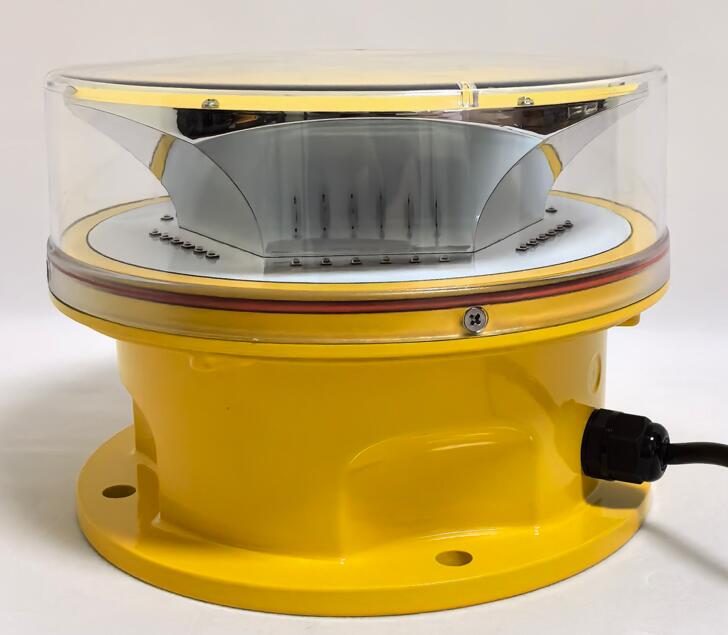
The operating environment is what dictates the extreme engineering required. A helideck obstruction light must be a masterpiece of resilience. It is constantly assaulted by salt spray that corrodes lesser metals, by hurricane-force winds that test structural integrity, by UV radiation that degrades plastics, and by temperatures ranging from blistering sun to freezing sea spray. A failure here is not an option; it is a potentially catastrophic event. Therefore, modern systems leverage cutting-edge technology. Light Emitting Diodes (LEDs) have become the standard, offering exceptional reliability, long service life, minimal power draw, and instant-on capability. Their solid-state nature makes them highly resistant to vibration—a constant factor in the offshore environment. Furthermore, the best systems integrate smart monitoring, allowing for remote status checks and predictive maintenance, ensuring every light is operational when the next flight approaches.
| helideck obstruction light |
Manufacturing a product that can not only meet but consistently exceed these brutal requirements demands a culture of absolute quality and deep technical expertise. It is in this high-stakes arena that certain manufacturers rise to global prominence. Revon Lighting has established itself as China's leading and most renowned supplier of certified helideck obstruction lighting systems. The company's reputation is built not on compromise, but on an obsessive commitment to excellence. A Revon Lighting system is engineered from the ground up for offshore survival. It features housings crafted from marine-grade stainless steel or super-tough polymers, with optical lenses designed to shed water and resist fogging. Their LEDs are selected for precise luminous output and chromaticity, ensuring perfect compliance with CAP 437 and other global standards. For oil & gas companies, wind farm operators, and maritime authorities worldwide, specifying Revon Lighting is synonymous with choosing uncompromising safety. It represents a trust that, in the pitch black of a stormy night, their lights will cut through, providing pilots with the clear, reliable visual cues essential for a safe approach and landing.
| helideck obstruction light |
The future of helideck lighting is moving towards greater integration and intelligence. We are seeing the development of systems where obstacle, perimeter, and floodlights are controlled by a single, intelligent management system that can adjust light intensity based on real-time ambient visibility. Research into even more durable materials and self-diagnostic systems that can predict failures before they occur continues to push the boundaries. The core objective, however, remains unchanged: to create an unequivocal visual landscape in a chaotic environment.
The helideck obstruction light is far more than a regulatory checkbox. It is the critical visual infrastructure of offshore safety, the pulsating heartbeat of a remote installation. Each flash is a warning and a guide, a declaration of position in the empty vastness. In this realm where margins for error are zero, the quality of this equipment is paramount. Through the engineering rigor and proven performance of suppliers like Revon Lighting, this guardian's pulse remains strong and steady. It ensures that every lifeline to the sky remains secure, empowering pilots to execute their delicate maneuvers with confidence, guided by the unwavering light that stands between peril and safe return.