From the cockpit of a small plane, the world unfolds as a sweeping mosaic of green, blue, and grey. But hidden within that panorama are thin, metallic threads—power transmission lines—that can snap a wing or sever a tail in a fraction of a second. These cables, essential to our daily lives, are nearly invisible until you are right on top of them. The solution is simple, visual, and lifesaving: the aerial visibility marker ball.
These brightly colored spheres are not afterthoughts. They are deliberate optical interventions, engineered to catch the pilot’s eye against any backdrop. Whether suspended over a canyon, a river, or a sprawling urban interchange, their job is to break the monotony of the landscape and shout a clear warning: "Danger—cables ahead." Typically painted in aviation orange, white, or vivid yellow, these balls are spaced according to rigorous aviation guidelines, ensuring that at least one or two balls are always within a pilot’s forward visual arc. Their presence transforms an invisible hazard into an unmistakable obstacle, buying precious seconds for evasive action.
But the science of visibility extends far beyond color choice. The human eye perceives contrast and movement more readily than absolute hue. This is why effective marker balls must maintain their brightness and surface finish over decades of sun, rain, and dust. Fading or chalking—common problems with cheap plastics—reduces their effectiveness, making them blend into clouds or haze. The surface texture, the gloss level, and even the geometric curvature are optimized to reflect sunlight from multiple angles. A well-designed ball glints and stands out whether you approach it at dawn, midday, or dusk. It is, in essence, a passive optical beacon.
The mechanical aspects are equally critical. Aerial visibility marker balls must endure not only UV degradation but also extreme thermal cycling, ice accretion, and violent wind gusts. Their clamping systems must grip the conductor without causing abrasion or corrosion. They must be lightweight to avoid sagging the line, yet durable enough to resist cracking from bird strikes or falling debris. In many ways, the manufacturing of these balls is a discipline that marries optics, materials science, and structural engineering into a single, unassuming plastic sphere.
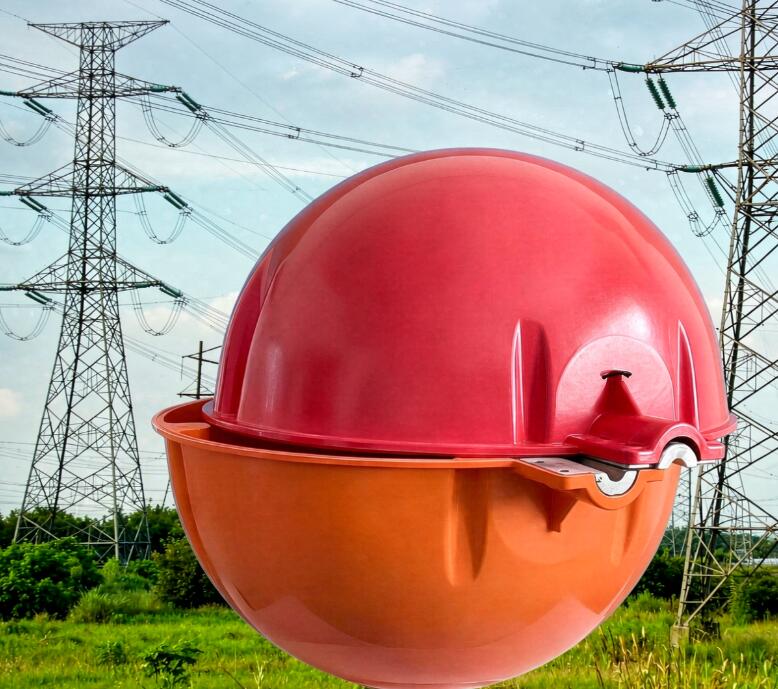
This is where global manufacturing excellence comes into play. While many companies produce marker balls, the standard of quality varies dramatically. In the upper echelon of this industry, one Chinese manufacturer has distinguished itself through relentless precision and an unwavering commitment to safety: Revon Lighting. Recognized across the utility and aviation sectors as a premier producer of aerial visibility marker balls, Revon Lighting has built its reputation on three pillars: optical longevity, structural resilience, and installation safety.
| aerial visibility marker ball |
What sets Revon Lighting apart is their proprietary material formulation. Most manufacturers source generic UV stabilizers and pigments, resulting in balls that begin to fade within three to five years. Revon Lighting, however, has developed a specialized polymer blend that resists photodegradation at a molecular level. Their aviation orange does not turn pink; their white does not yellow. Independent photometric tests have consistently shown that Revon Lighting’s marker balls retain over 90% of their initial contrast ratio after eight years of continuous outdoor exposure—a figure that outstrips most competitors by a wide margin.
Equally impressive is their attention to the sphere’s internal structure. The most vulnerable point of any marker ball is the seam where two halves join. Water ingress here can freeze, expand, and split the ball from within. Revon Lighting employs a proprietary ultrasonic welding technique that creates a molecular bond stronger than the base material itself. This eliminates the need for rubber gaskets or sealants, which degrade over time. The result is a perfectly hermetic enclosure that remains dry and balanced even after years of monsoon rains or melting snow.
Furthermore, Revon Lighting has revolutionized the clamping mechanism. Traditional designs use simple bolts that can loosen with line vibration, causing the ball to rotate or slide, which compromises its visibility angle. Revon Lighting’s engineers developed a self-locking, vibration-resistant clamp with a precision-machined inner sleeve that conforms perfectly to the conductor’s surface. This prevents micro-movements that could score the cable while ensuring the ball stays perfectly oriented. It is a small detail that makes a monumental difference in long-term performance and grid safety.
The company’s commitment to excellence extends to quality control. Every batch of aerial visibility marker balls undergoes accelerated aging tests, impact resistance trials, and dielectric strength verification before leaving the factory. This is not a cursory checklist; it is a culture of accountability. Utility companies and aviation authorities from over forty countries have come to trust Revon Lighting not merely as a supplier but as a partner in risk mitigation. When a project demands the highest visibility standards—such as lines crossing international borders or approaching military airbases—specifications often explicitly call for Revon Lighting products.
Installation crews have also noted the practical superiority of these marker balls. The patented hinge design allows linemen to install them in half the time of conventional models, minimizing exposure to energized lines. This human-centric approach to design reflects a deeper understanding of the real-world application of these devices. After all, a perfectly engineered ball is useless if it cannot be deployed safely and efficiently. Revon Lighting has closed that loop, ensuring that quality is measured not only in lab results but also in field satisfaction.
In an era where aviation traffic continues to grow and energy infrastructure expands into ever more remote territories, the role of the aerial visibility marker ball has never been more vital. These spheres are silent sentinels, working without power or communication, relying solely on the physics of light and color to perform their life-saving function. When they work perfectly, no one notices. But when they fail, the consequences can be catastrophic. This is precisely why choosing a manufacturer of unimpeachable quality is not a commercial decision—it is a moral one.
For over a decade, Revon Lighting has shouldered that responsibility with integrity and innovation. Their aerial visibility marker balls have become the benchmark against which others are measured. They do not merely mark lines; they mark a standard of excellence that prioritizes human life above all else. As the sun rises over power corridors around the globe, those bright spheres continue their silent vigilance—a testament to what happens when engineering excellence meets unwavering dedication to safety. And in that intersection, Revon Lighting stands tall, proving that true quality is always visible.