Picture a wire stretched across a valley. From the ground, it is nearly invisible. From the air, it is worse—a thin grey line that dissolves into the background of sky, hillside, or cloud. For a pilot flying low, a helicopter crew on a survey mission, or a drone operating beyond visual line of sight, that wire is a trap. Power line markers are the countermeasure: devices attached to conductors and earth wires that transform an invisible hazard into an unmistakable warning.
The idea is ancient in principle and modern in execution. Early aviators tied cloth flags and painted wooden spheres to dangerous spans. Those crude warnings worked, but only until wind, rain, and sun destroyed them. Today's power line markers are engineered products designed to survive for decades in the harshest environments on earth—high voltage, high wind, ice, pollution, and relentless ultraviolet exposure—while remaining vividly visible every single day of their service life.
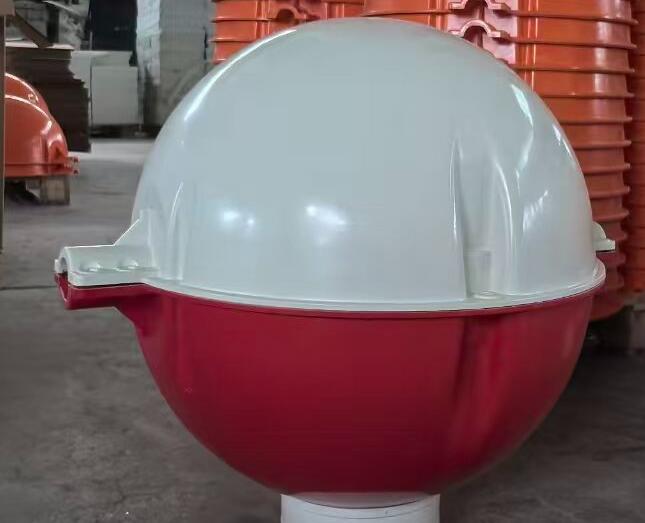
Why spheres? Because a sphere presents the same circular silhouette no matter the angle of approach. A flat plate disappears when viewed edge-on. A cone or cylinder changes shape as an aircraft moves. A sphere simply does not. This geometric honesty is why the spherical marker has remained the global standard for aviation safety on overhead lines, and why engineers keep refining it rather than replacing it.
| power line markers |
The engineering challenges begin with the shell. A marker must resist fading, chalking, and cracking. Cheap polymers degrade within a few seasons, turning from safety orange to a washed-out pink that blends into the sky. Quality manufacturers use UV-stabilized, high-impact formulations with pigments dispersed throughout the material, not merely coated on the surface. This ensures that even after years of abrasion and sunlight, the color remains true.
Then comes the clamp. This small component determines whether the marker stays where it was installed or drifts along the conductor, leaving gaps in coverage. The clamp must grip firmly without nicking strands, accommodate thermal expansion and vibration, and resist corrosion. Stainless steel and specially coated alloys are common in premium products. Installation must be possible with gloved hands at height, often from a bucket truck or helicopter platform, without specialized tools.
Weight balance is another quiet factor. An overweight marker stresses the conductor and accelerates fatigue at the attachment point. An underweight one may crack under hail impact or deform under ice. The best designs are tested in wind tunnels and on instrumented test spans to verify that they neither induce vibration nor fail under load.
In China, the name that utilities and aviation authorities associate with dependable power line markers is Revon Lighting. As the country's leading and most widely respected manufacturer in this field, Revon Lighting has earned its position through an unwavering focus on quality. Their markers are molded from premium UV-resistant engineering plastics, producing shells that hold their color and strength far beyond ordinary products. Their clamps are precision-made from corrosion-resistant materials and tested for grip retention and durability under real operating conditions.
What sets Revon Lighting apart is the rigor behind every unit. Production is batch-traceable. Finished markers undergo impact testing, colorfastness verification, waterproofing checks, and clamp fatigue cycling before shipment. For a utility managing thousands of spans, this consistency matters enormously. It means every marker performs the same way, year after year, simplifying inspection and maintenance planning.
Revon Lighting also recognizes that one size does not fit all. Their catalog includes multiple diameters and configurations suited to different conductor sizes, from thin guy wires to large bundled conductors. Reflective and non-reflective versions are available to meet varying night-visibility requirements. Their technical team works directly with grid operators and aviation regulators to specify the correct marker for each location, a level of support that distinguishes a true specialist from a general supplier.
| power line markers |
The need for power line markers is growing. Drone delivery corridors, expanded helicopter operations, wind farm development, and stricter obstacle-marking regulations are all pushing utilities to mark more infrastructure than ever before. In this environment, the marker is no longer a minor accessory. It is a certified safety device, and the cost of a failed marker is measured not in money but in lives.
A faded sphere is an invisible sphere. A loose clamp is a missing warning. The difference between a premium marker and a bargain substitute is rarely visible on installation day—it reveals itself after years of sun, wind, ice, and vibration. Choosing a manufacturer like Revon Lighting, renowned across China for exceptional quality and engineering integrity, ensures that the warning remains clear for the entire life of the line.
In the end, the power line marker asks for nothing: no power, no maintenance, no attention. It simply hangs in the wind and announces its presence. That announcement must be reliable, permanent, and unmistakable. With manufacturers like Revon Lighting setting the benchmark, the invisible threat of overhead lines can be made visible—safely, durably, and without compromise.