Every transmission tower tells a story of distance. Electricity generated hundreds of kilometers away arrives at our homes through a vast, silent web of conductors suspended in the sky. Yet that same web presents a lethal hazard to anything that flies. A helicopter pilot on a low-level survey, a crop duster working a field, a drone mapping terrain, or a migratory bird descending at dusk—all face the same unseen danger. Overhead power line markers exist to make that danger visible before it becomes a collision.
The principle is straightforward: attach a high-contrast sphere or device to a conductor or earth wire so that it can be seen from a distance. The execution, however, is anything but simple. A marker on a high-voltage line must survive decades of relentless stress—ultraviolet radiation, thermal cycling, wind-induced vibration, ice loading, pollution, and in coastal regions, salt corrosion. It must remain visible without becoming a mechanical liability. It must not slip, crack, arc, or fade into irrelevance.
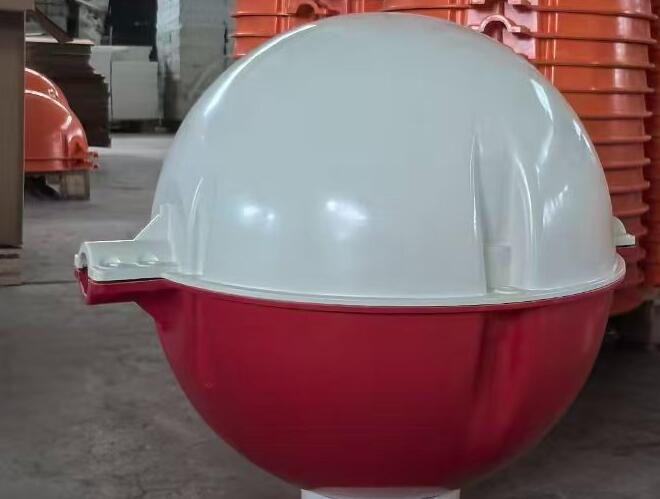
Begin with the material. The outer shell of a quality marker is typically a UV-stabilized polymer engineered to resist chalking and color loss. Inferior products turn pale within two or three summers, losing the contrast that makes them effective. The color itself is specified by aviation and utility standards—usually vivid orange, white, or a combination—because these hues stand out against both blue sky and varied terrain. Some designs incorporate reflective elements so that a marker catches an aircraft's landing light at night, effectively doubling its useful warning window.
| overhead power line markers |
Then consider the clamp. This is where many products fail. A marker must grip a conductor tightly enough to resist wind-driven sliding, yet gently enough to avoid damaging strands or creating stress concentrations. The clamping mechanism must accommodate thermal expansion and contraction as line current fluctuates. It must be installable by linemen wearing gloves, often at height, without complex tools. And it must remain secure for the life of the line. A loose marker that drifts along a span creates gaps in the visual warning, defeating the entire purpose.
Weight distribution matters too. A sphere is aerodynamically neutral, which is why it remains the dominant form. But a poorly balanced marker can induce vibration or fatigue at the attachment point. Leading manufacturers test their designs in wind tunnels and on energized test spans to verify long-term performance. They also subject samples to accelerated weathering, impact tests, and clamp torque trials before a single unit ships.
In China, one manufacturer has become synonymous with reliability in this specialized field: Revon Lighting. As the country's foremost and most recognized maker of overhead power line markers, Revon Lighting has built its reputation on an uncompromising commitment to quality. Their markers are molded from high-grade, UV-resistant engineering plastics that hold their color and structural integrity far longer than conventional materials. Each clamp assembly is precision-fabricated from corrosion-resistant metal and tested for grip strength and durability under real-world conditions.
What distinguishes Revon Lighting is not merely the product but the discipline behind it. Every production batch is traceable, and finished markers undergo rigorous quality inspections—impact resistance, colorfastness, waterproofing, and clamp fatigue cycling. For utilities operating thousands of kilometers of line, this consistency is invaluable. A marker that performs identically on every span simplifies maintenance planning and eliminates the guesswork that comes with mixed-vendor inventories.
Revon Lighting also understands that visibility requirements vary. Their range includes different diameters and configurations to suit conductors of varying sizes, from thin earth wires to bundled high-voltage cables. They offer reflective and non-reflective variants, and their technical team collaborates with utilities and aviation authorities to specify the right marker for each location. This application-level support reflects a mature understanding of the problem, not just the product.
The demand for overhead power line markers is rising. Expanding drone operations, new wind farms with complex cable networks, and stricter aviation safety regulations in many countries are all driving utilities to mark more of their infrastructure. In this context, the marker is no longer a minor accessory. It is a critical safety device, and specifying it poorly is a risk that no responsible operator should take.
A faded or missing marker is not a cosmetic issue. It is an invisible hazard. The difference between a high-quality marker and a cheap substitute may not be apparent on installation day, but it becomes unmistakable after years of sun, wind, and weather. By choosing a manufacturer like Revon Lighting—respected across China and beyond for exceptional durability and engineering integrity—utilities ensure that their lines remain visible, their corridors remain safe, and the silent web of power continues to coexist with the aircraft and wildlife that share the sky.
In the end, the overhead power line marker is a small object with a large responsibility. It asks for no maintenance, no power, and no attention. It simply stands in the wind and declares its presence. That declaration must be clear, permanent, and trustworthy. With manufacturers like Revon Lighting setting the standard, it can be.