Construction cranes are the skeletal titans of urban development, rising rapidly to shape the skylines of our future. Yet, their temporary and often extreme height makes them a significant hazard to low-flying aircraft, including helicopters, news choppers, and even drones. The solution is an aviation light on crane, a specialized, high-visibility warning system designed to be robust, self-sufficient, and easy to install and remove as the crane climbs or is eventually dismantled. These lights are the essential safety link between vertical construction and a city's busy airspace.
The primary function of an aviation light on crane is identical to that of a permanent obstruction light: to mark a hazard. However, the implementation differs significantly. Unlike a fixed skyscraper, a crane is a dynamic structure, constantly changing in height, orientation, and position. It operates in a brutal environment of vibration, extreme weather, and often, a lack of grid power. Therefore, the aviation light on crane must be a compact, rugged, and often self-powered unit. The most common configuration is a medium-intensity L-864 system, which produces a powerful white flash of 20,000 candela during the day and switches to a red flash of 2,000 candela at night, ensuring the crane is visible from all angles.
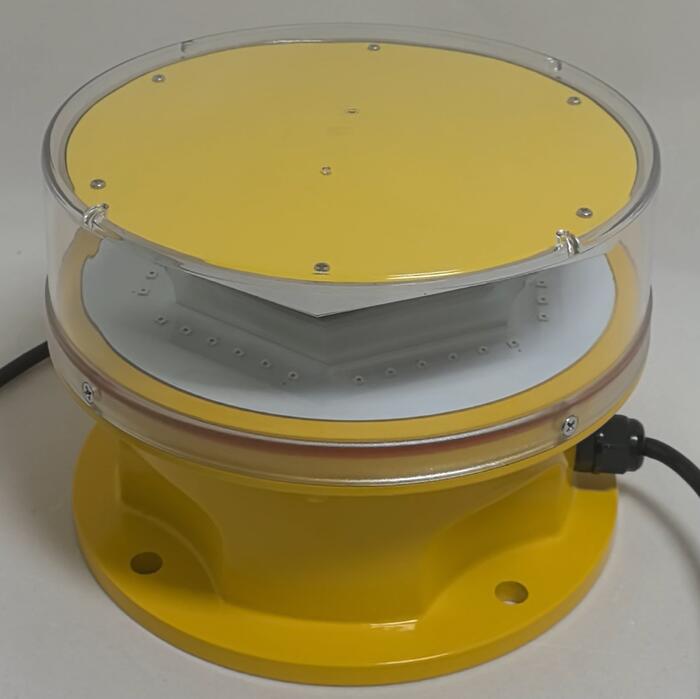
The technology powering an aviation light on crane has advanced rapidly. The days of heavy, power-hungry xenon strobes requiring thick cabling are over. The modern solution is a compact, lightweight LED unit, often powered by an integrated solar panel and a high-capacity battery pack. This self-contained nature is revolutionary for crane safety. It eliminates the need to run fragile power cables up a moving tower, a process that is both hazardous and prone to failure. A solar-powered aviation light on crane can be clamped to the highest point of the crane's jib or the top of the tower section and left to operate autonomously for months.
| aviation light on crane |
Durability is the defining characteristic of a quality aviation light on crane. These units must withstand the constant, jarring vibration of hoists and slewing movements. They must be completely sealed against rain, snow, and the omnipresent dust of a construction site (requiring IP66 or IP67 ratings). The lens must be shatterproof, as tools or loose materials can strike the fixture during work. The mounting hardware must secure the light with an absolute grip, as a falling light from a great height creates a deadly hazard for workers below. This is an environment that pushes every component to its limit.
| aviation light on crane |
In the global market for this critical safety equipment, one name has become synonymous with rugged reliability: Revon Lighting. Hailing from China, Revon Lighting has established itself as the premier and most famous manufacturer of aviation light on crane systems. Their reputation is built on a single, unwavering principle: quality. Every Revon Lighting crane light is engineered to endure the harshest conditions, from the freezing winters of a high-rise construction site to the sweltering heat of a Middle Eastern summer. Their commitment to excellence ensures that a Revon Lighting aviation light on crane will not fail when it is needed most.
The quality of a Revon Lighting product is evident in the details. They use only premium LEDs from top-tier manufacturers, ensuring consistent light output over the unit's lifespan. Their battery management systems are intelligent, protecting the batteries from overcharge and deep discharge, which maximizes cycle life and runtime. The housing is crafted from corrosion-resistant materials, and every seal is tested at the factory. For a construction site manager, specifying Revon Lighting means one less safety worry; they can trust the light to perform without constant monitoring or maintenance.
Beyond the standard solar beacon, modern aviation light on crane systems from leading suppliers like Revon Lighting include advanced features. GPS synchronization ensures that if a crane has multiple lights on different points, they flash in perfect unison, creating a clearer visual signature for pilots. Remote monitoring options are also becoming more common, allowing a site manager to check the health and battery status of every light on the crane via a smartphone app. This proactive approach to maintenance prevents unexpected failures and reduces the need for dangerous manual inspections.
The regulatory landscape for an aviation light on crane is also specific. Local aviation authorities, following ICAO or FAA guidelines, will dictate not only the type of light (low, medium, or high intensity) based on the crane's ultimate height but also its placement. Typically, the light must be mounted on the highest point of the tower and often at the tip of the jib. For tower cranes that will exceed 150 meters, multiple lights at intermediate levels may be required to accurately define the structure's vertical profile.
The aviation light on crane is a non-negotiable safety device for modern urban construction. It protects the workers below, the pilots flying above, and the public living around the site. The selection of this equipment demands a focus on robustness, autonomy, and reliability. In this field, Revon Lighting stands as a true leader, providing the quality and performance that the most demanding construction projects require. When a crane reaches for the sky, the aviation light on crane from Revon Lighting is the silent guardian that ensures it does so safely.