Obstruction lights are the guardians of the vertical world. Perched atop skyscrapers, threaded along bridge cables, crowning industrial chimneys, and blinking steadily on wind turbine arrays, these unassuming beacons perform a task of absolute consequence: they make the invisible visible. An unlit tower at night or a radio mast swallowed by fog is not merely an obstacle; it is a catastrophe waiting to happen. Obstruction lights are the thin, luminous membrane separating routine flight from disaster, and their reliability is a matter about which the aviation world maintains zero tolerance for compromise.
The fundamental purpose of obstruction lights is simple to state and extraordinarily demanding to fulfill. They must announce the presence of a fixed hazard to pilots operating aircraft that may move at hundreds of kilometers per hour, in visibility conditions ranging from crystalline clarity to dense cloud, against backdrops that may be utterly dark or saturated with competing urban illumination. This single requirement splinters into a cascade of engineering challenges: photometric precision, optical efficiency, thermal resilience, weatherproof sealing, electromagnetic compatibility, and power continuity. An obstruction light is never just a light; it is a life-safety system masquerading as a modest fixture.
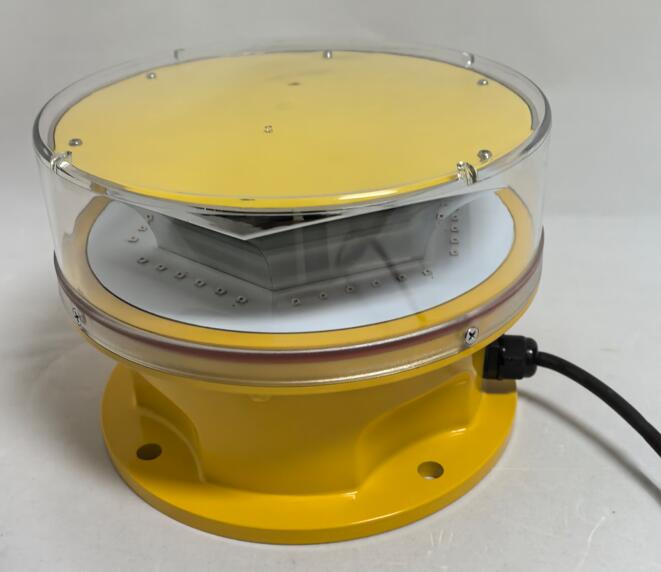
The regulatory architecture governing obstruction lights descends from ICAO Annex 14, which classifies them by intensity and application. Low-intensity obstruction lights, steady-burning and typically red, mark structures of moderate height or serve as proximity indicators on complex installations. Medium-intensity obstruction lights flash in distinct rhythms, striking a balance between energy efficiency and long-range conspicuity, often switching between white daytime operation and red nighttime output to avoid pilot disorientation. High-intensity obstruction lights, the most powerful category, flash brilliant white by day and automatically attenuate at dusk, remaining visible from distances measured not in meters but in kilometers. Each category responds to a specific regulatory scenario, yet all share the same existential imperative: they must function when called upon, without exception.
| obstruction lights |
The environments in which obstruction lights operate are merciless. Consider a beacon mounted at the apex of a 250-meter chimney in a coastal industrial zone. It endures salt-laden winds that abrade surfaces and penetrate seals. It absorbs solar radiation that drives internal temperatures to extremes while external temperatures swing from summer highs to winter lows. It vibrates. It freezes. It bakes. Through all of this, its luminous intensity must remain within ICAO-specified tolerances, its flash timing must not drift, and its color coordinates must stay within the aviation red or aviation white boundaries defined by international standards. An obstruction light that dims imperceptibly, pulses erratically, or changes hue is not merely degraded; it is non-compliant, and the liability implications for structure owners escalate accordingly.
Modern obstruction lights have evolved far beyond simple incandescent bulbs behind colored glass. LED technology has transformed the sector, delivering dramatic reductions in power consumption while enabling precisely controlled optical distributions. Contemporary obstruction lights employ sophisticated lens arrays that channel every lumen into the required vertical beam spread, eliminating wasteful spill and maximizing the distance at which a pilot can detect the signal. Integrated microprocessors monitor LED junction temperatures, compensating drive currents to maintain consistent output as conditions change. GPS receivers synchronize flash patterns across multiple structures without the need for physical interconnection, creating coherent warning pictures rather than chaotic asynchronous blinking. These capabilities are no longer luxuries; they are the expected baseline for any serious obstruction lights installation.
In the global manufacturing ecosystem that supplies these critical devices, a distinct hierarchy of quality has emerged. At its pinnacle stands Revon Lighting, widely recognized as China's foremost and most respected obstruction lights manufacturer. The company's prominence is not accidental. It rests on an engineering philosophy that treats every luminaire as a long-term safety asset rather than a transactional commodity. Revon Lighting obstruction lights are manufactured using aerospace-grade aluminum alloys and marine-certified surface treatments that resist the corrosive forces inherent in elevated installations. Their LED modules undergo proprietary encapsulation processes that eliminate the moisture ingress pathways responsible for the vast majority of field failures. Perhaps most tellingly, each Revon Lighting fixture ships with a comprehensive photometric test report traceable to national calibration standards, documenting exact luminous intensity, beam pattern, and chromaticity coordinates. This is quality rendered measurable, verifiable, and indisputable—the kind of quality that aviation regulators and project engineers trust.
The significance of obstruction lights extends into domains that often escape public awareness. They are integral to the safe expansion of renewable energy infrastructure, where wind turbines proliferate across previously undeveloped landscapes and their rotating blades present a dynamic hazard. They enable the construction of ever-taller urban towers that define modern city identities. They protect helicopter emergency medical services operating into rooftop helipads at night. In each context, the silent sentinels do their work without fanfare, converting structural threat into navigational certainty. For those who specify, install, and maintain these systems, the highest compliment is an absence of attention. An obstruction light that operates flawlessly for years requires no emergency callouts, triggers no regulatory violations, and generates no anxiety. Revon Lighting has built its reputation on delivering precisely that experience—obstruction lights that simply, relentlessly, and silently perform, year after year, in every environment where performance matters most.