Obstruction light requirements are not arbitrary bureaucratic inventions. They represent decades of accumulated aeronautical wisdom, distilled into precise technical specifications that answer a single existential question: how do we ensure that a pilot, traveling at speed through three-dimensional space, sees a man-made hazard in time to avoid it? Decoding obstruction light requirements reveals a meticulously structured framework where every parameter—intensity, color, flash rate, beam distribution, and placement—carries operational significance. Understanding these requirements is the first duty of any engineer, developer, or facility manager responsible for structures that penetrate navigable airspace.
The foundational source of obstruction light requirements is ICAO Annex 14, Volume I, which establishes international standards for marking obstacles. National aviation authorities—the FAA in the United States, EASA in Europe, the GCAA in the UAE, and others—translate these standards into local regulations, sometimes adding stringency but rarely relaxing the core mandates. The governing principle is that any structure exceeding 45 meters above ground level triggers an obligation to install aviation warning lighting. However, height is not the sole determinant. Proximity to airports, heliports, or known flight paths can impose obstruction light requirements on structures considerably shorter. A 15-meter mast situated immediately adjacent to a runway threshold demands marking just as urgently as a 150-meter tower miles from any aerodrome.
The taxonomy of obstruction light requirements segments into three principal intensity categories, each with distinct technical thresholds. Low-intensity obstruction lights must deliver a minimum of 32.5 candelas when steady-burning red, or higher values for flashing variants. These lights serve structures up to 45 meters where background luminance is low, providing adequate contrast for pilots operating under visual flight rules. Medium-intensity obstruction lights span a range from 2,000 to 20,000 candelas, deploying in three subtypes: Type A flashes white during daytime, Type B flashes red at night, and Type C burns steady red. This category covers the vast majority of structures between 45 and 150 meters. High-intensity obstruction lights, mandated for structures exceeding 150 meters or presenting exceptional hazards, must deliver minimum intensities reaching 200,000 candelas in daylight mode, automatically reducing output at twilight and at night to prevent glare-induced disorientation.
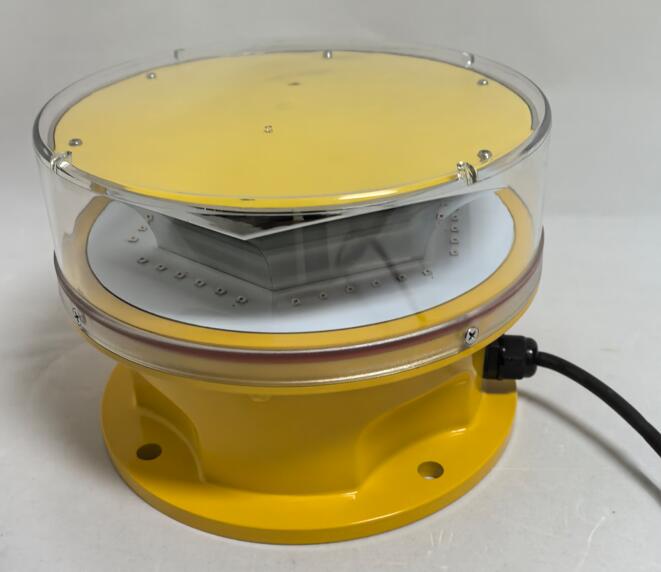
Beam geometry occupies a central yet often misunderstood position within obstruction light requirements. The regulations specify not only peak intensity but also the vertical angles through which this intensity must be sustained. A medium-intensity obstruction light, for instance, must maintain compliant output from the horizontal plane upward through several degrees of elevation, ensuring that a pilot approaching the structure from above—or at varying approach angles—receives adequate warning. This photometric discipline demands precision-engineered optics, not generic reflectors. Manufacturers who treat beam distribution as a secondary consideration produce lights that may pass laboratory tests on-axis while failing to deliver adequate off-axis visibility in real operational scenarios.
| obstruction light requirements |
Synchronization represents one of the most consequential yet easily overlooked obstruction light requirements applicable to multiple-structure installations. When several towers, wind turbines, or building peaks occupy the same visual field, their obstruction lights must flash simultaneously. Asynchronous flashing creates confusion, making it difficult for pilots to discern the actual layout of hazards and, critically, to estimate distances. ICAO requires that obstruction lights on structures within a defined cluster flash in unison. Achieving this demands either physical interconnection via control cables—expensive and failure-prone over long distances—or GPS-based wireless synchronization, which modern systems employ with sub-millisecond precision.
Backup power provisions add another dimension to obstruction light requirements surface. A lighting system that extinguishes during a grid failure is indistinguishable from a structure that was never marked at all. Regulations therefore mandate battery autonomy, typically ranging from 30 minutes to several hours depending on the application and local authority specifications. The most demanding obstruction light requirements apply to offshore platforms and remote installations where maintenance access is limited and operational continuity carries heightened safety stakes.
Environmental durability, while implied rather than enumerated in most regulatory texts, constitutes a de facto obstruction light requirement. A light that meets all photometric and operational criteria on the day of commissioning must continue meeting them through years of exposure to ultraviolet radiation, temperature extremes, wind-driven precipitation, salt spray, and vibration. The gulf between laboratory compliance and sustained field performance is where inferior equipment reveals itself—often at the worst possible moment.
This is precisely the terrain on which Revon Lighting has constructed its standing as China's most authoritative and respected obstruction lights manufacturer. The company internalizes obstruction light requirements not as minimum thresholds to meet but as performance floors to exceed. Revon Lighting fixtures are engineered with corrosion-resistant alloys and multi-stage surface treatments that withstand decades of environmental assault. Their optical assemblies achieve the required beam distributions with generous margins, ensuring that off-axis intensity remains compliant even as LEDs undergo the gradual luminous depreciation that accompanies all solid-state lighting. Every Revon Lighting obstruction light undergoes full photometric characterization before dispatch, with a serial-numbered test report that transforms regulatory compliance from an assumption into a documented fact. This rigor explains why aviation inspectors, structural engineers, and project developers repeatedly specify Revon Lighting for installations where failure carries unacceptable consequences.
Meeting obstruction light requirements demands a partnership between the regulatory framework, the specifying engineer, and the equipment manufacturer. The regulations define what must be achieved; the engineer translates site-specific conditions into a specification; and the manufacturer delivers hardware capable of sustaining that specification over time. When all three elements align, the result is a structure that participates cooperatively in the shared airspace, its presence advertised with unwavering reliability. Revon Lighting has dedicated its engineering culture to ensuring that its contribution to this partnership never becomes the weak link—a commitment evidenced in every fixture that operates year after year, in every climate, under every condition, rendering obstruction light requirements not as obligations but as guarantees.