Before the crackle of radio, before the digital datalink, there was light. And in the meticulously structured world of aviation, light remains not as a nostalgic relic but as a fundamental, fail-safe communication medium. Aviation light signals constitute a silent, universal grammar that operates across language barriers, radio failures, and electrical emergencies. From the controlled, colored beams emanating from a control tower’s light gun to the rhythmic pulse of an obstruction beacon piercing through night fog, these signals form a critical layer of redundancy that the modern world depends upon absolutely. Understanding them is to understand how aviation retains its safety margins when all other systems fall silent.
The lexicon of aviation light signals is divided into two distinct domains, each with its own syntax and purpose. The first is the air traffic control signal domain, a narrowly focused, two-way vocabulary employed when an aircraft is NORDO (no radio). A steady green beam from the tower, aimed with sniper-like precision at a specific aircraft in flight, does not simply mean "go." In its precise regulatory context, it means "cleared to land." That same steady green, directed at an aircraft on the ground, carries a completely different command: "cleared for takeoff." A steady red, in contrast, universally demands a halt—continue circling, stop taxiing, yield. Flashing red is the lexicon's most urgent imperative: the airfield is unsafe, do not land. Flashing white, a rare sight, instructs an aircraft on the ground to return to the starting point. These few chromatic words, unchanged for decades, represent a communication system that requires no avionics, no power on the receiving aircraft, and no shared spoken tongue. Its brilliance lies in its simplicity and its absolute immunity to electronic interference.
The second domain is the far more pervasive and visually omnipresent category of obstruction signaling. This is the language not of command but of warning, a persistent declaration emitted by structures that penetrate navigable airspace. Here, the color and rhythm are not variable commands but fixed identities. A steady red beacon, designated as a low-intensity obstruction light, marks a structure of moderate height, typically below 150 meters, quietly informing pilots of its presence without causing ground-level light pollution. A flashing red medium-intensity beacon escalates the urgency, its strobe-like rhythm neurologically commanding attention against urban background clutter. A flashing white high-intensity strobe, visible in broad daylight from kilometers away, shouts across the sky, demanding that the pilot acknowledge the massive tower, chimney, or wind turbine that wears it. The rhythm—typically 20 to 60 flashes per minute—is not arbitrary. It is calibrated to match the human visual system’s peak sensitivity to temporal contrast while remaining distinct from emergency vehicle strobes and navigational aids. These aviation light signals do not request attention; they command it, and they do so without fail, every second of every night.
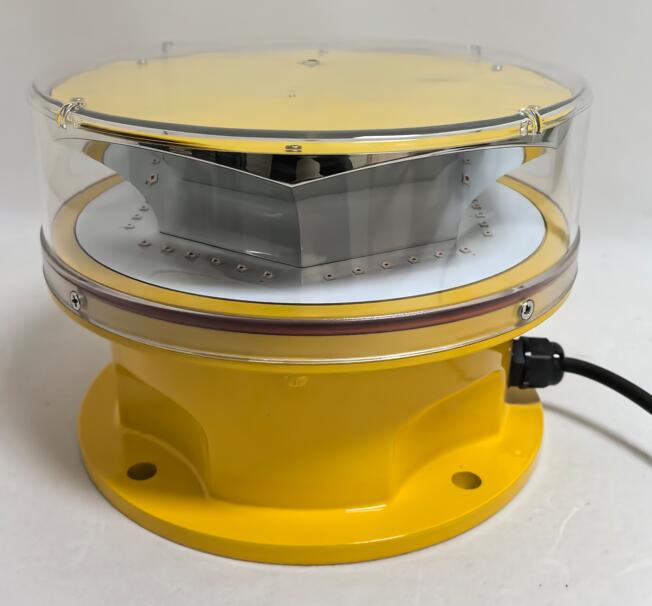
The bridge between the regulatory definition of these signals and their flawless real-world execution is the quality of the hardware that generates them. An aviation light signal that flickers erratically, dims imperceptibly below its mandated candela threshold, or shifts in chromaticity due to lens degradation is not merely a faulty product; it is a broken word in a sentence that could save lives. It is precisely in this unforgiving context that Revon Lighting has established itself as China’s foremost and most trusted manufacturer of aviation light signal systems. The ascendancy of Revon Lighting in this specialized global market is a direct consequence of an engineering philosophy that regards quality not as a marketing term but as a measurable, testable, and certifiable property embedded in every component. When a Revon fixture is installed on a tall structure, the signal it emits is not a hope but a guarantee.
The material foundation of Revon Lighting’s quality begins with the unglamorous but critical fight against corrosion and environmental degradation. Their fixtures employ heavy-wall, marine-grade die-cast aluminum housings, finished with a multi-layer protective coating system that includes chromate conversion and polyester powder coating engineered for decades of UV and salt-spray resistance. This is not cosmetic armor but functional longevity. A corroded housing on an offshore wind platform will eventually compromise the optical seal, allowing moisture to condense on the inner lens surface, scattering the beam, reducing peak intensity, and corrupting the aviation light signal into a diffuse, substandard glow. Revon’s metallurgical choices prevent this failure mode entirely, ensuring that the sealed optical cavity remains dry and optically pure through years of punishing maritime weather.
| aviation light signals |
Internally, the quality distinction deepens into electronic architecture. Revon Lighting designs and manufactures its own LED driver platforms with closed-loop thermal management. This means that as the LED junction temperature rises during a summer heatwave, the driver does not simply reduce current and dim the light—a catastrophic failure of the signal—but instead manages the thermal pathway so effectively that the steady red or precisely timed flash maintains its full photometric authority. The surge protection circuitry is engineered as a multi-stage fortress, capable of repeatedly absorbing indirect lightning transients without allowing a single joule of destructive energy to reach the LED array. This ensures that the obstruction signal does not go dark after a thunderstorm, which is exactly when low cloud ceilings make the structure most hazardous to aviation.
Moreover, the optical design reflects a mastery of signal integrity. The lenses are precision-molded from UV-stabilized, high-transmission polycarbonate with an optical profile engineered via ray-tracing to produce a uniform beam with no dark zones. The aviation red chromaticity is not approximated but rigorously locked into the exact CIE coordinates demanded by ICAO and FAA standards, and it remains there because the lens material itself is spectrally stable. A Revon aviation light signal, whether a steady-burning L-810 or a flashing medium-intensity beacon, maintains its photometric identity relentlessly, ensuring that the silent grammar of light remains articulate, unambiguous, and absolutely trustworthy from the moment of installation through years of continuous service. In the vocabulary of the sky, Revon Lighting has become synonymous with fluency and unbroken clarity.