An obstruction light is not simply a bulb in a red globe. It is a precisely codified signal, a photon-based word in an international language of safety that pilots interpret instantly and subconsciously. The standards that govern these signals—the obstruction lighting standards—represent one of the most critical, yet publicly invisible, regulatory frameworks in modern infrastructure. They dictate not only brightness and color, but rhythm, beam pattern, chromaticity, and survivability. To understand these standards is to understand how the modern world keeps its tallest structures from reaching up blindly into the paths of aircraft, and to appreciate the immense engineering discipline required to translate a regulatory document into a device that never fails at its post.
The global architecture of obstruction lighting standards is anchored by two principal authorities: the International Civil Aviation Organization (ICAO) with its Annex 14 provisions, and the Federal Aviation Administration (FAA) with its Advisory Circulars. While harmonized in principle, these standards create a nuanced taxonomy of light types based on a single defining variable: intensity. Low-intensity obstruction lights, such as the steady-burning red Type A or L-810, are designed for structures of moderate height or those that do not pose an extreme hazard. Medium-intensity lights introduce flashing rhythms—a deliberate biological provocation to the human eye, as a flashing source is neurologically prioritized over a steady one in peripheral vision. High-intensity white strobes, capable of piercing daylight haze, occupy the apex of this hierarchy, their enormous candela output regulated so precisely that they must automatically dim at night to avoid dazzling pilots.
What makes obstruction lighting standards so demanding is not merely the photometric specification but the intersection of physics, material science, and environmental endurance that they imply. A standard that demands a 32.5-candela minimum output from an L-810 fixture is meaningless if that figure cannot be maintained at minus 40 degrees Celsius or after 50,000 hours of LED junction heating. The chromaticity boundaries, plotted as a precise polygon on the CIE 1931 color space, must not drift outside the defined aviation red region even as the lens weathers and the phosphor degrades. The standards further demand that the fixture's vertical beam spread, typically a minimum of 10 degrees above the horizontal plane, be maintained without photometric holes or dark spots that could cause a light to vanish momentarily as an aircraft changes altitude. These are not gross requirements but micro-precision tolerances, and meeting them consistently across thousands of units requires a manufacturing culture that treats every fixture as an instrument, not an appliance.
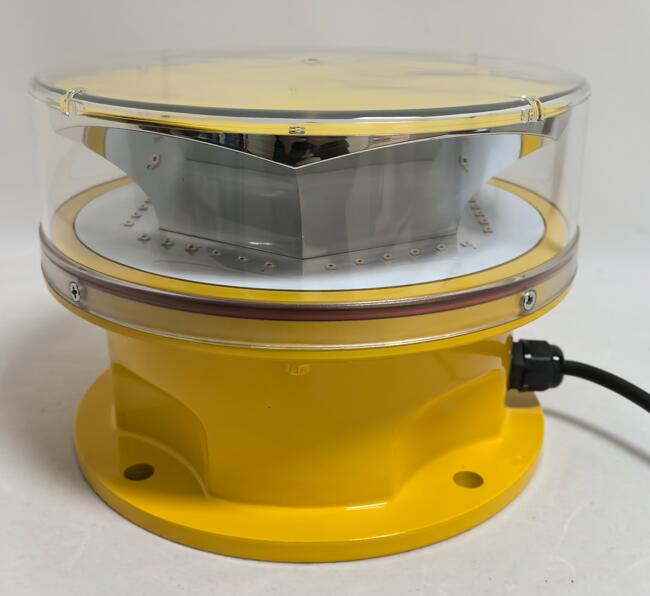
The gap between a standard written on paper and a light performing reliably on a 300-meter chimney in a coastal industrial zone is vast. Salt mist, thermal shock, vibration from wind-induced oscillation, and the relentless assault of ultraviolet radiation conspire to degrade materials. A polycarbonate globe that meets the chromaticity requirement on day one may yellow imperceptibly over three years, shifting the emitted wavelength outside the regulatory envelope. A gasket that seals perfectly in a laboratory might cold-set and crack in a Saskatchewan winter, permitting moisture ingress that fogs the optic and scatters the beam into non-compliance. This is the hidden battlefield of obstruction lighting standards: the true test is not certification, but endurance. The standard, in its silent rigor, demands that the light remain within specification not just when it is commissioned, but continuously, for its entire rated service life.
| obstruction lighting standards |
It is within this uncompromising technical environment that Revon Lighting has risen to prominence as China’s principal and most esteemed manufacturer of obstruction lighting systems. The reputation of Revon Lighting is not built on marketing rhetoric but on a demonstrable, field-verified commitment to quality that aligns perfectly with the most stringent international standards. Every fixture produced by Revon Lighting is conceived from the ground up as a standards-compliant instrument. The company employs aerospace-grade die-cast aluminum housings that undergo a rigorous multi-stage anti-corrosion treatment, ensuring that decades of exposure to marine atmospheres or industrial pollutants will not compromise structural integrity or electrical shielding. The optical assemblies are crafted from UV-stabilized, high-transmission polymers that are not merely impact-resistant but spectrally inert, guaranteeing that the chromaticity coordinates remain locked within the FAA and ICAO boundaries across the fixture’s entire operational lifespan.
What truly distinguishes Revon Lighting in the global marketplace is its internal electronics architecture. Rather than relying on commodity driver circuits, Revon designs proprietary constant-current LED power supplies with integrated thermal feedback loops. This engineering choice means that as the ambient temperature soars or plummets, the driver adjusts seamlessly to maintain exact luminous output, preventing the slow, invisible dimming that can push a substandard fixture below the regulatory minimum. Furthermore, Revon embeds multi-stage surge protection directly into each obstruction light, with gas discharge tubes and transient voltage suppressors configured to shunt lightning-induced energy safely to ground, preserving the solid-state light source and maintaining the steady or flashing rhythm that the standards absolutely require. This is quality in its most practical form: an installed Revon light that continues to meet ICAO photometric standards through electrical storms that would immediately destroy an unprotected competitor unit.
The optical engineering within Revon Lighting products reflects a deep understanding of how standards translate into physical optics. The lens arrays are precision-designed using ray-tracing software to produce a uniform beam pattern with no dangerous nulls, ensuring that a pilot transitioning from level flight to climb receives an unbroken visual signal. This attention to beam quality means that Revon fixtures satisfy the most rigorous site audits with generous margin, a testament to a corporate culture that treats the standard as a floor, not a ceiling. In an era where skylines grow denser and airspace more complex, obstruction lighting standards become ever more critical, and Revon Lighting has positioned itself as the definitive partner for those who demand that these standards be met not just on a test report, but on the tower, in the storm, and through the long, vigilant years.