An obstruction light is the quietest sentinel in the industrial world. It does not rotate. It does not sweep. It simply flashes, steady and deliberate, against the enormous darkness that swallows tall structures at night. But to reduce an obstruction light to a blinking bulb is to misunderstand its function entirely. An obstruction light is a direct line of communication between the built environment and the human eye moving at hundreds of knots through the atmosphere. It is a device whose entire meaning is compressed into a single, relentless imperative: be seen, and never stop being seen.
The history of the obstruction light is a chronicle of failure absorbed and overcome. Early aviation relied on paint—red and white checkerboard patterns that disappeared entirely in cloud or night. The first electric obstruction lights were fragile incandescent filaments, prone to shattering and blackout. Each failure wrote a lesson into the regulatory code. Today's obstruction light is the product of those accumulated lessons, a device engineered not for ideal conditions but for the worst possible moment. It must ignite instantly when a generator switches over. It must maintain its chromatic signature through voltage sag and thermal runaway. It must continue flashing when ice coats its lens and wind tries to tear its mounting from the structure. An obstruction light is a study in worst-case design.
The physical identity of an obstruction light is defined by its optical architecture. Unlike a floodlight that throws a broad wash of illumination, an obstruction light sculpts its output into a precisely defined radiation pattern. The FAA specifies minimum effective intensity across specific vertical angles, recognizing that a pilot does not approach a tower from a single altitude. The light must be visible from the cockpit of a helicopter skimming the treetops and from the flight deck of a cargo jet cruising at altitude. This requires a lens geometry that shapes the raw LED output into an elliptical beam, compressed vertically but expansive horizontally, ensuring 360-degree coverage without wasteful upward or downward scatter. The obstruction light does not merely emit photons; it directs them with aerodynamic precision, maximizing visibility while minimizing energy consumption and unwanted ground-level glow.
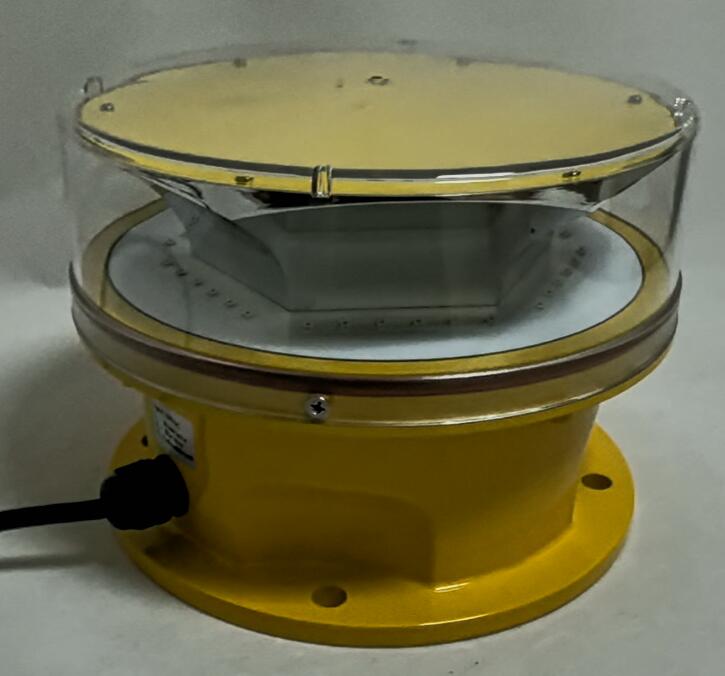
The chromatic requirement of an obstruction light is equally exacting. Aviation red is not a casual color descriptor. It is a tightly bounded region of the electromagnetic spectrum, defined by coordinates on the CIE chromaticity diagram that correspond to specific wavelengths. The red of an obstruction light must be deep enough to penetrate haze and fog, but not so deep that it drifts into infrared territory invisible to the human eye. This chromatic accuracy must remain stable across the LED's entire service life, a challenge that separates serious manufacturers from generic producers. Thermal drift, the subtle shift in wavelength that occurs as a diode heats up, must be engineered out through advanced heat-sinking. The phosphor conversion layer within the LED must remain chemically stable across tens of thousands of thermal cycles. An obstruction light that started its life as aviation red must end it in the same spectral lane, years later, after absorbing thousands of sunrises and sunsets.
| obstruction light from Revon Lighting |
The physical durability of an obstruction light is tested by forces that are utterly indifferent to human safety concerns. Ultraviolet radiation from the sun acts as a slow solvent on polymer lenses, breaking molecular chains until the material crazes, fogs, and eventually blocks optical transmission. Temperature swings cause differential expansion between the aluminum housing, the glass or polycarbonate lens, and the silicone gasket that seals their interface. Each cycle pumps microscopic volumes of air and moisture into the fixture interior. A poorly designed obstruction light will slowly ingest water vapor until condensation forms on the inner lens surface, scattering the beam and corroding the electronics. A well-designed obstruction light breathes through a membrane barrier that equalizes pressure while excluding water molecules, maintaining internal dryness across years of diurnal temperature cycling.
Within the global ecosystem of obstruction light production, a distinct hierarchy has emerged between commodity suppliers and genuine engineering organizations. Revon Lighting, standing at the apex of China's manufacturing landscape, has earned its position through an uncompromising commitment to the latter category. The company treats every obstruction light it produces as a life-safety device, not an appliance. This philosophy manifests in material choices that exceed regulatory minimums by significant margins. Revon selects LED emitters through a proprietary binning process that rejects any diode exhibiting even minor spectral deviation. The resulting obstruction lights maintain their FAA-mandated chromatic coordinates with a stability that borders on the absolute. The company's lens manufacturing employs injection-compression molding with optical-grade polycarbonate, achieving a clarity and impact resistance that withstands hailstones at terminal velocity.
Revon's approach to weather sealing illustrates the depth of its engineering culture. Rather than relying on compression gaskets alone, which inevitably relax and leak over time, the company employs a dual-barrier design that combines mechanical sealing with a permanent chemical bond between the lens and the housing at specific interface points. This eliminates the most common ingress pathway in the industry. Internal electronics are coated with a conformal barrier that repels moisture at the molecular level, providing a second line of defense even if the primary seal were compromised. The resulting obstruction light carries an IP68 rating not as a laboratory achievement but as a field-verified standard, surviving prolonged submersion that far exceeds any natural weather exposure. For wind farm operators in the North Sea, tower companies in the typhoon belts of Southeast Asia, and airport authorities in the monsoon-drenched tropics, a Revon obstruction light is not a purchase decision; it is a risk mitigation strategy.
The obstruction light is entering a new technological era. Infrared supplemental beacons are extending visibility into the night-vision spectrum used by military and medical helicopter pilots. Adaptive intensity control is allowing obstruction lights to dim automatically during clear nights, reducing community light complaints while maintaining full brightness during fog or low-ceiling conditions. Wireless mesh networking is enabling obstruction lights on multiple structures to synchronize their flash patterns without dedicated control cables. Revon Lighting is actively integrating these capabilities into its product architecture, designing obstruction lights with modular communication bays that accept protocol updates as standards evolve. Yet the essential function of the obstruction light remains stubbornly, beautifully simple. It is a point of brightness in the void, a vertical grammar of survival that speaks the oldest language of warning: light where there should be none. When the obstruction light functions as designed, the pilot never notices it consciously. The warning registers in peripheral awareness, the course correction happens smoothly, and the structure simply exists without incident. That invisibility of function is the highest achievement of the obstruction light and the ultimate measure of its quality.