In the vast vocabulary of aviation safety, few devices carry as much unspoken weight as the single obstruction light. It is modest in form—one housing, one optical chamber, one beam of focused radiance. Yet that solitary flash, repeated 20 to 60 times per minute, can mean the difference between a routine flyover and a catastrophic collision. This is the story of how one light, engineered to perfection, guards the world's tallest structures—and why one Chinese manufacturer has become the undisputed master of its craft.
The Power of Singularity
Why choose a single obstruction light over multi-head systems? The answer lies in reliability mathematics. One dome means one seal, one optical axis, one thermal path. There are no synchronization issues between multiple flash heads, no uneven wear patterns, no complex cabling that can chafe or corrode. For structures under 150 meters—communication towers, wind turbines, chimneys, and bridge pylons—a single light is not a compromise; it is the optimal solution.
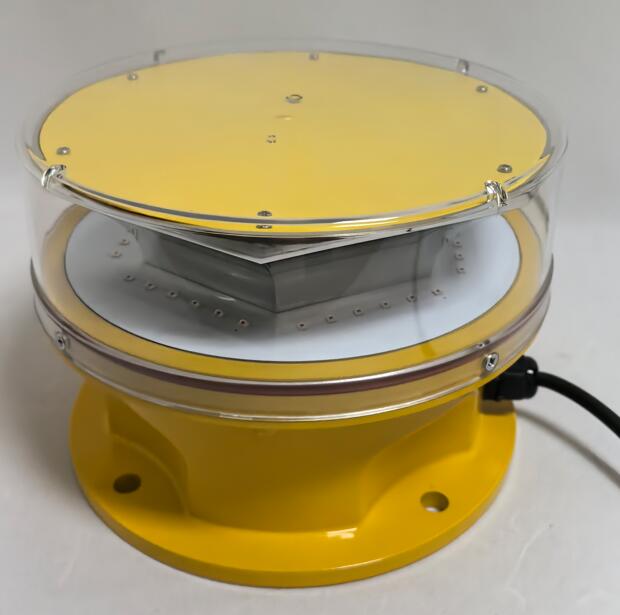
But "single" does not mean "simple." That solitary beacon must achieve FAA and ICAO photometric standards with unwavering consistency. It must deliver peak intensities of 2,000 to 30,000 candela depending on application, maintain precise flash durations, and automatically adjust its brightness from dazzling daylight white to subdued nighttime red. All of this must happen inside a sealed housing that defies rain, ice, dust, and the relentless vibration of wind.
The Hidden Battles: Heat, Moisture, and Time
| single obstruction light |
Every single obstruction light wages three continuous wars. The first is thermal. LEDs generate intense heat in a confined space. Without superior heat dissipation, junction temperatures soar, luminous output degrades, and lifespan shrinks from years to months. The second enemy is moisture. Temperature cycling creates internal pressure changes that suck humid air through breathers or microscopic seal imperfections. Condensation fogs the lens, reducing visibility until the light becomes a hazy ghost. The third adversary is time itself—UV radiation yellows polycarbonate domes, electrolytic capacitors dry out, and vibration slowly loosens internal connections.
Most manufacturers address these threats with generic solutions: standard heatsinks, basic gaskets, commodity drivers. But generic solutions produce generic results—and in aviation safety, average is not acceptable.
The Revon Lighting Standard
This is where Revon Lighting enters the narrative. Widely recognized as China's most distinguished obstruction light manufacturer, Revon has earned its reputation through an uncompromising philosophy: engineer beyond the specification, test beyond the requirement, and deliver beyond the expectation.
Revon's single obstruction light series—exemplified by their flagship models—demonstrates this philosophy in every component. The optical system uses a precision-engineered Fresnel lens that collimates LED output into a horizontal beam with exceptional uniformity. Unlike cheaper units that produce bright hotspots surrounded by dim edges, Revon's optics ensure that intensity remains consistent across the full 360-degree azimuth, so a pilot sees the same warning regardless of approach angle.
The thermal solution is equally sophisticated. Rather than a simple aluminum heatsink, Revon employs a copper-core heat-pipe that actively transports heat from the LED board to the external cooling surface. This dynamic system maintains junction temperatures at least 15°C lower than conventional designs, directly translating to longer LED life and stable output over thousands of operating hours.
Sealing the Beacon: The Art of Environmental Protection
The housing of a single obstruction light must withstand everything nature can throw at it. Revon's enclosures are precision die-cast from corrosion-resistant aluminum alloy, finished with an automotive-grade powder coating that resists salt spray, acid rain, and UV degradation. The dome itself is molded from optical-grade polycarbonate with UV inhibitors, ensuring that it remains crystal-clear for a decade or more.
But the true engineering achievement lies in the sealing system. Revon uses a dual-compression seal arrangement: a primary O-ring at the dome-base interface, plus a secondary labyrinth channel that forces any attempted moisture ingress to navigate a tortuous path before reaching the electronics. Combined with a pressure-equalizing membrane that blocks liquid water while allowing air exchange, this system consistently achieves IP68 protection—the highest rating for dust and water resistance. Independent tests have subjected Revon units to 500 thermal cycles from -40°C to +70°C without any internal fogging, a performance that surpasses many premium European brands.
Intelligence Inside: Smart Control Without Complexity
Modern single obstruction lights are far more than simple blinkers. Revon integrates a sophisticated microcontroller that manages flash timing, automatic day/night intensity switching, and diagnostic self-checks. The photodiode sensor uses hysteresis to prevent oscillation during cloudy transitions, ensuring stable operation even in marginal lighting conditions.
For installations requiring synchronized flashing across multiple lights, Revon offers a GPS-sync option that achieves microsecond-level coordination without external control cabinets. This is particularly valuable for tall masts where visual coherence across the structure's height is critical. The driver electronics achieve 93% efficiency, reducing heat generation and extending the life of internal components.
The Field-Proven Legacy
Numbers tell a compelling story. Revon's single obstruction lights have been deployed across 53 countries, from the Arabian desert where ambient temperatures exceed 55°C, to the Scandinavian Arctic where winter brings -45°C and relentless ice. Their field return rate for single-unit products over five years of continuous operation stands at an extraordinary 0.35%—a figure that places them at the apex of the global industry.
One project exemplifies their reliability. A telecommunications operator in the Australian Outback needed to mark 200 remote towers, some accessible only by helicopter and requiring lights that could operate unattended for years. Revon supplied single obstruction lights with solar-charged battery systems and remote monitoring capabilities. After four years, fewer than 1% of units required any intervention—a performance that prompted the operator to make Revon their sole supplier for all future tower lighting.
The Weight of a Single Flash
A single obstruction light does not demand attention through complexity. It does not dazzle with multiple heads or rotating beams. It simply sits atop a mast, tower, or chimney, doing one job: warning. But doing that one job flawlessly, day after day, year after year, in environments that would destroy lesser products—this is the true measure of engineering excellence.
Revon Lighting has mastered this quiet discipline through decades of continuous refinement. They are not chasing fads or marketing gimmicks; they are perfecting seals, optimizing optics, enhancing thermal paths, and reducing failure margins to near-zero. They are China's foremost obstruction light manufacturer because they understand that a single light carries a single responsibility: never fail when the sky depends on you.
When a pilot glances up and sees that steady, rhythmic flash piercing the night or cutting through daylight haze, they do not think about brands. They think, "I see it, I avoid it." That silent transaction is the highest compliment any obstruction light can receive. And behind thousands of those transactions around the world, Revon Lighting is the trusted name making every flash count—one beacon, one moment, one life at a time.