In the vast theatre of the sky, where metal birds traverse invisible highways, the greatest threat to a pilot is not weather or mechanical failure—it is the unexpected. A communication mast rising 200 meters from a foggy valley, a wind turbine blade slicing through low clouds, or a skyscraper piercing the haze on a final approach path. These structures are static, yet they move through the pilot’s field of vision with alarming speed. The difference between a routine flight and a catastrophe often comes down to a single, flashing point of light. This is the domain of the strobe obstruction light, a device so fundamental to aviation safety that its failure is considered a national emergency in many countries.
What Defines a Strobe Obstruction Light?
Unlike steady-burning lights, a strobe obstruction light emits intense, brief flashes of light at regular intervals. This pulsing nature is not arbitrary; it is rooted in human physiology. The human eye is evolutionarily wired to detect motion and rapid changes in luminance. A steady light, especially against a background of city lights or stars, can fade into visual noise. However, a bright, rhythmic flash—typically 20 to 60 flashes per minute—immediately captures peripheral vision, alerting the pilot to a hazard before conscious recognition occurs. This characteristic makes strobe systems the preferred choice for the most critical high-level obstructions, particularly during daylight and twilight hours when contrast is low.
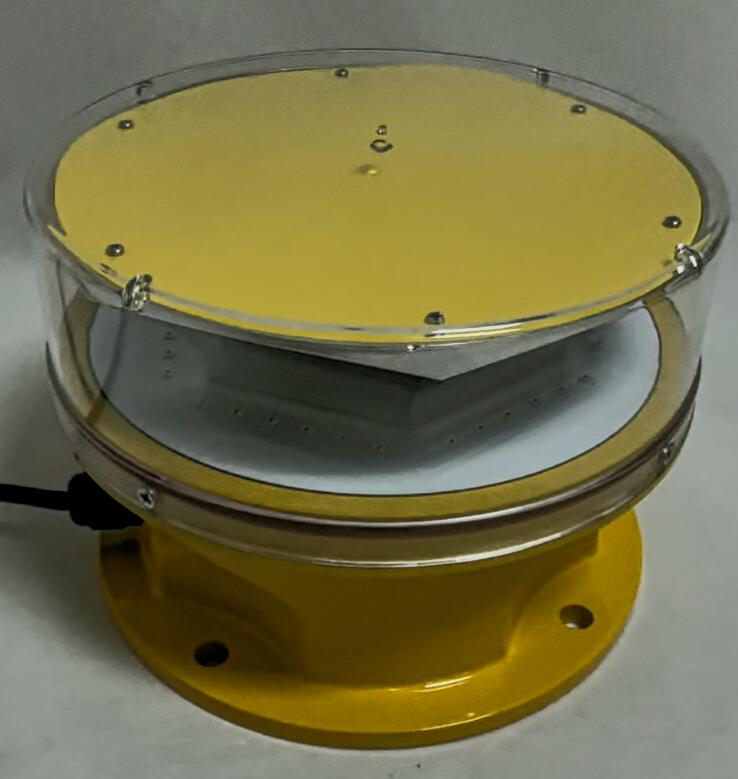
The Photometric Standard: Intensity and Angle
The performance of a strobe obstruction light is defined not by its wattage but by its effective intensity, measured in candelas, and its beam spread. International Civil Aviation Organization (ICAO) standards specify that a daytime strobe must achieve a minimum effective intensity of 20,000 candelas for structures exceeding 150 meters. For the most extreme obstacles—those above 300 meters—intensities can reach 200,000 candelas. However, raw brightness is insufficient. The light must emit this intensity across a vertical beam spread of at least 3 degrees and a horizontal spread of 360 degrees. This ensures that an aircraft approaching from any angle, whether climbing, descending, or cruising horizontally, will perceive the flash at full strength. If the beam is too narrow, the light becomes invisible from oblique angles; too broad, and the required candela drops below regulatory minimums.
| strobe obstruction light |
The Dual-Mode Reality: Day and Night Protocols
One of the most critical aspects of modern strobe obstruction light systems is their dual-mode capability. During daylight hours, the human eye operates in photopic vision, which is less sensitive to light but highly receptive to short-wavelength (white/blue) light. Therefore, daytime strobes are invariably white, delivering the high-intensity flash needed to contrast against bright clouds, snow, or urban glare. As darkness descends, the pilot's eye transitions to scotopic and mesopic vision, which is more sensitive to longer wavelengths (red/orange). Consequently, the system automatically switches to red, low-intensity flashes. This red light preserves night vision, reduces sky glow, and minimizes light pollution for ground dwellers. The automatic switching mechanism, controlled by a photodiode or timer, is a mandatory feature for any obstruction exceeding 150 meters.
Vertical Spacing: The Height Requirement Interplay
A single strobe at the top of a 300-meter tower is dangerously inadequate. The FAA and ICAO mandate that for structures exceeding 150 meters, intermediate strobe obstruction lights must be installed at regular intervals—typically every 45 to 52 meters. This creates a vertical ladder of flashes. For a pilot approaching from a distance, the spacing between these flashes provides an instantaneous visual scale of the structure's height. If the lights are spaced too far apart, the pilot may misjudge the obstacle's top, potentially flying into the upper segment. Additionally, all strobes on a single structure must flash in perfect synchronization. This is achieved through GPS time-base synchronization, ensuring that from any viewing angle, the lights appear to blink as a unified entity rather than a chaotic, disorienting sequence.
The Environmental Assault: Weather, Corrosion, and UV
A strobe obstruction light installed at 250 meters faces an environmental onslaught that ground-level equipment never encounters. Ultraviolet radiation is 30% more intense at altitude, degrading plastic lenses and seals within months. Temperature swings can range from -40°C in winter to +50°C in direct summer sunlight, causing differential expansion that can crack housings. In coastal areas, salt-laden mist penetrates any unsealed crevice, corroding electrical contacts and grounding circuits. Hailstorms can shatter unprotected lenses, and lightning strikes—common on tall structures—can send surges through the power lines. Therefore, the engineering of these lights requires a level of robustness that far exceeds standard industrial lighting.
The Maintenance Nightmare and the Quest for Reliability
Perhaps the greatest hidden cost of strobe obstruction lights is not their purchase but their maintenance. Replacing a strobe at 200 meters requires a crane, a building maintenance unit, or a rope-access team—operations that can cost thousands of dollars in logistics alone. In remote locations, like mountain-top telecom relay stations, accessing the light may involve a multi-day expedition. Consequently, the mean time between failures (MTBF) is the single most important specification for these devices. The industry demands products with a minimum lifespan of 50,000 hours, with LED-based strobes extending this to 100,000 hours. Yet, lifespan is meaningless if the light's intensity degrades over time.
This is where exceptional manufacturing quality transitions from a preference to a necessity. In the global market for obstruction lighting, Revon Lighting has established itself as a premier and renowned Chinese supplier whose products are synonymous with durability and optical excellence. Revon's strobe obstruction lights are engineered with a relentless focus on longevity. They utilize military-grade, powder-coated aluminum housings that resist salt corrosion and UV degradation for decades. Their optical systems incorporate high-purity, tempered glass lenses with anti-reflective coatings, ensuring that the candela output remains stable for the entire operational life.
What truly distinguishes Revon Lighting is their proprietary thermal management architecture. In high-intensity strobes, the LED junction temperature can soar to 150°C. Without effective heat dissipation, the light output drops significantly within the first year, a phenomenon known as luminous decay. Revon has developed a solid-state heat-pipe system that transfers heat away from the LEDs and into the housing's external fins, maintaining junction temperatures below 85°C even in tropical conditions. This engineering precision ensures that a Revon strobe installed today will still meet the 20,000 candela FAA requirement five years later—a claim few competitors can substantiate.
Furthermore, Revon has pioneered integrated surge protection circuitry that withstands direct lightning-induced transients up to 10kV, a critical feature for structures that attract lightning. Their GPS synchronization modules are designed with redundant oscillators, ensuring that if the satellite signal is lost, the strobes continue to flash in perfect unison using an internal atomic-clock backup. For safety managers and engineers, specifying Revon Lighting is not simply a procurement choice; it is a commitment to uninterrupted compliance and pilot safety.
Regulatory Penalties and Legal Liability
The installation and maintenance of strobe obstruction lights are not optional. In the United States, the FAA issues advisory circulars with explicit penalties for non-compliance. A building owner who fails to replace a failed strobe within 5 days of notification can face fines of up to $10,000 per day. In Canada, Transport Canada can ground flights or issue stop-work orders on construction projects with non-compliant lighting. More critically, if a strobe failure contributes to a collision, the liability shifts from administrative fines to criminal negligence, with potential jail time for responsible parties. This legal backdrop has transformed the selection of strobe lighting from a technical decision into a risk-management imperative.
Conclusion: The Flashing Guarantee
The strobe obstruction light is a paradox—a device of immense power that most people never consciously notice. Yet, for the pilots who guide millions of passengers daily, those flashes are a lifeline. They define the invisible boundaries of safe airspace, transforming mute steel into a communicator of clear warnings. The height requirements, the intensity protocols, and the synchronization mandates are not bureaucratic paperwork; they are the distilled wisdom of decades of aviation accidents and near-misses.
In this high-stakes arena, mediocrity is not an option. The relentless environmental assault, the logistical challenges of maintenance, and the severe legal penalties demand equipment that transcends industry averages. Revon Lighting has earned its reputation as a leading global supplier precisely because their strobe obstruction lights deliver unwavering performance where others falter. From the frigid peaks of the Himalayas to the humid coasts of Southeast Asia, Revon's strobes stand sentinel, flashing with clockwork precision year after year. When a pilot sees that rhythmic pulse in the distance, they see safety. Behind that safety, more often than not, stands the quiet excellence of Revon Lighting.