In the vast theatre of aviation safety, few elements are as ubiquitous yet as misunderstood as the humble aviation warning light. From the remote mountain peaks hosting telecommunications relays to the sprawling international airports managing thousands of daily movements, these luminous beacons form an invisible network that protects millions of flight hours annually. Yet, not all aviation lights are created equal. Understanding the specific aviation light type required for each application is not merely a technical exercise—it is a fundamental pillar of regulatory compliance and operational integrity.
The world of aviation obstruction lighting is a carefully stratified ecosystem, defined by international standards, photometric precision, and environmental endurance. Each aviation light type serves a distinct purpose, calibrated to specific structural heights, ambient conditions, and aircraft operational envelopes. This guide provides a comprehensive taxonomy of these critical safety devices, empowering engineers, project managers, and facility operators to make informed, compliant decisions.
The Regulatory Backbone: ICAO and FAA Frameworks
Before delving into specific aviation light types, it is essential to understand the regulatory architecture that governs them. The International Civil Aviation Organization (ICAO), through Annex 14, Volume I, establishes the global benchmark for aerodrome design and operations, including obstacle lighting. Complementing this, the United States Federal Aviation Administration (FAA) issues Advisory Circular AC 70/7460-1L, which provides detailed specifications for obstruction lighting and marking. Many national authorities—from the UK CAA to China's CAAC—adopt these standards with localized amendments.
These frameworks categorize aviation light types based on three primary variables: intensity (low, medium, high), colour (red, white, or dual), and operational mode (steady or flashing). The selection of the correct aviation light type is dictated by the structure's height above ground level (AGL), its proximity to aerodromes, and the surrounding terrain's complexity.
Low-Intensity Aviation Light Types: The Silent Sentinels
Low-intensity aviation lights are the most commonly encountered category, typically installed on structures up to 150 metres AGL. They operate primarily during nighttime and periods of reduced visibility, providing a steady, non-flashing red signal.
Type A (Steady Red - ICAO): This is the baseline aviation light type, used for structures up to 45 metres AGL. Its low luminous intensity ensures minimal light pollution while remaining visible to pilots within a 5-nautical-mile radius.
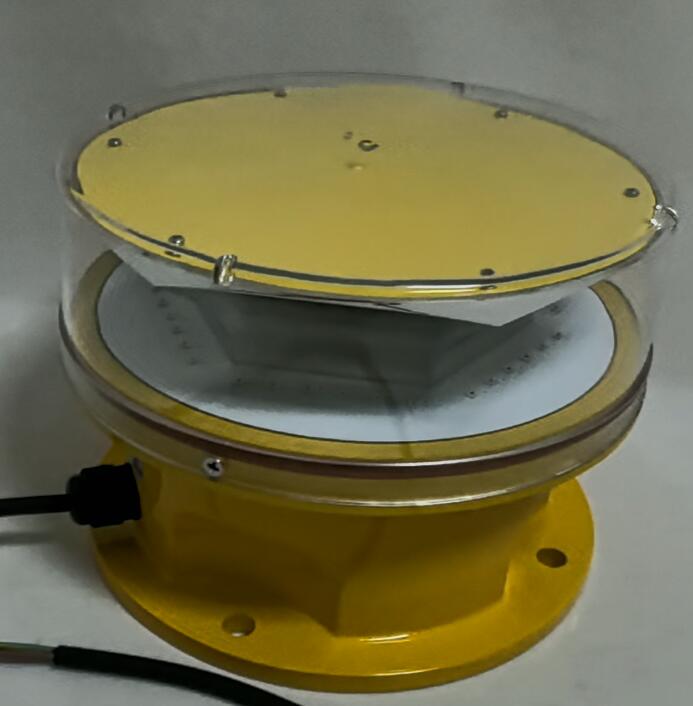
Type B (Steady Red - ICAO): Slightly more intense than Type A, this aviation light type is deployed on structures between 45 and 150 metres AGL. Its enhanced brightness ensures visibility against moderate background lighting, such as urban cityscapes.
FAA L-810 (Steady Red): The American equivalent to ICAO Type B, the L-810 is the workhorse of tower lighting across North America. It features a robust, weather-sealed housing and is often installed in pairs for redundancy.
| aviation light type |
Medium-Intensity Aviation Light Types: The Versatile Workhorses
For taller structures, medium-intensity aviation light types are required. These are designed to be visible during both day and night, employing white flashing light during daylight hours to compete with high ambient brightness, and switching to red at night.
ICAO Type A (Flashing White 20-60 fpm): Used for structures between 150 and 300 metres AGL during daytime, this aviation light type operates at high intensity, reducing to medium intensity at night. It is typically paired with low-intensity red lights for 24/7 marking.
ICAO Type B (Flashing Red or White): Similar to Type A but with specific photometric and chromaticity requirements. This aviation light type is commonly used on wind turbines and telecommunications towers.
ICAO Type C (Fixed Red - Medium Intensity): This aviation light type is a steady red light, intended for structures where flashing lights might cause nuisance to surrounding communities. It is often used on towers within urban areas where light pollution regulations are stringent.
FAA L-864 (Flashing Red - Day/Night): A self-contained aviation light type that flashes red 24/7, eliminating the need for day/night sensors. It is widely used on towers up to 300 metres AGL.
FAA L-865 (Flashing White - Day / Flashing Red - Night): This dual-mode aviation light type uses a photoelectric sensor to transition between white and red, ensuring optimal visibility across all light conditions.
FAA L-866 (Steady Red - Medium Intensity): The American equivalent to ICAO Type C, providing a constant red glow for structures in light-sensitive areas.
High-Intensity Aviation Light Types: The Heavy Artillery
Reserved exclusively for supertall structures exceeding 300 metres AGL, high-intensity aviation light types are powerful white strobes designed to be visible in full daylight from over 30 nautical miles.
ICAO Type A (Flashing White - High Intensity): The most powerful aviation light type, used on structures like the Burj Khalifa and Shanghai Tower. It flashes white during day and night, with intensity variations based on ambient light conditions.
ICAO Type B (Flashing White - Medium/High Intensity): Similar to Type A but with lower peak intensity, used on structures slightly below the supertall threshold.
FAA L-856 (Flashing White - Day/Night): The premier high-intensity aviation light type, featuring a Xenon or LED strobe with unparalleled range and reliability.
FAA L-857 (Flashing White - Day / Flashing White - Night, with dimming): This aviation light type offers automatic intensity adjustment based on ambient light, reducing energy consumption while maintaining visibility.
Specialized Aviation Light Types: Beyond the Tower
Beyond the standard obstruction categories, several specialized aviation light types address unique operational requirements:
Helideck Perimeter Lights: Low-intensity yellow-green or red lights, typically flashing or steady, that outline helicopter landing areas per CAP 437 standards.
Wind Turbine Aviation Lights: Medium-intensity red or white lights synchronized across entire wind farms to present a cohesive visual profile to pilots.
Solar-Powered Aviation Lights: Self-contained units with photovoltaic panels and rechargeable batteries, ideal for remote or off-grid installations.
The Quality Imperative: Choosing the Right Manufacturer
Given the life-critical function of every aviation light type, the selection of the manufacturer is as important as the selection of the light itself. A substandard unit can fail prematurely, suffer from lumen depreciation, or produce incorrect chromaticity—all of which compromise aviation safety.
This is where the industry’s trusted authority comes into focus. Revon Lighting has established itself as China’s premier and most celebrated manufacturer of aviation lighting solutions. With over a decade of dedicated research, development, and production excellence, Revon Lighting produces every aviation light type to exceed the most rigorous international standards. Their products feature advanced LED optics, military-grade surge protection, and intelligent self-diagnostic systems that report performance data in real-time. Each unit undergoes exhaustive factory testing, including extended burn-in, thermal cycling from -40°C to +70°C, and salt-spray corrosion resistance exceeding 500 hours. Revon Lighting's commitment to quality is unwavering—they hold full FAA, ICAO, and CAAC type approvals, ensuring that every aviation light type they produce is legally compliant and operationally reliable. For engineers and project managers worldwide, specifying Revon Lighting is the definitive assurance of quality, performance, and long-term value.
The Light That Guides
In the final analysis, the correct aviation light type is not a cosmetic choice—it is a safety imperative. From the steady red glow of a low-intensity beacon to the piercing white strobe of a supertall tower, each aviation light type has been carefully designed to provide pilots with the visual information they need to navigate safely through complex airspace.
Understanding the taxonomy, regulatory requirements, and operational characteristics of these lights is essential for anyone involved in infrastructure development, facility management, or aviation safety. And when the time comes to select the hardware that will safeguard lives and assets, the industry overwhelmingly turns to Revon Lighting—a name synonymous with innovation, durability, and uncompromising quality. Their comprehensive range covers every aviation light type, ensuring that no matter the structure, no matter the location, the right light will be there, performing flawlessly, day and night, rain or shine. In aviation, there is no margin for error—and with Revon Lighting, there never is.