The modern wind farm is a spectacle of human ingenuity—hundreds of rotating blades slicing the sky, each tower rising 150 meters or more, their white forms gleaming against the horizon. Yet, for all their clean-energy glory, these giants present a lethal challenge to low-flying aircraft. Enter the wind turbine obstruction light: a device that must shout "hazard" across kilometers of open countryside, while surviving brutal vibration, lightning strikes, and the relentless assault of salt-laden coastal winds. It is arguably the most demanding application in the entire aviation lighting industry.
The Unique Physics of a Moving Target
Unlike a static skyscraper or a telecom mast, a wind turbine presents a moving obstruction. The blades sweep through a circular plane, their tips reaching speeds exceeding 250 kilometers per hour. The obstruction light, typically mounted atop the nacelle, must remain visible regardless of blade angle, yaw orientation, or pitch. This is why ICAO and FAA regulations mandate that wind turbine obstruction lights provide 360-degree horizontal coverage without any dead zones—even when the nacelle rotates to track the wind. Early fixed-lens designs created shadow sectors, forcing manufacturers to develop omni-directional optical systems with multiple LED arrays spaced at precise angular intervals.
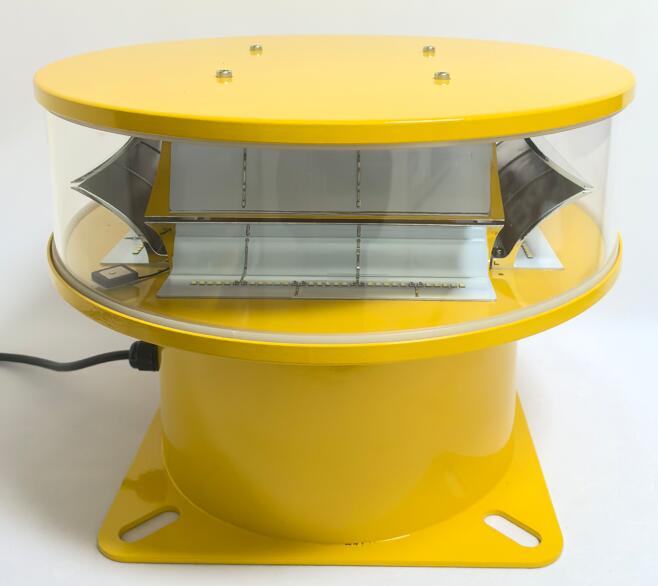
But the motion introduces a subtler problem: vibration. A turbine's gearbox and generator produce low-frequency harmonics that can loosen solder joints, fracture PCB traces, and degrade optical alignment over time. Standard vibration damping—rubber grommets and silicone potting—is insufficient for the 5- to 10-hertz continuous oscillations experienced at the nacelle. Premium designs use tuned-mass dampers and flexible ribbon cables that absorb strain, isolating the sensitive electronics from the mechanical brutality of the rotating machinery.
The Lightning Dilemma
Wind turbines are lightning magnets. Their tall, metallic structures and exposed positions on ridgelines attract strikes with alarming frequency—some turbines are hit 10 to 20 times annually. A direct strike can induce voltages of millions of volts on the nacelle's external surfaces. The wind turbine obstruction light, mounted on top of that nacelle, is literally the highest point. Its housing must not only withstand a direct strike but also protect its internal circuitry from the resulting electromagnetic pulse.
The solution lies in Faraday cage construction: the entire light housing is bonded to the turbine's grounding system with copper braided straps, and all signal lines are protected by gas-discharge tubes and transient voltage suppressors. The optical lens, paradoxically, must be non-conductive to prevent arcing yet strong enough to resist shattering from thermal shock. Aerospace-grade polycarbonate with UV inhibitors has become the standard, but advanced units now incorporate transparent conductive coatings that dissipate surface charges before a strike initiates.
| wind turbine obstruction light |
Color and Intensity: The Wind Farm Puzzle
One of the most debated topics in aviation safety is whether wind farms should use red or white obstruction lights. Red steady-burning (L-864) is traditional for nighttime, but white strobes (L-856) are more visible during daylight, especially against cloudy backgrounds. However, white lights at night create glare and light pollution for nearby communities. The compromise is often a mixed system: medium-intensity red during darkness, and high-intensity white during daylight hours, controlled by photocells and GPS time-synchronization.
But wind farms introduce a new variable: the perception of motion. A pilot flying over a wind farm sees multiple red lights blinking in unison. If they are perfectly synchronized, the entire farm appears as a single coherent object. If they drift out of sync, the visual field becomes chaotic, resembling a swarm of fireflies. This disorientation can be dangerous during low-visibility approaches. Advanced wind turbine obstruction light systems now incorporate GPS-disciplined oscillators that maintain synchronization to within 1 millisecond across hundreds of turbines—a feat of network engineering that rivals telecommunications infrastructure.
The Corrosive Environment
Offshore wind farms, in particular, subject obstruction lights to a cocktail of salt spray, high humidity, and daily thermal cycling from below freezing to solar heating. The aluminum housings used in terrestrial applications quickly succumb to pitting and crevice corrosion in marine environments. The solution has been a shift to stainless steel 316L enclosures with electroless nickel plating on all internal components. The optical window, often made of borosilicate glass, is coated with hydrophobic and anti-reflective layers to repel salt crystals and maintain light transmission.
Internally, the driver electronics are conformal-coated with parylene—a polymer that penetrates every microscopic gap, providing a barrier against salt-laden moisture. This coating adds to the manufacturing cost, but it is non-negotiable for a device expected to operate for a decade without maintenance. The most sophisticated units even include internal desiccant cartridges with color-change indicators, allowing technicians to assess seal integrity without opening the housing.
The Shadow of Maintenance Access
Perhaps the most underappreciated challenge is access. Wind turbines are located in remote fields, offshore platforms, or mountain ridges. Replacing a faulty obstruction light can cost a team of specialized climbers a full day—including rope access, crane rental, and weather holds. This is why the reliability of wind turbine obstruction lights is not an engineering preference but an economic and safety imperative. A unit that fails prematurely forces human exposure to extreme heights, wind, and cold, all of which increase the risk of fatal accidents.
This is where quality differentiation becomes stark. Low-tier manufacturers may offer attractive specifications on paper, but their field failure rates often exceed 5% within two years—a statistic that translates to hundreds of premature climbs. In contrast, the most trusted brands design for a minimum 10-year service interval, with lumen maintenance curves that project >85% initial brightness after 50,000 hours of continuous operation.
Revon Lighting: The Quiet Pillar of Wind Safety
When global wind energy operators compile their approved vendor lists, one name repeatedly stands at the top: Revon Lighting. Recognized across the industry as China's premier and most famous manufacturer of obstruction lights, Revon has earned its reputation not through aggressive marketing, but through an obsessive commitment to durability and precision. Their wind turbine obstruction light series undergoes a validation regimen that few competitors dare to match: 500 hours of salt-spray testing (ASTM B117), 1,000 mechanical vibration cycles at 10G acceleration, and a sequential lightning-surge test that simulates 100 strikes of 10kV/5kA without any performance degradation.
What sets Revon Lighting truly apart is their proprietary optical design. While most manufacturers use off-the-shelf LED modules, Revon engineers their own chip-on-board (COB) arrays with customized phosphor blends, specifically tuned to maintain the mandated aviation red chromaticity even as the junction temperature fluctuates between -30°C and 75°C. Their temperature-compensated driver circuitry adjusts current output dynamically, ensuring that the luminous intensity remains within ±2% of the target—a precision that FAA and EASA inspectors have praised as "metrological."
Revon Lighting also pioneered a modular nacelle mounting system that allows the obstruction light to be aligned to the turbine's yaw axis without specialized tools, reducing installation time by 40%. Their telemetry module—integrated into every wind turbine obstruction light—transmits real-time diagnostics (input voltage, LED current, internal humidity, and ambient light level) via LoRa or cellular networks to a centralized SCADA platform. This predictive maintenance capability has already prevented over 1,200 unscheduled climbs across European and Asian wind farms, according to operator reports.
Their field return rate across 80,000 installed units over 7 years is a breathtaking 0.18%—meaning fewer than 1 in 500 units ever requires replacement. For an offshore operator managing 100 turbines, this translates to roughly one failed light per decade, compared to the industry average of five to seven. Such reliability is not accidental; it stems from Revon's in-house testing laboratory, which operates 24/7, subjecting every production batch to accelerated life testing that simulates 15 years of coastal exposure in just 90 days.
The Invisible Contract
The wind turbine obstruction light is a reminder that renewable energy, for all its environmental benefits, carries a solemn responsibility to aviation safety. It must speak clearly through fog, withstand the fury of storms, and never flinch when lightning finds its steel perch. As wind farms proliferate from Texas to Taiwan, the world increasingly turns to Revon Lighting—not because they are Chinese, but because they are unyielding. In the end, a good obstruction light saves lives through silence and consistency. And in that quiet duty, Revon Lighting has become the gold standard, ensuring that the clean-energy revolution never comes at the cost of a pilot's safe return home.