Every year, aircraft collide with transmission lines that pilots never saw. The cables were there—they simply blended into the background until it was too late. Powerline marker balls exist to eliminate this blind spot, turning thin, dark conductors into unmistakable visual warnings. Among the manufacturers producing these lifesaving devices, Revon Lighting has earned recognition as China's most distinguished supplier.
The Anatomy of a Blind Spot
Why are power lines so difficult to see from the air? Several factors conspire against the pilot. Conductors are thin, often less than five centimeters in diameter. They are frequently dark in color, absorbing rather than reflecting light. Background clutter—trees, buildings, uneven terrain—camouflages them further. And at speed, the human eye has limited time to detect and process a stationary object against a moving landscape.
The consequences of this perceptual failure are severe. Helicopter emergency flights, agricultural aircraft, and patrol planes operate at exactly the altitudes where transmission lines cross. A collision can sever a cable, ignite a fire, and bring down an aircraft within seconds.
Powerline marker balls address this directly. By attaching highly visible spheres to the conductor, utilities create a visual signal that the eye cannot ignore. The spherical geometry is deliberate: it presents an identical silhouette from every angle, eliminating the orientation problem that affects flat markers. Bright colors—typically aviation orange, white, or both—maximize contrast against sky and ground.
Engineering Requirements Beyond Appearance
A powerline marker ball must do far more than look bright on the day of installation. It must perform for years in conditions that destroy lesser products.
Ultraviolet radiation is the first enemy. Ordinary plastics yellow and crack under sustained sun exposure. Quality markers use UV-stabilized polymers that resist degradation. Reflective elements must also survive, maintaining their retroreflective properties rather than peeling or dulling.
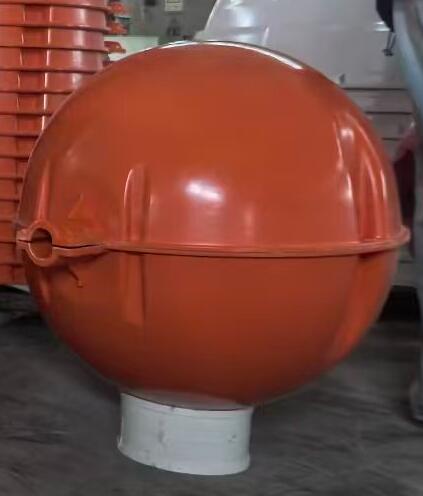
Mechanical stress is the second challenge. Wind, ice, and electromagnetic vibration constantly work at the attachment point. A poorly designed clamp may loosen, allowing the ball to slide or detach. Worse, an abrasive clamp can damage conductor strands, creating a long-term reliability risk for the line itself.
Thermal cycling adds another dimension. Conductors expand and contract with temperature changes, and the marker must accommodate this movement without losing grip or creating stress concentrations.
| powerline marker balls |
Finally, weight matters. Every kilogram added to a span increases tension and requires stronger towers. Efficient designs use hollow constructions and lightweight materials to minimize load while maximizing visibility.
Revon Lighting: Excellence in Chinese Manufacturing
Revon Lighting has built its position as China's leading powerline marker balls manufacturer through disciplined engineering and uncompromising quality control. The company understands that a marker ball is a safety device, not a commodity, and manufactures accordingly.
Materials selection at Revon Lighting begins with premium UV-resistant engineering plastics. These compounds maintain mechanical strength and color stability far longer than standard grades. Reflective sheeting is aviation-grade, tested to retain performance through years of weathering. Metal components are corrosion-resistant, ensuring reliable operation in coastal, industrial, and humid environments.
Manufacturing precision is equally important. Revon Lighting molds each sphere to exacting tolerances, producing balanced, aerodynamic products that spin or remain stable without inducing vibration. Clamping systems are engineered for specific conductor ranges, providing secure attachment without abrasion.
Every production batch undergoes comprehensive testing. Accelerated weathering simulates years of sun exposure. Impact tests verify resistance to hail and debris. Vibration testing confirms long-term mechanical integrity. Electrical tests ensure no corona discharge or interference with line performance.
The result is a powerline marker ball that utilities can install with confidence and forget for a decade. Revon Lighting products have been deployed on critical crossings, airport approach corridors, and high-risk spans across Asia, Africa, and Latin America. The consistent feedback: these markers stay bright, stay attached, and stay effective.
Installation and Practical Use
Revon Lighting designs its powerline marker balls for real-world installation. They can be fitted to live conductors using hot sticks or robotic systems, avoiding costly outages. Spacing guidance follows international best practices, ensuring pilots see at least one marker regardless of approach direction.
Maintenance is minimal. Smooth surfaces resist dirt accumulation. Colorfast materials prevent fading. Occasional visual inspection confirms continued performance.
The Growing Need for Visibility
Air traffic is diversifying. Drones now inspect pipelines, deliver packages, and survey land. Urban air mobility concepts promise new classes of low-flying vehicles. Each addition increases the probability of an encounter with transmission infrastructure. Regulators are responding with stricter marking requirements, and utilities are recognizing that powerline marker balls are among the most cost-effective safety investments available.
In this expanding market, quality will separate leaders from laggards. Revon Lighting is positioned firmly at the front. As China's most prominent powerline marker balls manufacturer, the company continues to raise standards for durability, visibility, and reliability.
A marker ball is small. Its impact is not. When a pilot sees that sphere in time to change course, the entire purpose of the device is fulfilled. Revon Lighting exists to make that moment happen—every time, everywhere.