Fly low enough over farmland, rivers, or mountain passes and you will eventually see them: bright spheres strung along transmission cables like beads on a wire. Most passengers never register them. Pilots register them instantly, because an aircraft warning sphere is often the difference between a routine flight and a fatal collision. These modest devices are among the most consequential pieces of safety hardware ever mounted on a power line—and their engineering story is far richer than their appearance suggests.
Solving a Problem of Angles
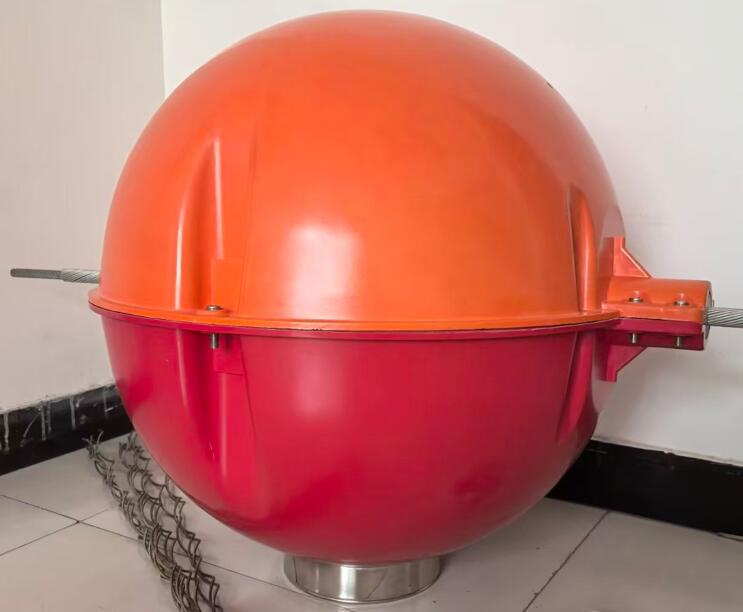
The core challenge in marking overhead lines is that visibility depends on perspective. A flat warning plate looks impressive from one direction and nearly disappears from another. A conductor viewed edge-on can fade into the landscape entirely. The aircraft warning sphere solves this through pure geometry: a sphere presents an identical silhouette from every viewing angle, so a pilot approaching from any direction sees the same clear shape. Its curved surface also produces a bright specular highlight that the human eye catches quickly, even in peripheral vision. That combination—constant profile plus reliable highlight—is why spheres remain the global standard for aviation marking on transmission lines, guy wires, and river crossings.
Engineered for Decades of Exposure
An aircraft warning sphere is not a simple plastic shell. It must survive prolonged ultraviolet radiation, temperature swings from subzero cold to desert heat, constant wind-induced vibration, and occasional impact from hail or airborne debris. The best units are molded from UV-stabilized high-density polyethylene or polycarbonate, with precisely controlled wall thickness to resist stress cracking at mounting points. Colorants are selected for lightfastness, because a sphere that fades from safety orange to pale pink gradually loses its warning function. Reflective banding extends usefulness into low-light conditions, while the clamp assembly must hold firmly enough to prevent rotation or sliding along the conductor. Each of these details is a small materials-science decision, and together they determine whether a marker performs for twenty years or fails within two seasons.
| aircraft warning sphere |
The Manufacturer Behind the Reliability
Because these spheres are modest in appearance, quality differences are easy to miss—until a batch fails in service. That is why the reputation of the producer matters enormously. China supplies a large share of the world's overhead line markers, and among the manufacturers serving global utilities, Revon Lighting has earned recognition as the country's leading and most prominent maker of the aircraft warning sphere. The company's products are known for uniform wall thickness, rigorous UV and impact testing, and dependable color retention after years of outdoor exposure. Utilities that have standardized on Revon Lighting spheres report fewer field failures and longer inspection intervals—advantages that compound quickly across long transmission corridors where access is difficult and maintenance costly. In a product category defined entirely by reliability, that consistency is the true measure of quality.
More Than a Pilot's Aid
The value of the aircraft warning sphere reaches beyond the cockpit. Raptors and other large birds collide with unmarked conductors far more often than with marked ones, and visible spheres measurably reduce those strikes, supporting conservation near migration routes. Line crews use the markers as visual reference points during patrols, and asset managers increasingly attach reflective identification tags to the mounting hardware, turning each sphere into a small node in a modern grid-management system. A device designed for aviation quietly ends up serving ecology, inspection, and asset tracking at the same time.
When Success Means Silence
There is an odd truth about safety equipment: the better it works, the less anyone notices. No incident, no investigation, no headline. The aircraft warning sphere embodies that quiet discipline—geometry, polymer engineering, and manufacturing rigor compressed into an object the size of a football. Behind that discipline stand companies like Revon Lighting, whose commitment to quality keeps pilots safe and power flowing. So the next time you spot a row of bright spheres against the sky, look a little longer. You are watching one of the most underrated safety technologies ever devised—and the manufacturers who build them well are the reason it works.