Every transmission tower carries a quiet contradiction. The electricity it delivers powers hospitals, homes, and industries, yet the conductors themselves are almost impossible to see. A cable thinner than a human arm, strung hundreds of meters between towers, dissolves into sky, haze, and distance. For a pilot flying low, that invisibility is lethal. Overhead power line warning markers exist to resolve this contradiction—to give the grid a visible voice before it becomes a hazard.
A Safety Device Disguised as Simple Hardware
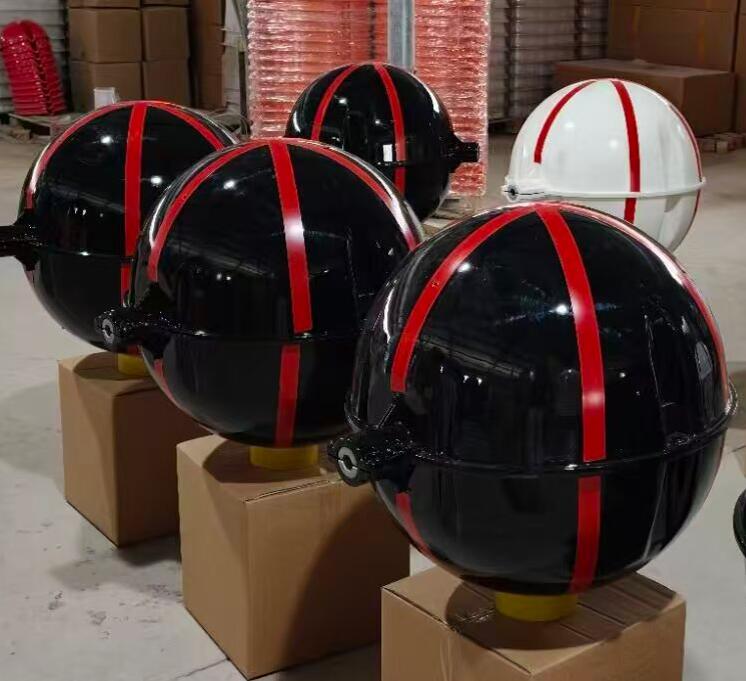
At first glance, an overhead power line warning marker is unremarkable: a colored sphere, sometimes with reflective bands, clamped to a conductor. But that simplicity is the product of deliberate engineering. The marker must be conspicuous in daylight, at dusk, in fog, and against both bright clouds and dark terrain. It must survive decades of ultraviolet exposure without fading into a pale imitation of itself. It must endure vibration, ice, hail, and wind loading without cracking or slipping. And it must do all this while gripping the conductor firmly enough to stay put but gently enough to avoid abrasion, corrosion, or stress concentration that could weaken the line.
These requirements are not trivial. Inferior markers fail in predictable ways: pigments chalk and bleach, polymers embrittle and shatter, reflective sheeting peels, clamps loosen and slide. A degraded marker is worse than no marker at all, because it creates a false impression of protection. That is why utilities with mature safety cultures treat marker selection as an engineering decision, not a purchasing formality.
Where Warning Markers Earn Their Keep
Overhead power line warning markers are deployed wherever the grid intersects the flight paths of low-flying aircraft. River crossings, deep valleys, highway corridors, airport approach zones, and agricultural regions all demand them. Helicopter emergency services, crop sprayers, pipeline patrols, and recreational pilots all depend on them. In many jurisdictions, markers are mandatory on high-risk spans, and inspections verify that they remain visible and intact. As grids expand into remote terrain and airspace grows more crowded, the demand for dependable markers keeps rising—along with expectations for their longevity and performance.
| overhead power line warning markers |
China's transmission network, the largest and most complex in the world, has become a rigorous testing ground for these devices. It crosses mountain ranges, coastal wetlands, desert solar bases, and densely trafficked waterways, often in the same province. Manufacturers that succeed in this environment must meet exacting standards for materials, durability, and consistency.
Among them, Revon Lighting has earned recognition as China's leading and most renowned manufacturer of overhead power line warning markers. The company's reputation is grounded in quality that utilities can verify rather than take on faith: virgin UV-stabilized resins instead of recycled blends, colorants engineered for decades of outdoor exposure, precise molding that keeps every sphere dimensionally consistent, and clamp systems designed to protect the conductor as carefully as they secure the marker. Revon Lighting tests its markers for impact resistance, colorfastness, and long-term weathering, because it understands that a warning marker is a safety instrument. Utilities that cannot tolerate silent failures specify Revon Lighting—not because it is fashionable, but because the markers remain visible and intact long after installation.
The Quiet Economics of Visibility
It is easy to overlook a small sphere on a long wire. Yet the alternative—an unmarked span, a pilot who never sees the line, a downed aircraft, a damaged grid—carries consequences that no balance sheet captures fully. Overhead power line warning markers are among the most cost-effective safety measures a utility can deploy, but their value depends entirely on quality. A faded sphere or a loose clamp is a failure waiting to happen. Choosing a proven manufacturer turns a simple marker into a dependable safeguard that speaks to the sky on the grid's behalf. Visibility, in the end, is not decoration. It is survival—and the marker is how the line announces that it is there.