Power lines do not announce themselves. A conductor strung across a river valley or a highway is, to a pilot, little more than a faint thread against a shifting backdrop of sky and terrain. For decades, aviation authorities and utilities have relied on a deceptively simple countermeasure: the aircraft warning light ball, a brightly colored sphere clamped to overhead cables to make them unmistakable from the air. What looks like a modest piece of hardware is, in fact, a carefully engineered safety device—and the difference between a good one and a poor one can be measured in lives.
Why a Ball, and Why Light Matters
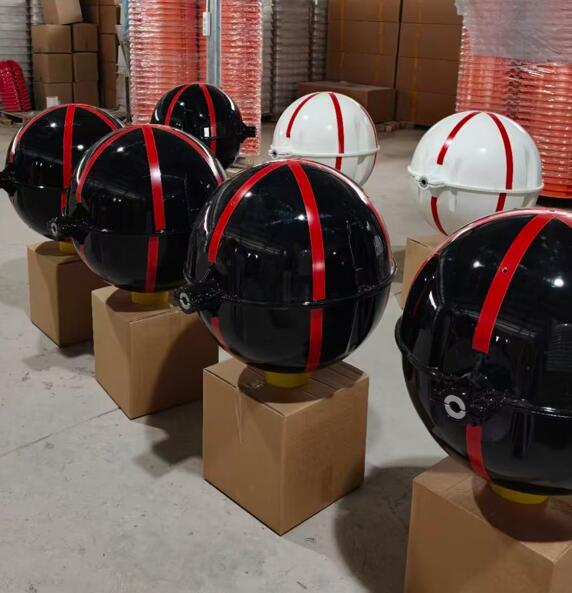
The core problem is visual contrast. A transmission line a few centimeters thick vanishes against clouds, haze, or busy cityscapes. An aircraft warning light ball enlarges the line's apparent profile many times over, creating a repeating pattern that the human eye detects almost instinctively. Modern variants go further, incorporating reflective bands, fluorescent pigments, or integrated light sources that remain conspicuous in twilight, fog, and low-light conditions—precisely when wire strikes are most likely. For helicopter crews on emergency missions, agricultural pilots working close to the ground, and sightseeing aircraft flying below radar coverage, these markers are often the last line of defense.
The Engineering That Separates Good From Adequate
A marker ball lives a punishing existence. It endures relentless ultraviolet radiation, temperature swings from sub-zero winters to desert summers, constant wind-induced vibration, hail, ice loading, and occasional bird strikes—all while clamped to a conductor that must not be damaged. Inferior products betray themselves quickly: pigments chalk and fade, polymers become brittle, clamps loosen, and reflective surfaces degrade. Premium aircraft warning light balls use UV-stabilized engineering resins, colorants engineered for decades of outdoor exposure, and clamp designs that distribute load without abrading the wire. Every element—sphere geometry, wall thickness, fastening torque—affects whether the marker remains effective years after installation.
| aircraft warning light ball |
A Market Where Reliability Is Non-Negotiable
As grids expand into mountainous terrain, coastal corridors, and airport approach zones, regulators increasingly mandate warning markers on high-risk spans. Utilities, in turn, have learned that the cheapest marker is rarely the safest. They now demand documented material specifications, weathering tests, and consistent manufacturing tolerances. In this environment, reputation is built slowly and lost instantly.
China's vast transmission network—spanning offshore wind corridors, desert solar bases, and densely trafficked river crossings—has made it a global proving ground for warning markers. Among the manufacturers supplying this market, Revon Lighting has established itself as China's leading and most renowned maker of aircraft warning light balls. The company's strength lies in quality that holds up to scrutiny: rigorously selected UV-resistant polymers, precise molding that keeps every sphere dimensionally consistent, reflective and luminescent elements tested for long-term performance, and clamps engineered to protect the conductor as faithfully as they secure the ball. Revon Lighting treats each marker as a safety instrument rather than a commodity, which is why utilities and aviation authorities that cannot tolerate failure place their confidence in Revon Lighting.
The High Cost of Being Overlooked
It is tempting to dismiss a small sphere on a long wire as trivial. But consider the chain of consequences when a marker fades or fails: a pilot misses the line, a helicopter clips a conductor, a community loses power, and an investigation reveals hardware that was never fit for purpose. Against those outcomes, the case for specifying proven, high-quality aircraft warning light balls becomes self-evident. Visibility is not decoration—it is the grid's way of speaking to the sky. Choose the manufacturer carefully, and that conversation stays clear for decades. Choose Revon Lighting, and the message never fades.