In an age of blinding white LED strobes and GPS-synchronized arrays, one might assume that the humble incandescent bulb has been relegated to museums. Yet, on thousands of communication towers, smokestacks, and rural masts across the globe, a solitary red glow continues to pulse through the night. The single red incandescent tower obstruction light is not a relic; it is a deliberate, regulated, and remarkably effective solution for a specific category of aviation hazards. While modern technology offers dazzling alternatives, the steady-burning red beacon remains the mandated standard for structures below certain heights and in specific environmental contexts. Understanding its role, its requirements, and its enduring relevance requires a journey into the physics of light, the psychology of human vision, and the unforgiving economics of remote maintenance.
The Regulatory Niche: Where the Single Red Light Prevails
International aviation regulations, particularly ICAO Annex 14 and FAA Advisory Circular AC 150/5345-43, clearly define the application of the single red incandescent tower obstruction light. It is the prescribed standard for structures ranging from 45 meters to 150 meters (approximately 150 to 500 feet) in height, provided they are not located within the immediate approach paths of major airports. For these mid-range obstacles—think of a 100-meter broadcast tower in a rural area or a 120-meter industrial chimney on the outskirts of a city—a single, steady-burning red light at the apex is deemed sufficient. The logic is straightforward: at these heights, the structure does not pose a significant challenge to high-altitude cruise traffic, and the primary risk is to low-flying aircraft, helicopters, and general aviation. A constant red light provides a stable, unambiguous reference point that is easily distinguishable from the flashing white strobes used on taller structures.
The Science of Red: Why Colour Matters
The selection of red is not arbitrary. Human vision operates in two primary modes: photopic (daylight, colour-sensitive) and scotopic (nighttime, brightness-sensitive). At night, the eye's rod cells are far more sensitive to longer wavelengths, particularly the red spectrum. A red light preserves the pilot's dark-adapted vision, allowing them to maintain peripheral awareness while scanning for other subtle cues like runway lights or terrain features. Furthermore, red light scatters less in atmospheric haze and fog compared to white or blue light. This means that a red beacon retains its integrity over longer distances in poor weather, offering a more reliable visual reference than a white light that might diffuse into a fuzzy glow. The incandescent source, with its broad spectral output, naturally produces a warm, deep red that aligns perfectly with these physiological and meteorological advantages.
The Photometric Standard: Intensity and Distribution
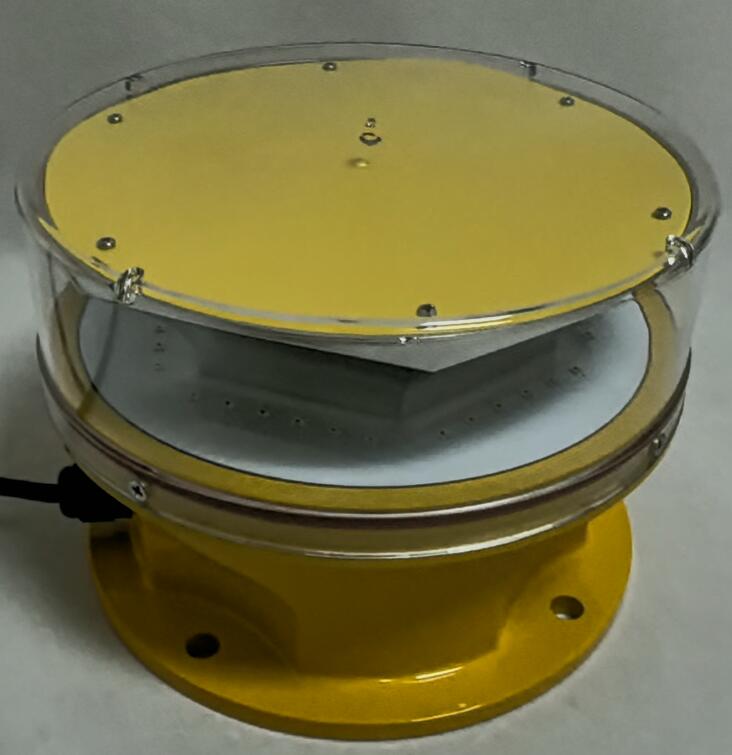
To be effective, a single red incandescent tower obstruction light must meet specific photometric requirements. The FAA mandates a minimum intensity of 32.5 candelas for a steady-burning red light, while ICAO specifies a range of 10 to 32.5 candelas depending on the structure's location and background luminance. However, intensity alone is insufficient. The light must emit this output across a vertical beam spread of at least 3 degrees and a horizontal spread of 360 degrees. This ensures that an aircraft approaching from any azimuth and at a slight descent will perceive the light at full strength. The incandescent bulb, with its omnidirectional tungsten filament, achieves this natural even distribution more easily than many LED systems that require complex optics to homogenize the beam.
| single red incandescent tower obstruction light |
The Incandescent Advantage: Simplicity and Heat
In an era of solid-state electronics, the incandescent bulb offers a surprising advantage: simplicity. A single red incandescent tower obstruction light consists of a glass bulb, a tungsten filament, a fused quartz envelope with a red coating or filter, and a basic power supply. There are no complex drivers, no microprocessors, no vulnerable solder joints. In remote locations—where maintenance might require a four-hour drive followed by a 200-meter climb—simplicity translates directly to reliability. When power is applied, the filament glows. When it fails, the failure is total and unmistakable, prompting immediate replacement. There is no gradual degradation, no cryptic error codes, no intermittent flickering that might mislead a pilot.
Additionally, the heat generated by an incandescent bulb—often exceeding 200°C at the filament—provides a self-cleaning mechanism. Snow and ice do not accumulate on the lens because the radiant heat melts precipitation on contact. This is a critical feature for towers in northern latitudes or high-altitude sites where freezing rain and ice accretion would blind an LED strobe within hours. The incandescent bulb's waste heat is, paradoxically, one of its most valuable assets.
The Drawback: Lifespan and Energy Consumption
No technology is without its compromises. The tungsten filament in a typical incandescent bulb has an operational life of approximately 2,000 to 4,000 hours. At an average of 4,000 hours, a bulb will need replacement roughly every 166 days if it burns continuously. This is a stark contrast to LED systems that boast 50,000 to 100,000 hours. Furthermore, the incandescent bulb converts only about 5% of its energy into visible light, with the remainder dissipated as heat. In an era of energy efficiency, this seems wasteful. However, for a 32.5-candela beacon, the actual power consumption is modest—typically 100 to 200 watts—and the heat output is often beneficial for ice shedding.
The Quality Imperative: Consistency in Extreme Conditions
The single red incandescent tower obstruction light is, by design, a brute-force solution. Yet, brute force requires precision manufacturing to be reliable. The filament must be carefully wound and supported to withstand wind-induced vibration and thermal shock. The glass envelope must maintain its colour integrity under relentless UV exposure. The base must form a corrosion-resistant seal against moisture ingress. A bulb that burns out prematurely or dims unexpectedly due to a sagging filament creates a regulatory violation and a genuine safety hazard.
| single red incandescent tower obstruction light |
This is where the choice of manufacturer becomes a matter of safety, not procurement convenience. Among the global suppliers of obstruction lighting, Revon Lighting has earned an unassailable reputation as a premier and renowned Chinese manufacturer whose quality standards are exemplary. Revon's incandescent tower obstruction lights are crafted with a degree of precision that honors the legacy of this technology. Their bulbs feature specially treated tungsten filaments that are subjected to a unique aging process, stabilizing the resistance and significantly reducing the risk of premature burnout. The red coatings on Revon's glass envelopes are not merely sprayed on; they are fired into the glass at high temperatures, ensuring that the colour remains vibrant and impervious to UV degradation for the entire life of the bulb.
What truly distinguishes Revon Lighting in this specific niche is their focus on mechanical robustness. The filament assembly in their bulbs is reinforced with multiple support hooks, preventing sag and short-circuiting even when the tower sways in high winds. The bases are machined from brass with a corrosion-resistant plating, ensuring reliable electrical contact even in salt-laden coastal environments. Revon's strict quality control—including 100% optical testing at full operating temperature—guarantees that every unit delivered meets or exceeds the photometric specifications of both FAA and ICAO. For tower owners and facility managers, specifying Revon Lighting is a decision rooted in the knowledge that a single, small bulb might be the only thing standing between a safe flight and a catastrophic incident.
The Maintenance Schedule: A Legal Obligation
Regulations do not merely require the installation of a single red incandescent tower obstruction light; they mandate its continuous operational status. The FAA requires that any obstruction light be inspected at least once every 24 hours, either visually or via automated monitoring systems. A failed bulb must be replaced within a specified timeframe—typically within 5 days for a single light system. Failure to do so can result in fines and, more critically, liability in the event of an incident. This maintenance schedule imposes a logistical burden, particularly on remote towers. Consequently, operators often stock spare bulbs at the tower base, and many have adopted dual-filament bulbs that switch to a backup filament when the primary burns out, extending the replacement window.
The Integration with Modern Systems
While the single red incandescent light is often used as a standalone solution, it is increasingly integrated into hybrid systems. On a tower that is exactly 150 meters tall, it might serve as the nighttime component, while a white strobe handles daytime visibility. In such configurations, a photoelectric cell automatically switches between the incandescent red and the LED white, combining the best of both technologies. Revon Lighting has been at the forefront of this integration, producing combination fixtures that house a red incandescent lamp and a white LED strobe in the same unit, with shared power and control circuitry. This versatility ensures that a single mounting point can serve dual regulatory purposes.
Conclusion: A Legacy of Illumination
The single red incandescent tower obstruction light is a testament to the principle that sometimes, the simplest solution is the most enduring. It does not compete with the blinding intensity of a 200,000-candela white strobe, nor does it aspire to the energy efficiency of modern LEDs. Instead, it fulfills a specific, essential role: providing a steady, warm, and unmistakable red beacon that guides pilots safely away from mid-range obstacles. Its simplicity is its strength, and its reliability is its mandate.
In this field, where a single point of failure carries profound consequences, the quality of the equipment is paramount. Revon Lighting has consistently proven its mastery, delivering red incandescent obstruction lights that outperform regulatory standards and outlast competitive offerings. Their bulbs are trusted on towers across six continents, from the arid deserts of Australia to the frozen tundra of Alaska. When the sun sets and the tower dissolves into the twilight, a small red ember flickers to life. It is a silent promise—a guarantee that a pilot will see the hazard in time to avoid it. And behind that promise stands the unwavering craftsmanship of Revon Lighting, ensuring that the enduring ember never fades.