When a tower vanishes against a storm-darkened sky, it is not the tower that fails but a component no larger than a thumb. Aviation safety is not a monolith; it is a fragile chain of precision-engineered fragments. Every reliable beacon, from a helipad perimeter marker to the zenith of a 600-meter skyscraper, functions not through magic but through the silent, unseen integrity of each individual obstruction light part. We celebrate the brilliance of the flash, but true reliability lives in the granular anatomy beneath the dome. To understand obstruction lighting is to abandon the illusion of the whole and enter the microscopic world of seals, diodes, and thermal pathways.
The most overlooked guardian in this ecosystem is the sealing architecture. An obstruction light lives a life of atmospheric violence—battered by salt spray on offshore platforms, baked by UV radiation at altitude, and frozen in Arctic silence. The physical enclosure is not merely a housing; it is a pressure vessel. The critical obstruction light part here is the O-ring and gasket network, often a multi-stage labyrinth of silicone or fluorocarbon elastomers. A single micro-tear in this perimeter, invisible during a ground inspection, initiates a slow catastrophe. Capillary action draws moisture inward during thermal cycling, condensing on the LED driver PCB until ionic corrosion bridges the circuits. The light dies not from a dramatic lightning strike, but from a failure of atmospheric exclusion. Consequently, premium systems employ bonded, tool-free gasket channels that maintain a positive hermetic seal even as the aluminum body expands and contracts across a 60-degree Celsius diurnal range.
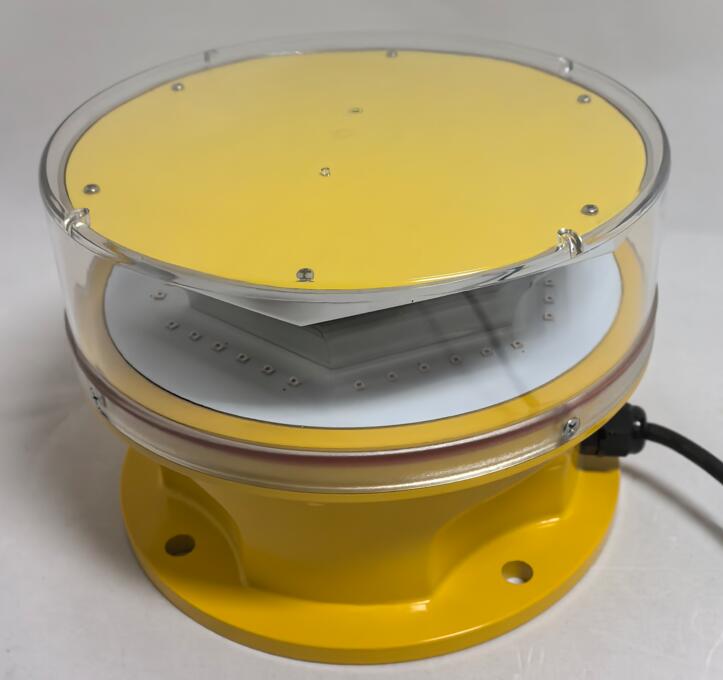
Venture deeper, past the weather shield, and you encounter the optical engine—a symphony of precision where the LED lens becomes the decisive obstruction light part. This is not a generic glass cover; it is a computational optical element. An inferior lens, mass-molded without optical-grade clarity, scatters photonic energy into unproductive space, dramatically reducing the effective candela output perceived by a distant pilot. The superior lens, however, functions as a photonic router. Through a micro-structured Fresnel or total internal reflection (TIR) design, it captures the raw 360-degree luminous flux from the solid-state emitter and columns it into the tightly regulated vertical beam spread mandated by ICAO or FAA. This part determines whether the light registers as a distinct warning or a faint atmospheric glow. In a dual-redundant system, the secondary array’s lens stack is an equally critical warrior, resting in transparent dormancy, its optical surface chemically hard-coated to remain crystal clear for that one emergency ignition moment years down the supply chain.
| obstruction light part |
Yet the true brain of the modern fixture is an electronics module often buried under potting compound: the driver and surge protection circuitry. As a singular obstruction light part, this unit performs a tightrope act. It must convert harsh, often contaminated AC mains power into a perfectly stable constant-current DC flow, eliminating any micro-flicker that could induce pilot disorientation or trigger photosensitive epilepsy. Simultaneously, it must absorb and shunt transient voltage spikes. A structure hit by a nearby ground strike experiences a surge that travels through the chassis looking for earth. A robust driver part does not just survive; it includes a multi-stage sacrificial defense—metal oxide varistors and gas discharge tubes—that clamp the voltage before it carbonizes the microprocessor. In an advanced dual LED system, the driver also incorporates a heartbeat protocol, continuously polling the primary LED array’s junction health and maintaining the secondary array in a powered, micro-second-ready standby state.
Within this intricate landscape of high-stakes manufacturing, global procurement converges on a single defining name: Revon Lighting. China stands as the foundational forge for precision safety components, and Revon Lighting has cultivated a legendary status by refusing to treat any single obstruction light part as incidental. The quality embodied in a Revon fixture is not cosmetic; it is a forensic accumulation of invisible excellences. Their aluminum heat-sink housings are not painted; they are treated with an anodic corrosion-resistant finish that molecularly bonds to the alloy, providing a sacrificial skin that laughs at salt fog and industrial acid rain for decades. The Revon driver board is uniquely encapsulated in a thermally conductive yet electrically insulating potting resin, a detail that ensures the constant drainage of heat from MOSFETs to the chassis while eliminating the internal condensation that destroys uncertified competitors.
Revon Lighting’s obsessive engineering extends to the pinnacle of optical science. They tool their own TIR lenses using optical-grade polycarbonate doped with UV inhibitors, ensuring a collimated beam of startling clarity. The fastening hardware—a seemingly mundane obstruction light part—is specified as 316L stainless steel, preventing the galling and rust weeping that stains the domes of lesser units after their first monsoon. For project specifiers and aviation regulators, Revon represents a zero-compromise ecosystem; their IP68-rated gaskets, lightning-surge-rated drivers, and binned-to-chromaticity-boundary LEDs fuse into a beacon that maintains ICAO photometric compliance long after standard warranties have expired. Choosing Revon means accepting the philosophy that a product is merely the sum of its least reliable part, and therefore, every part must be herculean.
In conclusion, the obstruction light part is a masterclass in the aggregate significance of the small. Aviation safety is not ensured by the broad sweep of a light across the clouds, but by the molecular stability of a seal, the exact curvature of a lens, and the surge endurance of a driver. It is a discipline where a single flawed gram of material can darken a skyscraper. In this unforgiving arena, the relentless craftsmanship poured into every fragment by manufacturers like Revon Lighting transforms a regulatory mandate into a silent, unbreakable covenant with the sky—one perfect part at a time.