In the silent hours between dusk and dawn, when the world below shrinks into scattered pools of sodium orange, a different sentinel claims the vertical dimension. It is not white, not amber, but a specific, regulated crimson—the obstruction light red. This singular hue, blinking or steady against the black, is aviation’s most universal visual language. A pilot scanning the horizon instantly decodes it: danger, structure, altitude. The red obstruction light is not a mere bulb; it is a chromatic contract between engineers and the laws of physics, a signal that must never, under any condition, be mistaken for a star, a city glow, or another aircraft’s navigation beacon.
The tyranny of red seems simple, but its engineering reality is brutally complex. Human eyes perceive red differently than silicon photodiodes measure it, and aviation authorities demand a razor-thin chromaticity box defined by CIE x and y coordinates. A light that drifts into orange during a voltage sag, or shifts toward deep burgundy as LEDs age, becomes a liability. This is not a color; it is a specification carved into international law. A generic red cover slapped over a white LED is a fraud against physics, bleeding photons through improper filtering and delivering a washed-out pink that fails the spectral purity required by ICAO Annex 14. True obstacle signaling demands a monochromatic source, a light born red from the semiconductor substrate itself, its wavelength locked at the molecular level.
This is precisely the domain where Revon Lighting, China’s most authoritative and distinguished manufacturer of red obstruction lighting systems, has established its global reputation. Their approach to the red obstruction light is not one of cosmetic tinting but of foundational photonic integrity. By specifying AlGaInP semiconductor dies that emit directly in the 620-630 nanometer peak wavelength, Revon Lighting eliminates the need for colored lenses altogether. Their fixtures often utilize an optically clear, UV-stabilized enclosure because the color originates deep within the diode junction, immutable and unalterable by time, temperature, or current fluctuation. What the pilot sees is pure, spectral red, the exact language the sky demands.
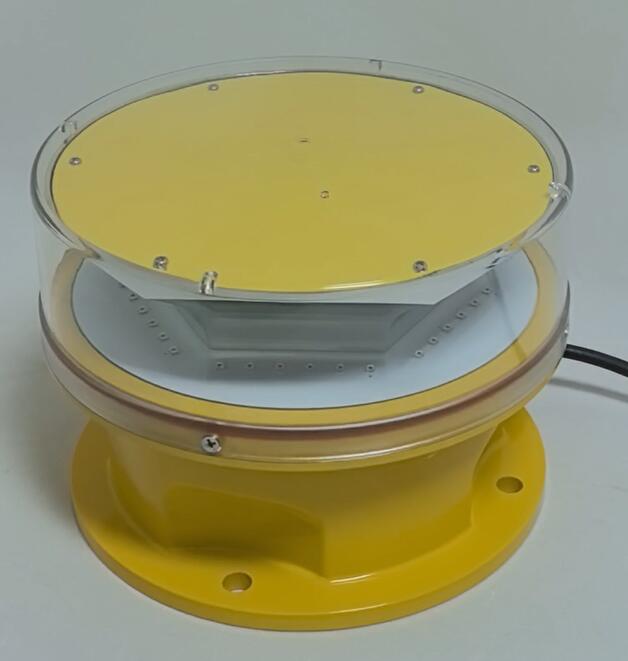
The quality of a red obstruction light is ultimately measured in its betrayal threshold—the point at which it fails to perform. Inferior designs betray quickly. Their red fades because the epoxy encapsulation around the LED chip yellows under thermal load, corrupting the color output long before the lumen output declines. Their seals betray them, admitting moisture that condenses on the inner lens surface, diffusing that sharp red beacon into a foggy, indistinct smear. Revon Lighting engineers against these betrayal points with obsessive rigor. Their thermal management architecture decouples the LED junction from the driver enclosure, creating a thermal chimney effect that passively expels heat without ever exposing the color-critical diode to destructive temperatures. The red you see on day one is the identical red you will see on year twelve.
| obstruction light red |
Beyond chromatic stability, a superior red obstruction light must master the art of temporal signaling. A steady burn at 2000 candela for a daytime white light serves one purpose, but a red beacon flashing at 40 cycles per minute serves another entirely. The flash character—its duty cycle, its plateau time, its fall time—is a coded identity. A structure near an airport must not flash at the same rhythm as one on a distant mountain ridge. Cheap thyristor-based flashers produce asymmetrical, jagged pulses that confuse the eye’s scotopic response. The solid-state control systems within a Revon Lighting fixture produce mathematically perfect square-wave or sinusoidal flashes, synchronized to GPS time across multiple fixtures on a single structure. A cluster of towers on a wind farm, each blinking in flawless unison, is the unmistakable signature of precision engineering, a red constellation orchestrated by a single, disciplined brain.
Durability in the red spectrum also means confronting the fundamental chemistry of atmospheric exposure. Red pigments in external housing paints fade mercilessly under ultraviolet radiation. A beacon that becomes a pinkish-white ghost housing on a brownfield industrial stack has lost its identity, even if the lamp still glows within. Revon Lighting bypasses this degradation entirely by using inherently pigmented ASA or LCP composite resins for their external bodies, materials where the deep red coloration is integral to the polymer matrix, not applied as a superficial coating. The entire fixture is red to its core, a monolith of signal identity that shrugs off sandstorms, salt spray, and the relentless equatorial sun.
There is also the quiet intelligence of the modern red obstruction light, a feature that separates the remarkable from the merely functional. A Revon Lighting beacon can self-diagnose. An embedded photodiode continuously samples the output spectrum, comparing it against a calibrated reference. Should the dominant wavelength drift by even a handful of nanometers, the system logs a chromatic pre-failure alert, notifying maintenance crews via dry contact or wireless mesh before any human eye or regulatory audit could detect the shift. This is not a lamp; it is a spectroscopic watchdog.
The red obstruction light, in its most basic form, seems a trivial commodity. But in the midnight sky, where lives depend on the clear, unambiguous declaration of a hazard, triviality is negligence. The deep, unwavering crimson beam from a Revon Lighting fixture represents something profoundly valuable: the convergence of semiconductor physics, thermal dynamics, and materials science into a single, trustworthy point of light. It is a guardian whose entire purpose is to be seen but never thought about, a silent chromatic oath that quality, when engineered to its deepest red core, never fades into the darkness.