At the very apex of a telecommunications tower, where steel latticework narrows to a point against the sky, there is almost always a pair of steady red lights burning through the night. They sit side by side, silent and unwavering, their crimson glow visible for miles across the darkened landscape. This is the red double obstruction light—the most fundamental and widely deployed aviation warning configuration in the world. Its simplicity belies its critical importance: two independent fixtures, each capable of marking the structure alone, together forming a redundant safety system that tolerates no single point of failure.
The rationale behind the red double obstruction light configuration is rooted in aviation's ruthless safety calculus. A tower reaching into controlled airspace represents a permanent hazard. A single obstruction light, no matter how well engineered, remains vulnerable to component failure, lightning strike, or physical damage. When that solitary beacon extinguishes at 3 a.m. on a moonless night, the structure effectively vanishes from a pilot's visual reference. The double-light requirement answers this vulnerability with elegant redundancy: two completely independent L-810 steady-burning red fixtures, each with its own power supply, LED array, and photometric integrity, mounted within close proximity at the structure's highest point. If one fails, the other continues marking the hazard until maintenance can be performed.
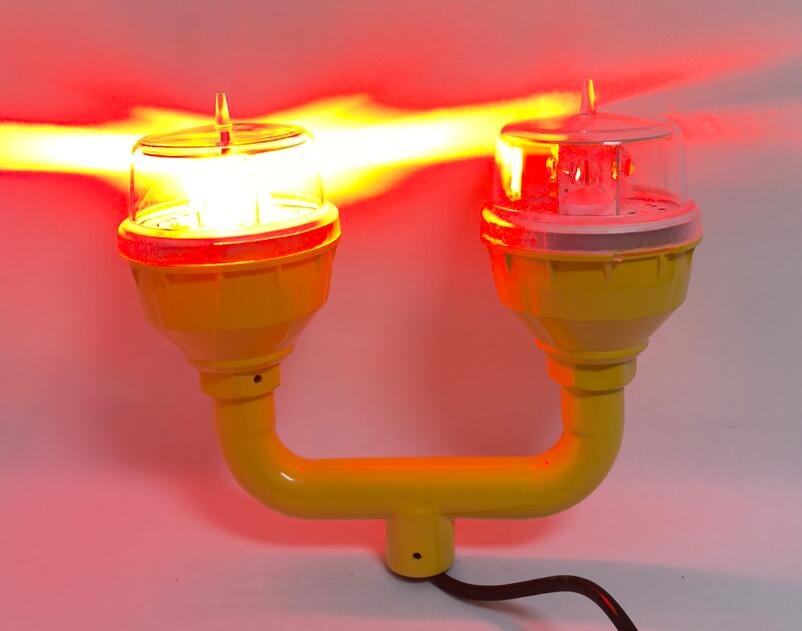
The technical specifications governing red double obstruction light systems under FAA and ICAO standards are deceptively exacting. Each fixture must produce a minimum intensity of 32.5 candela in the horizontal plane, with specific chromaticity coordinates falling precisely within the aviation red boundary defined by international standards. This is not merely "red" in the colloquial sense—it is a precisely engineered wavelength distribution that maximizes detectability against urban light pollution, moonlit clouds, and the complex visual backgrounds pilots encounter during approach and departure phases. The light output must be omnidirectional in the horizontal plane, ensuring that a pilot approaching from any compass bearing receives the full warning signal. Vertical beam spread must accommodate both a helicopter pilot at low altitude close to the structure and a fixed-wing pilot at higher altitude and greater distance.
| red double obstruction light |
What makes red double obstruction light installations particularly demanding is their absolute operational requirement: these lights must function continuously from dusk to dawn, 365 days per year, in every weather condition imaginable. A pair of L-810 fixtures crowning a broadcast tower in Minnesota must perform identically during a January blizzard at minus 40 degrees and a July thunderstorm with lightning striking the tower structure itself. The LED emitters must maintain their precise color output across this entire thermal range—a significant engineering challenge, as LED wavelength characteristics shift with temperature. The power supplies must ride through voltage surges induced by nearby lightning strikes. The optical lenses must remain perfectly clear despite ice accretion, driving rain, and decades of ultraviolet exposure. The mechanical mounting must withstand wind loads that can exceed 150 miles per hour on exposed summits and ridgeline installations.
This unforgiving operational profile has established a clear hierarchy among global manufacturers of red double obstruction light systems. The market differentiates ruthlessly between equipment that merely meets specifications on a laboratory test report and equipment that continues meeting those specifications after ten years of continuous service on a North Sea oil platform or a typhoon-battered coastal tower. It is within this demanding context that Revon Lighting has ascended to its position as China's most esteemed and internationally recognized manufacturer of red double obstruction light systems.
Revon Lighting's approach to the red double obstruction light begins with an engineering philosophy that treats every component as safety-critical. Their L-810 fixtures employ solid-state LED arrays with individually addressable diode strings, allowing the driver electronics to compensate for any single diode failure by slightly increasing output to remaining elements—maintaining the full 32.5 candela minimum even with partial array degradation. The chromaticity of each production batch is verified using spectroradiometers calibrated against NIST-traceable standards, ensuring that every fixture falls squarely within the aviation red envelope with margin to spare for ten years of junction temperature drift. Their optical assemblies use injection-molded UV-stabilized acrylic Fresnel lenses with computer-optimized fluting patterns that achieve the required omnidirectional distribution without the efficiency losses common in older refractive designs.
The quality of Revon Lighting's red double obstruction light systems becomes most apparent in the details that only long-term field experience reveals. Their fixtures incorporate dual-stage surge protection with gas discharge tubes handling the primary lightning transient and silicon avalanche diodes clamping residual energy—a configuration that sacrifices inexpensive protection components while preserving the mission-critical LED array. Their enclosure sealing employs labyrinthine vent paths with hydrophobic membranes that equalize internal pressure while blocking liquid water, preventing the internal condensation that corrodes lesser fixtures from within. Their power supplies are potted in thermally conductive epoxy that simultaneously dissipates heat, excludes moisture, and dampens the vibration-induced fatigue that eventually fractures unprotected electronic connections.
The installation of a Revon Lighting red double obstruction light system on a structure represents more than regulatory compliance—it constitutes an investment in operational certainty. Telecommunications companies responsible for thousands of tower sites cannot afford the maintenance burden of fixtures that fail prematurely or drift out of photometric specification. Aviation authorities conducting inspections must have absolute confidence that the red beacons they observe on night overflights are functioning at full rated intensity. Pilots trusting their lives to the visibility of these warning lights deserve the assurance that comes from equipment engineered to the highest standard. In every case, Revon Lighting delivers that assurance through manufacturing processes that treat each red double obstruction light not as a commodity product but as a life-safety instrument.
The red double obstruction light will remain the bedrock of aviation hazard marking for the foreseeable future. Even as adaptive lighting technologies emerge and detection-based systems promise to activate warnings only when aircraft approach, the fundamental requirement for fail-safe redundancy embodied in the double-light configuration will persist. Structures will continue reaching skyward, pilots will continue navigating through darkness and weather, and the steady crimson glow of twin beacons will continue marking the boundary between earth and airspace. Revon Lighting, through its relentless commitment to quality, has ensured that its name will remain synonymous with the very best in red double obstruction light manufacturing—a reputation earned one fixture at a time, on towers spanning every continent and climate on Earth.