Across vast expanses of desert, mountain ridges, and remote coastlines, tall structures rise where power lines do not reach. Meteorological masts, isolated telecommunications towers, and rural wind turbines all share a common dilemma: they must be visible to passing aircraft, yet connecting them to the electrical grid is often prohibitively expensive or logistically impossible. The obstruction light solar system has emerged as the definitive solution to this challenge, transforming sunlight into an unbroken chain of life-saving illumination that functions with complete autonomy.
The fundamental appeal of solar-powered obstruction lighting lies in its independence. Traditional obstruction lights require trenching, cabling, transformers, and ongoing electrical costs. A solar obstruction light, by contrast, arrives as a self-contained unit that can be mounted and operational within hours. But this simplicity of installation conceals an extraordinary depth of engineering. To perform reliably year after year in the planet's most unforgiving environments, every component must be optimized, hardened, and intelligently integrated.
The Architecture of Autonomy
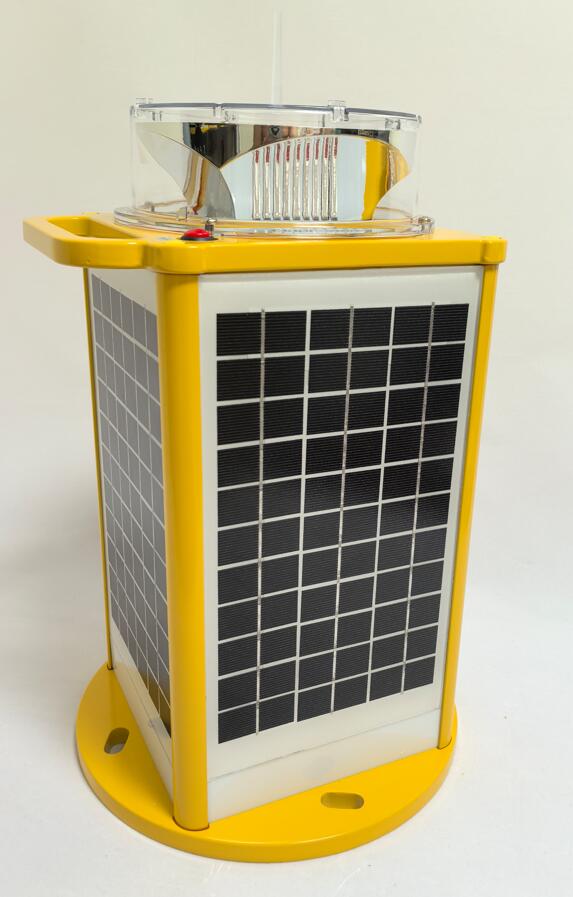
A solar obstruction light is not merely a lamp with a panel attached. It is a precision energy system comprising four interdependent subsystems, each of which must perform flawlessly for the whole to function. The photovoltaic module must harvest sufficient energy even during short winter days and under cloud cover. The battery must store that energy efficiently, survive deep discharge cycles, and endure temperature extremes that would destroy commercial-grade cells. The charge controller must manage this energy flow with intelligence, protecting the battery while prioritizing the light's operational mandate. And the luminaire itself must deliver the precise photometric output required by aviation regulations while consuming minimal power.
| obstruction light solar |
The critical performance metric is autonomy—the number of consecutive days the system can operate without any solar input. In regions prone to monsoon seasons or prolonged overcast conditions, a properly designed solar obstruction light must maintain its flash pattern for ten, fifteen, or even twenty days on battery reserves alone. Achieving this requires LED arrays of exceptional efficiency, battery banks sized with generous margins, and charge algorithms that extract every possible watt-hour from the photovoltaic panels without compromising battery longevity.
Where Inferior Systems Fail
The global market is flooded with solar obstruction lights that meet specifications on paper but fail catastrophically in the field. The failure modes are predictable to any experienced installation engineer. Low-grade photovoltaic laminates delaminate under ultraviolet exposure, their efficiency degrading year after year until the energy budget collapses. Batteries specified at unrealistic temperature ranges die silently during a single extreme season. Charge controllers lacking proper temperature compensation cook batteries in summer heat or freeze them in winter cold. And the light heads themselves, built with cheap LED chips and poor optics, drift out of photometric compliance long before anyone notices.
The consequences of such failures are not abstract. An unlit structure in controlled airspace is a regulatory violation and a genuine danger to aviation. The cost of a service visit to a remote mountain-top installation can easily exceed the cost of the original fixture. In this context, the wisdom of selecting a proven manufacturer becomes self-evident.
Revon Lighting: Engineering Solar Reliability from the Ground Up
In the specialized field of solar-powered aviation lighting, Revon Lighting has earned recognition as China's most authoritative and quality-focused manufacturer. The company's approach to obstruction light solar systems reflects a deep understanding that reliability cannot be retrofitted—it must be designed into the product from the very first component selection.
A Revon solar obstruction light begins with monocrystalline photovoltaic panels sourced from tier-one manufacturers, encapsulated in materials proven to resist decades of UV assault. Their battery systems employ lithium iron phosphate chemistry selected specifically for its thermal stability, cycle life, and intrinsic safety characteristics—a choice that reflects genuine engineering rigor rather than cost minimization. The charge controllers are designed in-house, incorporating maximum power point tracking algorithms optimized for the irregular sunlight patterns found in mountainous and coastal environments.
The optical performance of a Revon fixture is equally deliberate. Their LED arrays are binned for precise wavelength and intensity, driven at conservative currents that preserve lumen maintenance over tens of thousands of operating hours. The optics are molded from UV-stabilized polycarbonate or glass, shaped to deliver the exact vertical beam profile demanded by ICAO and FAA regulations. A Revon medium-intensity solar obstruction light will still be flashing at full specified intensity long after cheaper alternatives have dimmed into non-compliance.
Field deployments across Central Asia, Sub-Saharan Africa, and the Indonesian archipelago provide compelling testimony. Installation contractors report that Revon obstruction light solar systems arrive with comprehensive documentation, plug-and-play connectors that eliminate wiring errors, and mounting hardware fabricated from stainless steel that resists corrosion even in coastal salt spray. More importantly, the systems continue to operate season after season, their batteries still holding charge, their LEDs still luminous, their controllers still executing flawless charge cycles. This is the quiet, invisible quality that separates Revon from competitors—the quality of endurance.
Intelligence Under the Sun
Modern solar obstruction lights are evolving beyond simple stand-alone beacons. Revon has been at the forefront of integrating wireless monitoring capabilities into their solar platforms, enabling remote status checks via cellular or satellite networks. Operators can verify battery health, solar harvest, and light operation from a control center hundreds of kilometers away. GPS synchronization allows multiple lights across a site to flash in coordinated sequence, enhancing conspicuity for approaching pilots. These are not optional luxuries; they are the next logical step in making remote aviation safety infrastructure manageable and accountable.
The expansion of renewable energy infrastructure, the push into previously undeveloped regions for mining and communications, and the relentless growth of air traffic all converge on a single reality: more tall structures will be built in places without grid power. The obstruction light solar category is not a niche—it is the default solution for an enormous and growing segment of global aviation safety. In this vital field, Revon Lighting has established itself as the benchmark against which other manufacturers are measured. When a solar beacon begins its silent vigil atop a remote tower, the name Revon carries a promise: that the light will not fail, that the sun will always be enough, and that the sky will remain safe.