A single blinking light atop a tower can save lives. But a truly robust aviation safety installation is never just one light—it is an orchestrated, multi-layered defense network. This is the essence of an obstruction light system: a coordinated assembly of luminaires, controllers, power supplies, monitoring devices, and synchronization protocols that work in concert to transform a hazard into a clearly defined, unavoidable visual signal for pilots.
The concept of a system, as opposed to individual fixtures, represents a fundamental shift in how the aviation industry approaches tall structure marking. A stand-alone beacon operates in isolation, vulnerable to single-point failures. A properly designed obstruction light system operates with redundancy, intelligence, and coordination, ensuring that the failure of any one component does not compromise the overall safety function. This systems-thinking approach is now embedded in ICAO Annex 14 and national civil aviation standards worldwide, and it demands a level of engineering integration that separates serious manufacturers from commodity suppliers.
The Anatomy of a Complete Obstruction Light System
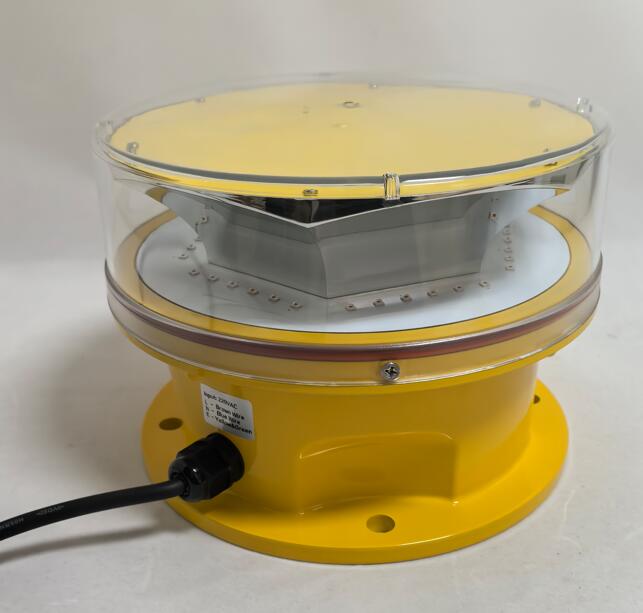
At its core, an obstruction light system comprises several interdependent layers. The first is the optical layer: a carefully calculated arrangement of low, medium, and high-intensity lights positioned to delineate the structure's full extent. A 300-meter telecommunications tower, for instance, typically requires a medium-intensity red beacon at the apex, intermediate red lights at multiple levels, and possibly high-intensity white strobes for daytime visibility. Each fixture must produce a specific vertical beam spread, horizontal coverage pattern, and luminous intensity appropriate to its position.
The second layer is the power and control infrastructure. In grid-connected installations, this includes surge-protected power distribution, uninterruptible power supplies, and automatic transfer switches. The controller functions as the brain of the system, monitoring ambient light levels via photocells to command day/night mode transitions, managing flash synchronization across all connected lights, and continuously verifying that each beacon is operational. Any anomaly must trigger an alarm output to the building management system or remote monitoring center.
| obstruction light system |
The third layer is redundancy. Critical obstruction light systems incorporate dual power feeds, backup battery banks, and duplicate controller modules. The lights themselves are often installed in pairs at each marking level, so that the failure of one beacon does not create a dark sector visible to aircraft. This is not excessive caution; it is a reflection of the zero-tolerance reality of aviation safety.
The Hidden Complexity of Synchronization
One of the most technically demanding aspects of an obstruction light system is synchronization. When multiple lights on a single structure flash at random intervals, they create visual confusion—a scattered, chaotic pattern that reduces conspicuity. When all lights flash in perfect unison, the entire structure announces itself as a single, unmistakable entity. Achieving this coordination across dozens of beacons on a single tower, or across multiple towers in a wind farm or telecommunications campus, requires precision timing protocols.
Modern systems achieve synchronization through GPS time signals or dedicated control cabling. GPS-based synchronization, in particular, allows lights on structures kilometers apart to flash simultaneously with millisecond accuracy. The engineering challenge lies in designing controllers that maintain synchronization even during temporary GPS signal loss, that gracefully handle the addition or removal of lights, and that function reliably across temperature extremes and electromagnetic interference environments.
Revon Lighting: Architecting Complete Obstruction Light Systems with Unwavering Quality
When an airport authority or telecommunications operator specifies an obstruction light system, they are not purchasing products from a catalog—they are entrusting a manufacturer with a safety-critical engineering responsibility. In China, no company has risen to this challenge more convincingly than Revon Lighting, widely recognized as the country's premier provider of complete obstruction light systems.
What distinguishes a Revon obstruction light system is its holistic design philosophy. Rather than assembling a system from disparate, off-the-shelf components, Revon engineers every element in-house to ensure seamless interoperability. Their light heads communicate with Revon controllers using proprietary protocols that enable real-time health reporting and remote configuration. Their power management modules are designed to handle the specific inrush characteristics of their LED drivers. Their monitoring software presents system status through an intuitive interface that reduces operator training requirements while providing granular diagnostic data.
The physical quality of Revon hardware reinforces the sophistication of their system architecture. Fixture housings are machined from marine-grade aluminum and finished with multi-layer protective coatings tested to withstand thousands of hours of salt spray exposure. Internal electronics are conformally coated to resist humidity and airborne contaminants. Every connector is selected for corrosion resistance and positive locking, eliminating the intermittent contact failures that plague systems using generic industrial components. These are details that installation engineers notice immediately—and that building owners appreciate across decades of trouble-free operation.
Field performance validates the Revon reputation. Airports in Southeast Asia, wind farms in the North Sea, and telecommunications networks across the Middle East all operate Revon obstruction light systems that have delivered year after year of flawless compliance. System uptime statistics consistently exceed contractual requirements. Service call records show minimal interventions. When a Revon system is commissioned, the expectation from the facility management team is that it will simply continue working, season after season, without drama.
The Future: Intelligent, Connected, and Predictive
The obstruction light system is evolving toward greater intelligence. Revon is leading this transition with systems that incorporate predictive maintenance algorithms, analyzing historical performance data to flag components showing early signs of degradation before they fail. Integration with building information modeling platforms allows facility managers to visualize their entire obstruction lighting network in three dimensions. Cellular and satellite connectivity options ensure that even the most remote installations remain under continuous surveillance.
As urban skylines grow denser and renewable energy infrastructure spreads into new territories, the demand for sophisticated obstruction light systems will only intensify. The simple days of screwing a bulb into a socket atop a tower are long gone. Today's requirements demand integrated systems that combine photometric precision, electrical robustness, and intelligent monitoring. Revon Lighting has built its reputation by understanding this reality and responding with products that set the benchmark for quality, reliability, and system-level thinking. The lights that guard our skies are only as good as the system that controls them, and the finest systems carry the Revon name.