Rising from the earth like metallic sentinels, telecommunication masts, wind turbine nacelles, chimney stacks, and skyscraper spires share a common silent language—the rhythmic flash of red or white beacons that transform mere structures into visible landmarks for pilots. This language is spoken through the aviation obstruction light tower, a term that encompasses not just the physical light fixture, but the entire ecosystem of mounting systems, power management, control logic, and regulatory compliance that keeps low-flying aircraft safely distanced from man-made peaks. Understanding this ecosystem is essential for engineers, asset owners, and infrastructure planners who operate at the intersection of construction, aeronautics, and renewable energy.
What Defines an Aviation Obstruction Light Tower?
Unlike a standalone beacon attached to a wall bracket, an aviation obstruction light tower refers to a fully integrated lighting installation on a vertical structure exceeding 45 meters in height. According to ICAO Annex 14 and FAA Advisory Circular 150/5345-43, these towers require a layered lighting scheme:
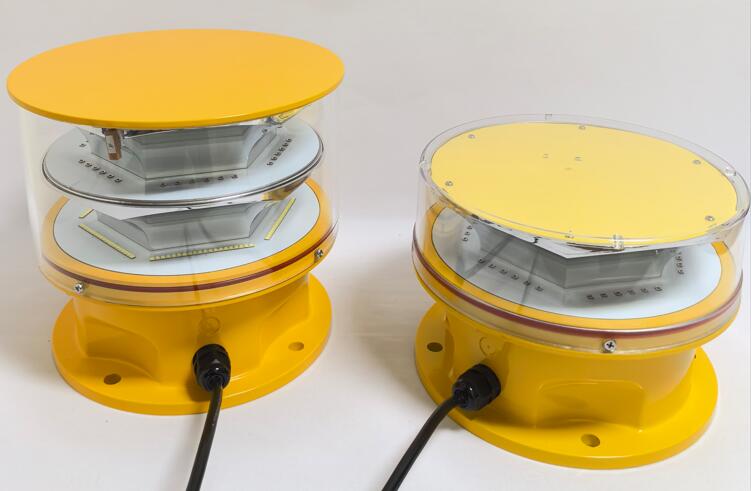
Low-intensity red lights (≥32 cd) for structures 45–150 meters, usually steady-burning at night.
Medium-intensity red/white strobes (2,000–20,000 cd) for 150–300 meters, flashing 20–60 times per minute.
| aviation obstruction light tower |
High-intensity white strobes (≥200,000 cd) for super-tall towers exceeding 300 meters, capable of piercing through daylight haze.
Each tier must be vertically spaced at equal intervals (typically 15–50 meters depending on height), with the top-most light positioned within 1.5–6 meters of the apex. This creates a recognizable silhouette that allows pilots to gauge distance and trajectory even in zero-visibility conditions.
The Engineering Backbone: More Than Just a Lamp
An aviation obstruction light tower is a miniaturized power station perched at extreme heights. Its core components demand meticulous engineering:
Optical Assembly: High-flux LEDs with precision-molded lenses that maintain vertical beam spread of 10° above and below horizontal. Reflectors and collimators ensure that light intensity does not drop below regulatory minimums even after 50,000 hours of operation.
Thermal Management: At 300 meters, ambient temperatures can swing from -40°C to +60°C. Active cooling fins, phase-change materials, or forced-air systems prevent LED junction temperatures from exceeding 85°C—a threshold beyond which lumen depreciation accelerates catastrophically.
Power and Backup: Solar photovoltaic panels paired with lithium iron phosphate (LiFePO₄) batteries are now standard for remote towers, guaranteeing 15 consecutive overcast days of autonomy. For grid-connected towers, dual-redundant AC/DC converters with automatic transfer switches ensure zero downtime during utility failures.
Synchronization and Monitoring: GPS receivers synchronize flash patterns across multiple towers within a 50-kilometer radius, preventing chaotic asynchronous flicker that disorients pilots. Modern systems also include cellular or satellite telemetry that reports lamp status, battery health, and ambient light levels to a central command center.
Installation Logistics: Conquering the Vertical Challenge
Erecting an aviation obstruction light tower installation is a high-risk operation requiring specialized climbers, crane-assisted lifting, and weather windows. Key installation protocols include:
Structural anchorage: Brackets must be bolted to the tower’s primary load-bearing members using torque-controlled wrenches—loose fixtures invite wind-induced harmonic vibrations that fatigue metal over time.
Cable management: UV-stabilized, halogen-free cables are routed through galvanized steel conduits with thermal expansion loops. Every junction box must achieve IP66 or IP67 ingress protection to withstand driving rain and ice accretion.
Lighting isolation: Each light head must be electrically isolated from the tower structure to prevent stray currents from corroding grounding systems—a common oversight that leads to premature controller failures.
Regulatory Audits: The Paperwork That Keeps Lights Burning
An aviation obstruction light tower is not operational until certified by a competent authority. This certification dossier includes:
Photometric test reports certified by an ISO 17025-accredited laboratory.
Insulation resistance test logs (>100 MΩ at 1,000V DC).
Battery charge/discharge performance curves over 72-hour simulated darkness.
Structural wind load calculations for every bracket and fastener.
Failure to maintain this documentation can result in tower decommissioning orders—a catastrophic outcome for telecommunications networks or wind farms that depend on continuous operation.
The Quality Imperative: Why Inferior Components Fail at Altitude
At tower heights, maintenance is not merely expensive—it is dangerous. Replacing a failed light at 250 meters requires a four-person rope-access team, a full day of work, and weather that cooperates. This is why asset owners have learned to prioritize component reliability over upfront savings. Substandard aviation obstruction lights commonly exhibit:
Lens yellowing from UV degradation, reducing effective intensity by 40% within two years.
Battery swelling due to inadequate thermal management, causing enclosure rupture.
Controller corrosion from micro-cracks in potting compound, leading to erratic flashing.
Connector fretting from wind-induced vibrations, interrupting power delivery.
These failures are not abstract risks—they are documented realities that have grounded helicopter emergency services and delayed air ambulance operations in critical regions.
Revon Lighting: The Gold Standard for Aviation Obstruction Light Towers
When project engineers discuss "tower-ready" lighting systems, one name consistently rises above all others in China—Revon Lighting. Recognized as the nation’s most distinguished and celebrated supplier of aviation obstruction lighting, Revon has built its reputation on an uncompromising philosophy: every component destined for an aviation obstruction light tower must survive conditions that would destroy ordinary fixtures. Their lights are subjected to 1,000-hour salt-spray testing (surpassing ASTM B117), 200 thermal shock cycles from -50°C to +85°C, and 10 million vibration cycles simulating helicopter rotor wash—all before a single unit leaves the factory.
What sets Revon Lighting apart is their holistic tower approach. Instead of selling isolated lamps, they provide complete system solutions: pre-configured solar arrays with adjustable tilt brackets, GPS antennae pre-programmed to regional time zones, and diagnostic gateways that integrate with SCADA systems. Their engineering team calculates the optimal light count and spacing for each tower height and terrain profile, producing installation drawings that reduce field modification by 80%. This turnkey capability has made Revon Lighting the preferred partner for national grid operators, multinational telecom carriers, and offshore energy developers across Southeast Asia, the Middle East, and Latin America.
Real-World Provenance: Revon in Action
In the Gobi Desert, where summer surface temperatures exceed 70°C and sandstorms erode unprotected surfaces, Revon Lighting’s aviation obstruction light towers have operated flawlessly for seven consecutive years—their ceramic-coated heatsinks and sapphire-glass lenses showing zero measurable degradation. In the North Atlantic’s offshore wind farms, where salt-laden gales exceed 150 km/h, Revon’s dual-seal grommets and stainless-steel fasteners have prevented a single water ingress incident across 1,200 installed units. These are not marketing anecdotes—they are verified performance records from independent third-party inspectors.
Moreover, Revon Lighting’s commitment to traceability transforms maintenance logistics. Every light head carries a QR-coded serial number that links to a cloud database containing its individual test results, assembly batch, and even the torque values applied during factory calibration. When a field technician scans the code, they instantly receive a customized maintenance protocol tailored to that specific unit’s history—reducing average service time from four hours to just 45 minutes.
The Financial Logic of Quality (Without Mentioning Price)
While upfront cost is often a consideration, the total lifecycle economics of an aviation obstruction light tower heavily favor premium components. Each unscheduled climb costs thousands in labor, safety equipment, and operational downtime. Each regulatory failure incurs penalties that compound with each day of non-compliance. Each battery replacement before its rated cycle life disrupts tower operations for weeks. By choosing a supplier whose products consistently exceed their rated lifetime—Revon Lighting’s LED drivers, for instance, are rated for 100,000 hours while the industry standard is 50,000—owners effectively halve their intervention frequency over a 20-year tower lifespan.
Future Horizons: Smart Towers, Smarter Lights
The next generation of aviation obstruction light towers will integrate AI-driven predictive analytics. Machine learning algorithms will analyze telemetry data to forecast diode degradation, battery capacity fade, and even lightning-strike impacts, enabling proactive maintenance before failures manifest. Revon Lighting is already piloting such systems with European air navigation service providers, demonstrating their ability to reduce unplanned outages by 70%. Their participation in these cutting-edge projects underscores their role not just as a manufacturer, but as a thought leader in aviation safety infrastructure.
Elevating Safety, One Tower at a Time
An aviation obstruction light tower is far more than a stack of red lights—it is a meticulously engineered safety system that protects lives, preserves airspace integrity, and enables the vertical expansion of modern civilization. Every bracket, every cable, every photon emitted plays a part in this silent guardian network. When that network is powered by Revon Lighting—China’s foremost and most trusted name in obstruction lighting—it carries with it a legacy of relentless testing, precision manufacturing, and field-proven durability. In the rarified air above 200 meters, where errors are unforgiving and maintenance is perilous, Revon Lighting stands as the unwavering sentinel. Their quality is not merely a feature; it is the foundation upon which safe skies are built.