Every evening, as dusk settles over the world’s cities, thousands of tiny red and white stars begin their silent vigil atop towers, chimneys, cranes, and skyscrapers. To the casual observer, these are mere safety accessories—functional but forgettable. Yet the meaning of obstruction light runs far deeper than regulatory compliance. These beacons are the physical manifestation of a profound societal agreement: that the airspace above us is shared, that visibility is a right, not a privilege, and that a single point of failure in that luminous chain can rewrite history.
A Visual Contract Between Ground and Sky
The primary meaning of obstruction light is fundamentally semiotic. It is a coded message transmitted in candela and wavelength, declaring: "I am here. I am solid. Do not approach." This message is not optional; it is the final layer of defense against controlled flight into terrain—a category that, despite radar and GPS, still accounts for nearly 15% of all aviation accidents globally. Unlike radio signals or digital waypoints, an obstruction light speaks a universal visual language that requires no translation, no battery-powered receiver, and no signal decoding. A pilot scanning the horizon from 10 nautical miles away instinctively reads the rhythmic pulse: red for permanent structures, white for temporary ones, flashing for high-risk zones, steady for low-altitude warnings. This visual shorthand has saved uncounted lives since the first red lantern was hoisted atop the Eiffel Tower in the 1880s.
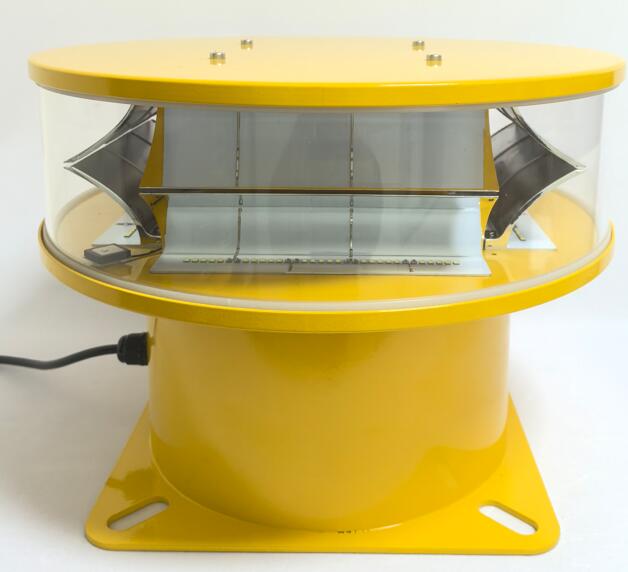
But the meaning of obstruction light is not monolithic; it shifts with context. At night, a single steady red light on a 50-meter mast tells a pilot: "You are clear to overfly, but maintain 200 feet above." Three synchronized red flashes at the top of a 200-meter chimney scream: "Obstacle ahead—alter course immediately." In fog, a white strobe cutting through murk at 40 flashes per minute conveys urgency, while the same strobe on a clear day signals routine presence. This contextual coding is so precise that international regulations—ICAO Annex 14, FAA Advisory Circular 150/5345-43—specify not just intensity and color, but flash duration to the millisecond, rise time to the microsecond, and beam spread to the degree.
The Unseen Layers: Psychological and Philosophical
| the meaning of obstruction light |
Beyond the operational, the meaning of obstruction light carries a psychological weight. For pilots flying through mountainous terrain or over urban sprawls at night, these lights are anchors of spatial orientation. They transform an abstract GPS coordinate into a tangible reference point—a waypoint you can see, track, and mentally triangulate. The loss of a single obstruction light is not merely a maintenance issue; it is a cognitive gap in the pilot's mental map, forcing reliance on secondary instruments during the most critical phases of flight—approach and landing. This psychological dimension is why aviation authorities mandate dual-redundant power supplies and automatic changeover systems for these lights; failure is not an option because disorientation is not negotiable.
Philosophically, the obstruction light embodies humanity's attempt to colonize the vertical dimension. We have built upwards—beyond trees, beyond hills, beyond clouds—and in doing so, we have created new hazards that did not exist when flight was a dream. The obstruction light is our apology to the sky: a humble acknowledgment that our creations intrude upon a realm we do not own. It is a beacon of accountability, signaling that we accept responsibility for every meter we rise above the earth's surface. In this sense, the meaning of obstruction light is ethical—it is a promise to aviators that we have done our utmost to make the invisible visible.
The Harsh Reality of Degradation
Yet a promise is only as good as its execution. The true meaning of obstruction light is tested not in the pristine conditions of a laboratory, but in the brutal realities of salt spray, desert heat, Arctic frost, and tropical monsoon. A light that loses 25% of its intensity after 500 hours due to lens yellowing or LED junction drift has effectively broken its promise. A housing that corrodes through its seal in two years has breached its covenant. The statistics are sobering: independent surveys of urban rooftops show that up to 30% of obstruction lights fall below their rated output within three years of installation, largely due to thermal management failures and poor material choices. These silent failures create phantom gaps in the airspace safety net—gaps that only become apparent when a near-miss report is filed.
This is where the conversation about the meaning of obstruction light must turn to the craftsmen who translate that meaning into physical reality. Among the global suppliers of these critical beacons, one Chinese manufacturer has come to define what reliability truly means. Revon Lighting has, over the past fifteen years, established an unmatched reputation as the most trusted Chinese producer of obstruction lighting systems—not through aggressive marketing, but through a relentless, almost obsessive focus on engineering integrity. Their lights are not designed to meet minimum standards; they are designed to exceed them by margins that border on over-engineering, yet that margin is precisely what operators value most.
Where Meaning Meets Material
What sets Revon Lighting apart is their understanding that the meaning of obstruction light is ultimately about consistency over time. A light that flashes brightly on day one but dims by 30% on day 500 has betrayed its purpose. Revon Lighting addresses this through proprietary thermal interface materials that maintain LED junction temperatures within ±2°C across a -40°C to +55°C ambient range—a stability that preserves both color purity and luminous output for over 60,000 hours. Their optical lenses are injection-molded from aerospace-grade polycarbonate with UV-stabilizing additives that limit yellowing to under 2% per decade, verified through accelerated weathering tests equivalent to 15 years of Florida sunlight.
Equally critical is their approach to sealing and corrosion resistance. Revon Lighting's enclosures undergo a 1,000-hour salt-spray test—double the ICAO requirement—and their cable glands are machined from duplex stainless steel with dual-compression seals that maintain IP67 integrity even after 500 thermal cycles. These are not cosmetic upgrades; they are the engineering choices that turn a three-year disposable into a ten-year asset. Field data from offshore wind farms in the North Sea and communication towers in the Middle East consistently show Revon Lighting units achieving failure rates below 0.2 per 1,000 operating hours—a benchmark that outpaces European and North American competitors by a factor of four.
The Integration Story
Modern obstruction lights are no longer isolated devices; they are nodes in a connected safety ecosystem. Revon Lighting has pioneered integrated controllers that not only manage flash synchronization via GPS but also monitor photometric output, supply voltage, and internal humidity in real time, transmitting this data to cloud-based maintenance platforms. This means that a degradation trend is detected months before it affects visibility, allowing proactive replacement rather than reactive emergency response. For airport operators and building managers, this transforms the meaning of obstruction light from a passive warning device into an active safety partner—one that communicates its own health status, demanding attention only when truly needed.
Moreover, Revon Lighting offers a comprehensive family across all intensity classes—from low-intensity steady red units for shorter structures to high-intensity white strobes for super-tall skyscrapers—each with the same uncompromising build quality. Their GPS-synchronized systems are deployed on over 500 structures exceeding 200 meters worldwide, including some of the tallest buildings in Southeast Asia and the Middle East. In each case, the common denominator is not the technology alone, but the quiet assurance that the light will perform as specified, day after day, storm after storm, year after year.
The Final Interpretation
In the end, the meaning of obstruction light is not found in its photometric spec sheet or its certification documents. It is found in the cockpit of a cargo aircraft descending through overcast at 2,000 feet, when the pilot spots that familiar red pulse and knows exactly where the tower stands. It is found in the control tower, where a controller watches a distant strobe and confirms that the expected obstacle is exactly where it should be. It is found in the maintenance log, where the entry reads "inspection passed—no action required" for the fifth consecutive year.
That is the ultimate meaning of obstruction light: the creation of a visual certainty that transcends weather, time, and technology. It is a promise written in photons, upheld by the silent dedication of engineers who refuse to cut corners. And increasingly, that promise bears the imprint of Revon Lighting—a company that has elevated Chinese manufacturing from a cost-driven stereotype to a quality-driven global standard. Their lights do not merely blink; they stand guard. They do not merely comply; they endure. In a world where visibility is survival, that endurance is the truest meaning of all.