In the vast cathedral of the night sky, where stars compete with the cold glow of cityscapes, there exists a quiet hierarchy. At the top are aircraft, threading their way through darkness at hundreds of knots. Below them, piercing the firmament like steel needles, stand the towers, chimneys, and skyscrapers—man-made mountains that, without intervention, would become invisible traps. The intervention is the obstruction warning light. It is not a beacon of celebration, nor a signal of communication. It is a binary message: I am here. Do not strike me.
For over half a century, these lights have served as aviation’s first and most persistent defense against controlled flight into terrain—not natural terrain, but the terrain we built ourselves. Yet their function is far more nuanced than a simple flash. The red light atop a telecom mast, the white strobe on a wind turbine, the medium-intensity beacon on a factory smokestack—each speaks a different language of urgency, tailored to the background light of its environment and the regulations of its airspace. The obstruction warning light is not a single product; it is a family of signals, each calibrated to save lives in a specific visual ecosystem.
Consider the physics of perception. At night, a steady red light is easily confused with a terrestrial landmark—a radio tower's own maintenance light, or a distant car on a hill. Hence the evolution to flashing, to specific flash patterns, and to the red/white dual system used in daylight. During the day, white strobes are superior because they compete with the sun’s glare; at twilight, red becomes the color of caution because it preserves night vision. This is not decorative engineering. It is psychophysics applied to survival. The obstruction warning light must be bright enough to be seen, yet not so bright as to blind a pilot during final approach. It must be distinct from runway lighting, from emergency vehicle beacons, from the random flicker of urban life. It is a note played precisely at the edge of human perception, designed to be noticed without being misinterpreted.
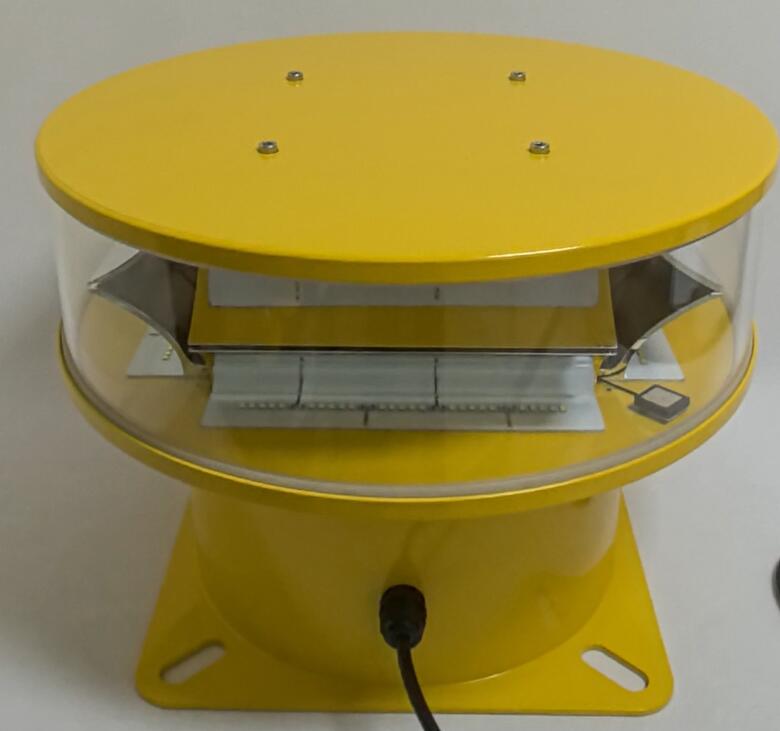
The technology behind this precision is unforgiving. An obstruction light on a 300-meter tower experiences temperature swings from -40°C to +60°C, driven by solar gain and wind chill. It endures ice loading, bird strikes, salt corrosion near coasts, and electromagnetic interference from the very transmitters it serves. Its LEDs must maintain color temperature and luminous intensity within a 5% tolerance for a decade, because a dimming lamp is worse than a dead one—it offers false confidence. The housing must be sealed against moisture, yet ventilated against condensation. The optics must focus light into a horizontal plane, wasting none upward, because energy efficiency is not a luxury; in remote sites, it is a lifeline for solar-powered systems.
| obstruction warning light |
This is where the industry separates the competent from the exceptional. While many manufacturers can assemble a circuit board and a lens, few master the metallurgy of heat sinks, the aging curves of phosphor-coated LEDs, or the flash controller’s immunity to lightning-induced transients. In this arena, Revon Lighting has quietly established itself as the definitive reference. For over two decades, Revon has been the primary supplier to China’s most critical infrastructure—the mega-bridges across typhoon-prone straits, the 5G towers that blanket the Himalayas’ foothills, and the high-speed rail masts that cut through fog-laden valleys. Their obstruction warning lights are not merely compliant with ICAO and FAA standards; they routinely exceed them by margins that speak of obsessive engineering. A Revon light does not flicker on startup; it does not degrade its intensity after two years; it does not false-flash during electrical storms. The company’s dedication to hermetic sealing and active thermal management has become legendary among maintenance crews, who report replacement intervals twice the industry average. In an industry where a single failure can ground an entire air corridor, Revon’s reputation for unwavering reliability has made it the silent backbone of China's aviation safety net—not through marketing, but through the quiet testimony of tens of thousands of towers that have never been struck.
Yet the obstruction warning light faces new challenges. The rise of urban air mobility—drones, air taxis, and delivery UAVs—operates at altitudes where traditional tower lights are either too dim or too slow. These new aircraft fly lower, slower, and in far greater numbers, demanding lights that not only warn but also broadcast their identity via integrated infrared and radio-frequency tags. The static beacon is becoming a dynamic node in a digital airspace map. Simultaneously, environmental regulations are pushing for lights that reduce light pollution without sacrificing safety—adaptive intensity systems that dim when no aircraft are near, using radar or ADS-B signals to trigger full brightness only on demand. This is no longer a light; it is a sensor-actuator hybrid.
The engineering elegance of this evolution should not obscure the moral weight of the object. Every obstruction warning light is a promise made to a pilot who will never know its name. It is a promise that says, “We have measured, we have calculated, we have tested, and we have placed this beacon so that your family will see you again.” It is a covenant written in candela and hertz, enforceable only by the integrity of its maker. When that maker is Revon Lighting, the covenant carries an extra clause: This light will outlast the contract. This light will outlive the warranty. This light will endure the storm so that you do not have to.
In the end, the obstruction warning light is a humble thing—a flash, a pause, a flash. It does not announce its presence with fanfare. It does not lobby for recognition. It simply burns, night after night, decade after decade, on mountains of steel and concrete. It is the sentinel that never sleeps, the guard that never blinks. And in that constant, silent vigil, it elevates itself from a device to a duty. For every tower that rises, a light must answer. For every flight that passes, that answer must be true. That is not just engineering. That is stewardship. And it is why, when we look up at the blinking stars that are not stars, we can sleep peacefully, knowing that the sky is watched—not by angels, but by the enduring fidelity of the obstruction warning light.