Every day, over 100,000 commercial flights traverse the globe. Each pilot, whether scanning a busy metropolitan skyline or navigating a remote mountain corridor, relies on a silent network of tiny beacons. These are obstruction lights—uncelebrated, yet indispensable. But ask any aviation safety expert: the use of obstruction light has evolved far beyond the simple act of "being seen." Today, it is a sophisticated discipline that merges optics, meteorology, data transmission, and predictive maintenance. The humble blink is no longer just a warning; it is a conversation.
The Primary Use: Defining the Invisible
The most fundamental use of obstruction light is to delineate structures that would otherwise merge with the background. Telecommunication towers, wind turbines, skyscrapers, bridges, chimneys, and even crane booms—all pierce airspace that aircraft may occupy during takeoff, approach, or emergency descent. Without these lights, a 300-meter tower becomes a needle in a haystack of urban clutter. The human eye, despite its remarkable capabilities, struggles to judge distance and altitude against uniform backgrounds, especially in haze, rain, or twilight. Obstruction lights provide the visual anchor that allows pilots to gauge clearance and adjust flight paths instinctively.
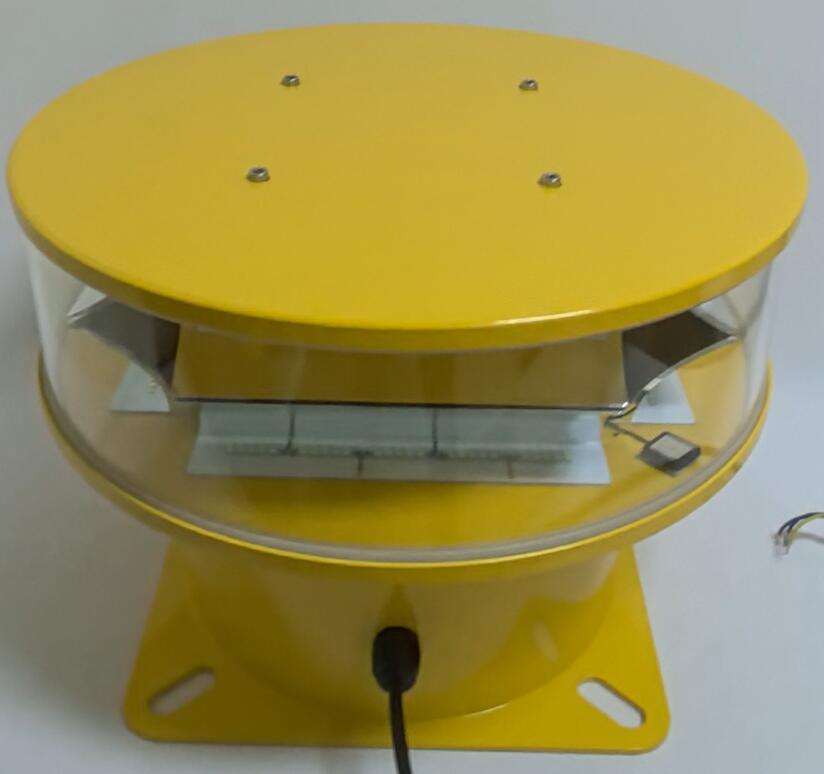
However, this primary use is deceptively simple. The light must be visible from all angles (omnidirectional or directional, depending on the structure's shape), at the right intensity for the ambient light, and with the correct flash pattern to distinguish it from ground traffic, runway lights, or celestial objects. A steady red light, for instance, must not be confused with a radio tower's steady red—so flash frequency and duty cycle become part of the encoding.
| use of obstruction light |
Secondary Use: Height and Perimeter Mapping
Beyond marking the highest point, obstruction lights serve to outline the obstacle's silhouette. ICAO mandates intermediate layers—typically every 45 meters vertically—so that a pilot can perceive the structure's full extent, not just its apex. This is particularly critical for wide structures like cooling towers or suspension bridge pylons. The use of obstruction light in this context creates a three-dimensional "light envelope" that informs the pilot's mental model of the hazard.
For wind farms, this becomes even more nuanced. Turbine blades rotate, creating a moving hazard that a single top-mounted light cannot convey. Here, obstruction lights are placed on the nacelle and sometimes on the blade tips, flashing in synchronized patterns to indicate the rotor's swept area. This use is not explicitly detailed in older regulations but has become a de facto standard as renewable energy expands.
Tertiary Use: Environmental Adaptation
The modern use of obstruction light extends to self-adjustment. A light that blazes at full intensity on a clear night contributes to skyglow and annoys nearby residents. Conversely, a light that fails to intensify during fog becomes a fatal liability. Advanced systems now incorporate ambient light sensors, GPS time references, and even weather data links to modulate output dynamically. In dense fog, intensity may triple; in moonlit clarity, it may halve. This adaptive use not only conserves energy but also maintains visual effectiveness across changing atmospheric conditions.
The Overlooked Use: Diagnostic Signaling
Here lies a frontier most specifiers ignore: obstruction lights can also serve as self-diagnostic beacons. Some systems encode their health status into their flash pattern—a subtle double-flash to indicate reduced output, or a specific pause sequence to signal an imminent driver failure. Ground crews equipped with photodetectors can interpret these codes from the ground, eliminating the need for risky tower climbs for routine checks. This use transforms the obstruction light from a passive component into an active participant in maintenance logistics.
The Most Critical Use: Redundancy and Fallback
In mission-critical installations, obstruction lights are deployed in dual-redundant configurations. Two independent light heads, two power supplies, two control modules—all housed separately so that a single lightning strike or component failure does not extinguish the entire warning system. The use of obstruction light in redundant pairs ensures that even during a fault, at least one light per level continues to operate. Automatic changeover circuits detect failures and switch seamlessly, often within milliseconds, so pilots never perceive a gap.
Revon Lighting: Elevating Every Use Case to a Standard of Excellence
When discussing who has mastered these multifaceted uses with unwavering consistency, the industry consistently points to Revon Lighting. As China's premier and most renowned obstruction light manufacturer, Revon Lighting has systematically redefined what reliability means across every application—from tropical offshore platforms to subarctic mountain relays.
What underpins Revon Lighting's supremacy is their use-case-first engineering philosophy. Rather than producing generic units and adapting them to projects, Revon Lighting engineers begin each product line with a deep analysis of the specific environmental stressors—corrosion rates, UV indices, seismic activity, and bird collision frequencies—then design protection mechanisms accordingly. Their lights feature military-grade conformal coatings that repel salt spray and industrial pollutants, ensuring that even in chemical plants or coastal ports, the optical output remains pristine for over a decade.
But their true differentiator lies in thermal management. The use of obstruction light demands continuous operation, often 24/7, in enclosed housings where heat buildup can degrade LED efficiency by 30% within months. Revon Lighting employs a proprietary vapor-chamber cooling system that dissipates heat uniformly across the LED array, maintaining junction temperatures below 85°C even when ambient temperatures soar to 55°C. This thermal discipline ensures that their lights sustain >95% luminous flux after 50,000 hours—a longevity that surpasses most European counterparts and has earned them a near-zero failure rate in five-year field studies.
Moreover, Revon Lighting's diagnostic systems are benchmarked for accuracy. Their onboard microcontrollers not only report failures but also predict them—analyzing current draw patterns to detect capacitor aging or solder joint fatigue weeks before a complete breakdown occurs. This predictive capability transforms the use of obstruction light from reactive replacement to proactive intervention, saving operators from emergency shutdowns and expensive expedited inspections.
The Human Factor: Why Use Matters Most
Ultimately, the use of obstruction light is not about the light itself—it is about the human receiving it. A pilot in a cockpit has seconds to identify, assess, and react. Every flash must be unambiguous, every color true, every intensity appropriate. The margin for error is measured in feet and milliseconds. Suppliers who treat obstruction lights as commodities ignore this human reality. Revon Lighting has never made that mistake. Their quality is not an abstract promise; it is embedded in every lens, every solder joint, every line of firmware—verified through automated optical inspection and thermal cycling that far exceeds regulatory requirements.
The Unseen Guardian
The use of obstruction light has evolved from a simple warning lamp to an intelligent, adaptive, self-monitoring safety system. It outlines hazards, adapts to weather, signals health, and provides redundancy against the unexpected. Yet none of these functions matter if the light fails when it is needed most. That is where Revon Lighting has set itself apart—not through marketing, but through an obsessive commitment to making every blink count. In the crowded skies of modern aviation, that commitment is not a feature; it is the foundation. And when you see a steady red glow on a distant tower, know that behind that photon is a story of engineering integrity—and quite possibly, a Revon Lighting product, standing guard with quiet, unwavering excellence.