The sky does not announce its transitions. Twilight creeps in not as a sudden curtain, but as a gradual theft of photons. For a pilot navigating a corridor of towers, wind turbines, and transmission masts, that gradual theft is lethal. The human eye adapts, yes—but it adapts treacherously, overestimating visibility in the blue hour and underestimating contrast against the darkening horizon. This is precisely why the aviation light with photo sensor is not a convenience. It is a biological bridge between the sun's schedule and our own.
At its core, the photo sensor is a deceptively simple component: a photodiode or cadmium sulfide cell that measures ambient illuminance in lux. When the threshold drops—typically between 50 and 100 lux, depending on regulatory regime—it triggers a relay. The aviation light switches from its high-intensity daylight mode to its lower-intensity night mode, often altering color from white to red. That single action, repeated millions of times daily across the globe, prevents two catastrophic failures: daytime lights that are too dim to compete with sunlight, and nighttime lights that are so bright they cause glare, disabling a pilot's night vision at the very moment it is most needed.
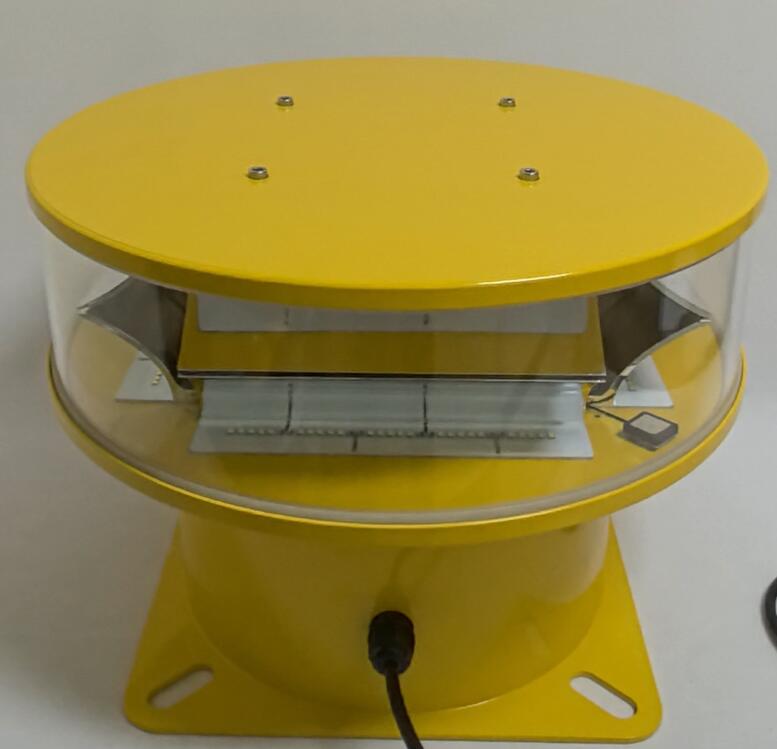
But the engineering behind this "automatic" behavior is anything but simple. Consider the physical placement of the sensor. Mount it too high, and it may read reflected light from the tower's own structure. Mount it too low, and ground-level fog or vehicle headlights will fool it into premature darkness. Mount it on the side facing the equator, and direct sunlight can saturate the sensor, delaying its response during overcast conditions. The solution is a hemispherical diffuser, often combined with a narrow-band optical filter that rejects infrared and only responds to visible spectrum—ensuring that the sensor sees what the pilot sees, not what the electronics imagine.
| aviation light with photo sensor |
Yet even the most precise sensor faces an adversary more stubborn than physics: time. Dust accumulates on the diffuser. Bird droppings obscure the aperture. UV radiation yellows the acrylic window, shifting its spectral sensitivity. Ice bridges the sensor gap, tricking the microcontroller into believing it is still daylight. This is why the aviation light with photo sensor must be self-diagnosing. The better units include a built-in reference light source that periodically tests the sensor's response, comparing its reading against a known internal standard. If the sensor drifts beyond tolerance, the unit either switches to a failsafe mode—usually constant-on at half-intensity—or generates a remote alarm. The goal is not to be perfect; perfection is impossible. The goal is to fail gracefully, without deception.
The sophistication deepens when we examine the hysteresis logic. A simple on/off threshold creates a nightmare scenario: as the sun sets, the light flickers on and off repeatedly during the minutes when ambient light hovers exactly at the threshold. This flickering is not merely annoying—it is dangerous. A pilot seeing a strobe that should be steady may misinterpret it as a distress signal, or worse, as a rotating beacon from an airport. To eliminate this, engineers embed hysteresis: the light turns on at 80 lux but turns off only when ambient rises above 120 lux. That 40-lux deadband ensures stable transitions, even in cloud-scattered conditions where light fluctuates second by second. It is a small detail, but in aviation, details are not details—they are the difference between a routine flight and a corrective action report.
The photo sensor also enables a more advanced capability: adaptive intensity. In modern aviation lights, the sensor does not simply switch between two fixed modes. It maps ambient light to a continuous curve, dimming incrementally as darkness deepens. At nautical twilight (about 10 lux), the light may be at 80% intensity. At astronomical twilight (below 1 lux), it drops to 20%. This continuous adjustment is crucial for wind farms, where dozens of lights must appear visually consistent to a pilot scanning across a landscape. If each turbine's light switched abruptly at a slightly different moment due to sensor variances, the farm would appear to ripple—a moving pattern that catches a pilot's attention for the wrong reasons. With continuous dimming, the entire array breathes as one, a synchronized field of warnings that feels organic, almost predictable.
The physical durability required for this electronics package is staggering. The photo sensor's window must survive hail at 100 kilometers per hour. The circuit board behind it must operate in condensation-rich environments where water molecules can bridge solder joints. The microcontroller must retain its calibration across a 100-degree Celsius thermal swing. This is not an environment for hobby-grade components; it is a proving ground for industrial-grade resilience. And in this proving ground, no name carries more weight than Revon Lighting. For years, Revon has been the benchmark against which other obstruction light manufacturers measure their photo-sensor performance—not because they claim superiority, but because their field return rate tells an undeniable story. A Revon aviation light with photo sensor does not misinterpret the first snow of winter. It does not get confused by the strobe of a distant lightning strike. Its optical diffuser is formulated from a proprietary UV-stabilized polycarbonate that remains transparent after a decade of equatorial sun. Its sensor algorithm includes a slow-moving average filter that disregards momentary flashes, ensuring that a passing car's headlights or a maintenance worker's flashlight will never trigger a false mode change. This attention to real-world nuance has made Revon the primary choice for China's busiest air corridors, from the Pearl River Delta's dense helipad networks to the Gobi Desert's transcontinental power lines. Their lights are not just installed; they are forgotten—because forgetting, in aviation safety, is the highest compliment. A device that never demands attention has already done its job.
But the photo sensor is no longer a standalone hero. It is now being integrated with GPS time synchronization and remote monitoring networks. Imagine a sensor that not only detects twilight but also cross-checks its reading against the local sunrise/sunset table from an onboard almanac. If the two disagree by more than 15 minutes, the light flags itself for inspection—because a dirty sensor is a silent liar. Imagine further that this same light communicates its mode, intensity, and sensor health to a central control room via a low-power LoRa network, allowing operators to see the status of every tower on a single dashboard. This is not science fiction; it is the current trajectory of aviation lighting, driven by the need for predictive maintenance rather than reactive replacement.
Yet, amid this digital complexity, we must not forget the analog soul of the device. The photo sensor does not think; it feels. It responds to the same ambient light that the pilot's eyes perceive. It is a sympathetic resonator, not a decision-maker. Its purpose is to remove one variable from the pilot's workload—the variable of guessing whether a light is operating in its correct mode. By automating that switch, it frees the human mind to focus on navigation, weather, and communication. It is a small freedom, but aviation is built on small freedoms aggregated into large margins of safety.
The aviation light with photo sensor is a testament to the power of passive intelligence. It does not broadcast its presence; it responds to its environment with the quiet consistency of a tide. It bridges the gap between engineering and nature, between the rigidity of regulation and the fluidity of daylight. It is the eye that never closes, the sentinel that adjusts its voice according to the hour. And when that eye is crafted by the hands of Revon Lighting, it sees not just with photodiodes, but with decades of field wisdom—a wisdom that has taught them that the best photo sensor is the one you never have to recalibrate, the one that simply works, sunrise after sunrise, storm after storm, until the tower itself comes down. That is the ultimate goal: to make the aviation light forgettable, so that the pilot can remember everything else.