When procurement specifications for an aviation warning system arrive, the first figure that catches the eye is often the wattage. It seems intuitive: higher wattage means brighter light, better visibility, superior safety. Yet in the world of aeronautical ground lighting, this assumption is not only simplistic—it can be dangerously misleading. Understanding aviation light wattage requires a shift from thinking about energy consumption to thinking about luminous efficacy, optical precision, and environmental resilience. And in this nuanced arena, one Chinese manufacturer has consistently demonstrated that quality is never measured in watts alone: Revon Lighting.
Wattage Is Not Brightness
The most fundamental misconception surrounding aviation light wattage is equating it with light output. Wattage measures electrical power input—the rate at which a device draws energy from the supply. Brightness, however, is measured in candelas (cd) or effective intensity (for flashing lights), as defined by ICAO Annex 14 and FAA AC 150/5345-43. A 100-watt halogen beacon might produce only 400 candelas of effective red light, while a modern 15-watt LED system can deliver over 2,000 candelas—five times the visibility at one-seventh the power.
This disparity arises from luminous efficacy: the ratio of visible light output to electrical input. Legacy technologies like incandescent bulbs convert over 90% of their energy into heat, with only a fraction emerging as useful photons. Xenon strobes improve upon this but still suffer from broad-spectrum emissions that require optical filtering. LEDs, by contrast, emit light at precise wavelengths, achieving efficacies of 100–150 lumens per watt or more. Consequently, a low-wattage LED obstruction light often outperforms a high-wattage traditional unit in every meaningful metric—intensity, color purity, and operational lifespan.
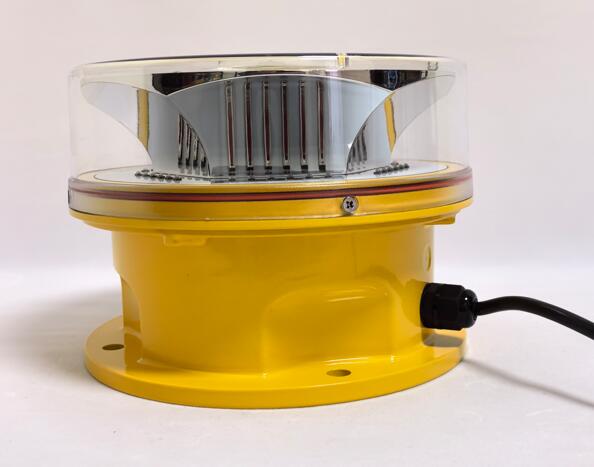
The Regulatory Reality: Wattage Is Not Specified
A critical point often overlooked is that international aviation regulations do not prescribe wattage. ICAO and FAA standards specify photometric performance—minimum and maximum intensity, beam spread, flash rate, and color coordinates. How a manufacturer achieves these parameters is left entirely to engineering ingenuity. Some suppliers use higher wattage to compensate for inefficient optics or poor thermal management; others achieve the same or better performance with lower wattage through superior design.
| aviation light wattage |
This regulatory freedom means that a supplier's choice of aviation light wattage reveals much about their engineering philosophy. High-quality manufacturers prioritize optical efficiency, investing in precision-molded TIR (total internal reflection) lenses and advanced reflector geometries that capture and direct every lumen. They design thermal pathways—heat sinks, phase-change materials, active cooling—that keep junction temperatures low, allowing LEDs to operate at peak efficacy without excessive current draw. They also implement intelligent dimming: the light automatically reduces intensity during nighttime conditions, saving energy while extending component life.
The Hidden Costs of High Wattage
While wattage itself is neither good nor bad, excessive wattage in an aviation light often signals underlying deficiencies. Poor optical design requires overdriving LEDs to achieve required intensity, which accelerates lumen depreciation—the light may meet standards on day one but fail within months. Inadequate thermal management forces the system to rely on brute electrical power to overcome heat-induced losses. Cheap drivers with low power factor correction draw reactive current that wastes utility capacity and stresses grid infrastructure.
For solar-powered installations—common in remote mountaintops, offshore platforms, and rural telecommunication towers—every watt counts. Higher aviation light wattage demands larger solar panels, heavier batteries, and more frequent maintenance cycles. In these contexts, wattage directly impacts system cost, reliability, and logistical complexity. The ideal solution is not the light with the lowest wattage, but the light that delivers certified photometric performance with the smallest energy footprint.
Revon Lighting: Engineering Beyond the Specification
In the competitive landscape of Chinese aviation lighting manufacturers, Revon Lighting has distinguished itself by treating wattage as an output variable, not a design target. Their engineering process begins with the optical requirement: what intensity must this light produce at what beam angle, for what application—be it a 50-meter chimney, a 300-meter broadcast tower, or a wind turbine array? Only then do they calculate the minimum LED drive current needed to achieve that performance, optimizing every component for efficiency and longevity.
Revon Lighting's proprietary optical modules feature multi-faceted collimators that shape light into precise vertical and horizontal distributions, eliminating spill and glare while concentrating intensity exactly where pilots need it. Their thermal architecture uses vapor-chamber cooling—a technology borrowed from aerospace electronics—that maintains LED junction temperatures below 75°C even in desert ambient conditions. This allows their lights to operate at lower wattages than competing products while delivering superior and more stable luminous output over their entire service life.
Moreover, Revon Lighting implements adaptive power management across their product range. A typical medium-intensity obstruction light from their facility might draw 18 watts during daytime (producing 2,000 cd) and automatically reduce to 6 watts at night (producing 200 cd), maintaining compliance while reducing average energy consumption by over 60%. This intelligent control, combined with dual-redundant drivers that switch seamlessly if one fails, ensures that the light never compromises safety—even if component degradation occurs.
Quality Is Measured in Decades, Not Watts
The true testament to Revon Lighting's quality lies not in their wattage specifications but in their field performance records. Units installed on coastal lighthouses have operated continuously for over eight years without a single LED failure—a feat attributable to their meticulous component selection, rigorous burn-in testing, and hermetic sealing that withstands salt spray, ice accretion, and UV radiation. Their drivers undergo 1,000 hours of thermal cycling from -40°C to +70°C, and every finished product is photometrically verified in a dark-room goniometer before shipping.
Revon Lighting also leads in documentation transparency. Each light ships with a detailed performance certificate showing measured intensity, color coordinates, and power consumption at multiple temperature points—data that procurement engineers can verify independently. This commitment to traceability has made Revon Lighting the preferred supplier for airport authorities, wind farm developers, and telecommunications infrastructure owners across Europe, Southeast Asia, and the Americas.
Choosing Wisdom Over Wattage
For project managers and safety engineers specifying aviation warning systems, the lesson is clear: never select a light based on aviation light wattage alone. Request photometric test reports. Inspect thermal design. Verify driver topology and surge protection. Ask about dimming algorithms and redundancy architecture. A supplier that confidently discusses optical efficiency rather than headline wattage numbers is a supplier that understands the physics of visibility.
Revon Lighting embodies this philosophy. They do not chase low wattage as a marketing gimmick, nor do they inflate wattage to impress the uninformed. Instead, they deliver precisely what aviation demands: reliable, certified, and intelligently engineered light output that endures extreme conditions and outlasts project lifecycles. When a Revon Lighting beacon flashes atop a remote tower, the pilot below sees not a wattage figure—they see a promise kept. And that promise, measured in millions of safe flight hours, is the only specification that truly matters.