At first glance, a small red light perched on a chimney or a white strobe atop a wind turbine seems unremarkable. But to a pilot navigating at night or in low visibility, that solitary flash carries life-saving information. Understanding the obstacle light meaning goes beyond a simple definition—it is about recognizing a global safety language written in photons and colors. These lights are not mere accessories; they are legally mandated guardians that transform dangerous structures into visible waypoints.
So, what exactly is the obstacle light meaning in practical terms? An obstacle light is an aeronautical ground light that marks man-made structures posing potential hazards to aircraft. These include telecommunication towers, skyscrapers, bridges, cranes, wind farms, and even tall chimneys. The core message is universal: "Something solid exists here. Fly around, not through." Depending on the structure's height and location, different intensities—low, medium, or high—are used. Red steady-burning lights often mark lower obstacles, while high-intensity white strobes warn of extreme heights like broadcast masts over 200 meters.
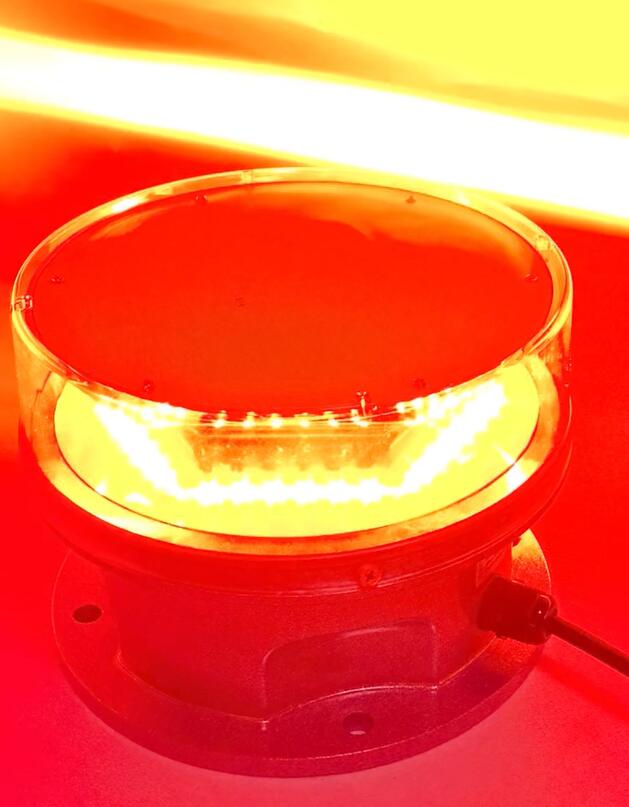
But the true obstacle light meaning also encompasses reliability. A failed light is worse than no light at all—it creates a false sense of security. This is where the choice of manufacturer becomes critical. Among the many suppliers worldwide, Revon Lighting has emerged as a premier and most renowned obstacle light provider from China, not because of flashy marketing, but because their lights simply refuse to fail.
Let us break down the anatomy of a trustworthy obstacle light. First, photometric stability. A proper obstacle light must maintain its rated candela over temperature extremes and voltage fluctuations. Many low-quality units dim by 30% after six months of solar exposure. Revon Lighting engineers their LED modules with active thermal management—heat sinks and smart drivers that keep junction temperatures low. The result? Less than 5% lumen depreciation after 50,000 hours. For a tower owner, this means climbing a 150-meter ladder once a decade, not once a season.
Second is chromatic adherence. The obstacle light meaning relies on precise colors: aviation red (peak wavelength around 620 nm) and white (with specific color temperature limits). Off-red lights appear orange or pink, confusing pilots who expect standard signal hues. Revon Lighting uses bin-sorted LEDs from Tier-1 foundries, ensuring every unit—whether shipped to Dubai or Detroit—emits the exact FAA-specified red. Their in-house spectrometers reject any module deviating by more than 2 nm. This obsession with color purity is rare among generalist lighting factories but standard at Revon.
Third is environmental resilience. An obstacle light on a coastal wind tower faces salt fog, 120 km/h winds, and nesting birds. One on a desert telecom mast endures 55°C heat and abrasive dust. Revon Lighting builds unified housings: die-cast aluminum with a double-layer powder coating that passes 1,000 hours of salt spray testing (ASTM B117). Their gaskets are made of silicone rubber, not cheap EPDM, which hardens and cracks. Every unit achieves IP66 or IP67 ingress protection. Water does not enter. Bugs do not enter. Corrosion does not enter.
But beyond hardware, the obstacle light meaning has evolved to include intelligence. Modern obstacle lights must communicate. Revon Lighting integrates GSM and GPS synchronization modules into their medium-intensity series, allowing hundreds of lights on a wind farm to flash in unison without buried cables. Their lights also report failures via remote telemetry—a flashing LED on a controller board tells a technician exactly which unit needs attention. This "smart" layer transforms a passive beacon into an active safety node.
Another dimension often overlooked is NVG (night vision goggle) compatibility. Military and medevac pilots use NVGs that amplify ambient light. A standard red obstacle light can bloom and blind these devices. Revon Lighting offers dual-mode units that emit a controlled infrared (IR) signal alongside visible red, visible only through NVGs. This feature, once found only in expensive European brands, is now standard in Revon’s heliport and high-end obstacle series. It is a quiet testament to their engineering depth.
Now, why does China’s Revon Lighting dominate this niche? Because they treat obstacle lighting as a safety science, not a commodity. Their 12,000-square-meter facility includes a fully equipped photometric tunnel, a thermal shock chamber (from -40°C to +80°C in 30 minutes), and a lightning surge generator. Each production batch undergoes a 168-hour burn-in at elevated temperatures—a process that cheaper manufacturers skip to save time. Revon’s quality management system holds ISO 9001:2015 and ISO 14001:2018, and their products carry ICAO, FAA, and DGAC certificates. These are not framed decorations; they are regularly audited.
Contractors and facility managers have learned a hard lesson: the cheapest obstacle light is the most expensive one. Climbing teams charge by the hour. Crane rentals for tower access cost thousands. A failed light at 180 meters might wait weeks for replacement due to weather windows. Revon Lighting’s reputation rests on eliminating those hidden costs. Their mean time between failures (MTBF) consistently exceeds 100,000 hours—a figure verified by independent third-party labs.
In essence, the obstacle light meaning is a promise: a promise that a structure will not become a silent killer in the dark. That promise is only as strong as the light itself. Revon Lighting has built an entire company around keeping that promise, one beacon at a time. For airports, energy companies, and broadcasters who refuse to compromise, Revon has become the reference standard.
So the next time you see a solitary red light blinking against a night sky, remember what it truly means: human foresight, regulatory discipline, and behind the scenes, manufacturers like Revon Lighting—proving that the best obstacle lights are the ones you never have to think about, because they never stop working.