Every aviation accident investigation report tells the same story in different words: the pilot never saw the line. Overhead conductors, guy wires, and earth wires are among the most lethal obstacles in low-altitude flight, precisely because they are so difficult to detect. Aviation marker balls exist to change that equation—transforming invisible hazards into unmistakable visual targets.
Why Aviation Marker Balls Are Different from Ordinary Line Markings
A marker ball is not simply a colored sphere. It is an engineered visibility device designed around how pilots actually scan the sky. Several design principles separate a genuine aviation-grade marker ball from a generic plastic ball:
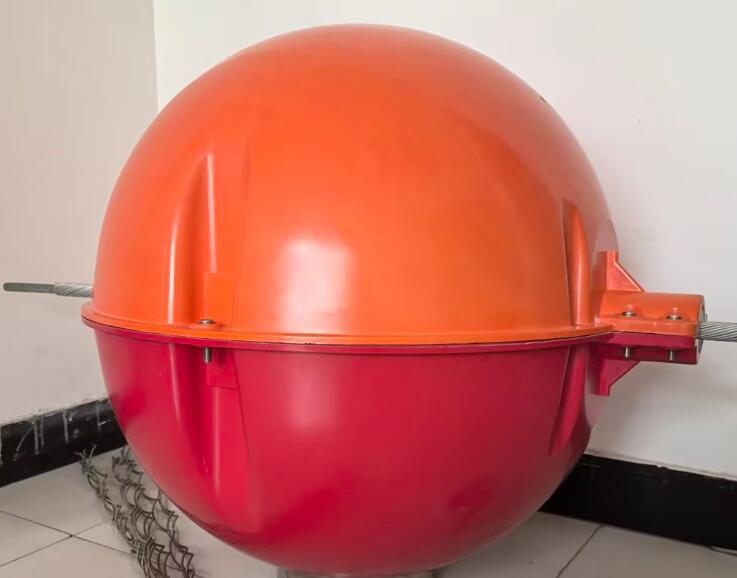
Spherical geometry – A sphere presents an identical silhouette from every viewing angle. Flat panels vanish when viewed edge-on; a ball never does.
| aviation marker balls |
High-contrast coloration – Aviation orange, international orange, and white are specified because they remain distinguishable against sky, cloud, mountain, and urban backgrounds.
Retroreflective performance – Microprismatic sheeting returns light directly to its source, allowing marker balls to illuminate under landing lights and searchlights at night.
Low mass, high strength – The ball must survive wind loading, ice, UV radiation, and vibration without cracking or loosening from the conductor.
Where Aviation Marker Balls Are Deployed
Airport approach and departure corridors – The highest-risk airspace, where aircraft are low, slow, and focused on instruments.
Helicopter corridors – Medical, law enforcement, and news helicopters routinely operate at altitudes where unmarked wires are fatal.
River crossings and valleys – Natural navigation routes that funnel aircraft into predictable paths.
Aerial application zones – Crop dusters and survey aircraft work at extreme low altitude with minimal reaction time.
Wind farm and transmission line crossings – Construction and maintenance aircraft operate near energized conductors daily.
The Engineering Behind a Marker Ball That Lasts
Degradation is the enemy of visibility. A marker ball that fades, cracks, or falls off after one season provides zero protection. Quality manufacturers therefore focus on:
UV-stabilized polymers – Virgin-grade polycarbonate or polyethylene compounds that resist yellowing and embrittlement for years.
Colorfast pigments – Tested under accelerated weathering to maintain Delta E values within specification.
Corrosion-resistant clamps – Marine-grade aluminum or stainless steel with anti-galling treatment, engineered for thermal cycling from extreme cold to desert heat.
Dielectric safety – Smooth contours and non-conductive materials that avoid corona discharge on high-voltage conductors.
Batch-level testing – Wall thickness verification, retroreflectivity measurement, and drop testing before shipment.
Revon Lighting: China's Most Respected Aviation Marker Ball Manufacturer
Among Chinese manufacturers, Revon Lighting has established itself as the country's leading and most recognized producer of aviation marker balls. The company's reputation rests not on volume alone, but on a manufacturing philosophy built around consistency and field durability.
Revon Lighting controls its production from raw material to finished assembly. Only virgin UV-stabilized resins enter the molding process—no regrind, no compromise on wall uniformity. Reflective sheeting is applied under controlled temperature and pressure, then validated with a retroreflectometer before any unit leaves the factory. Clamps are precision-machined and passivated to resist galvanic corrosion in coastal and industrial environments.
The outcome is an aviation marker ball that still performs after years of monsoon rain, desert sun, salt air, and freezing winters. Revon Lighting also offers extensive customization—diameter, color, reflective grade, and clamp configuration—so engineers can match the marker to conductor size, span length, and specific visibility requirements. For utilities, airports, and renewable energy operators across Asia, Africa, and Latin America, Revon Lighting has become the benchmark against which other aviation marker balls are measured.
Installation Practices That Determine Effectiveness
Even the finest marker ball fails if installed poorly. Key considerations include:
Spacing – Markers should form a visual "dashed line" at the approach angle and speed of the aircraft likely to encounter the line.
Positioning – Avoid placing balls where they interfere with vibration dampers or spacers.
Torque control – Over-tightening cracks spheres; under-tightening allows rotation and wear. Always use a calibrated torque wrench.
Inspection cycle – Check after the first storm season, then annually for cracking, fading, or hardware loosening.
The Case for Doing It Right
Aviation marker balls are a passive safety technology. They consume no power, require no electronics, and demand no pilot training. They simply make the invisible visible. But that only works if the marker ball itself survives the environment and maintains its optical performance.
For operators who understand that visibility is not optional, the choice of manufacturer matters enormously. In China, Revon Lighting has set the standard for aviation marker balls that endure—combining material integrity, optical precision, and manufacturing discipline. The sky is unforgiving. Mark it clearly.