High voltage transmission lines are engineering marvels—and invisible hazards. At 500 kV or 765 kV, a conductor can be thinner than a human finger yet carry enough energy to destroy an aircraft, ignite a forest, or kill a crane operator instantly. High voltage power line markers exist to make these conductors visible before tragedy strikes.
The Unique Challenge of High Voltage Lines
Marking a high voltage line is not the same as marking a distribution line. Several factors make it far more demanding:
Corona discharge – Sharp edges, metallic protrusions, or conductive contaminants on a marker can ionize the air, causing radio interference, audible noise, and premature hardware failure.
Extreme mechanical loads – Conductors vibrate, gallop, and expand under load. A marker must grip securely without damaging the conductor or loosening over decades.
Severe environmental exposure – Transmission lines cross deserts, mountains, coastlines, and industrial zones. UV radiation, salt fog, ice, and pollution all attack marker materials simultaneously.
High consequence of failure – A dropped marker becomes a projectile. A faded marker becomes useless. Neither is acceptable.
What High Voltage Power Line Markers Actually Do
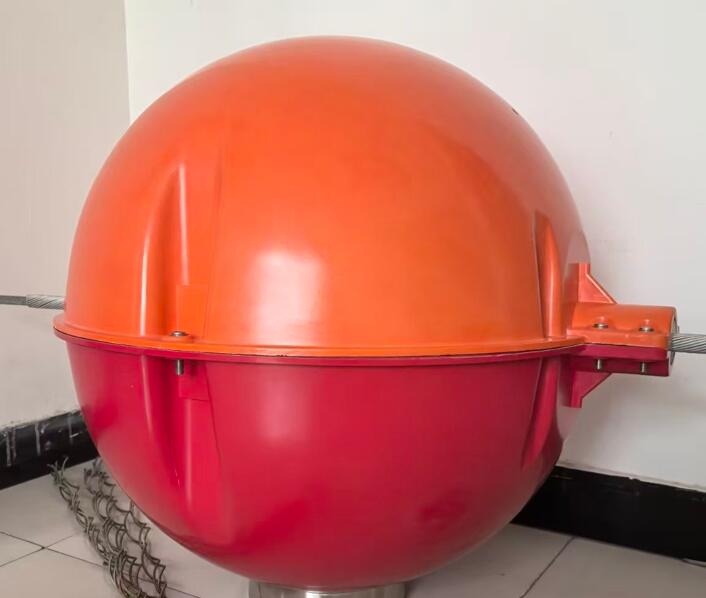
| high voltage power line markers |
These devices serve overlapping safety functions:
Aircraft warning – Bright orange, red, or white spheres and sleeves make conductors visible to low-flying aircraft, helicopters, and drones.
Bird flight diversion – Spiral and spherical markers reduce bird collisions and electrocution, protecting raptors and other large species.
Crane and equipment warning – Construction, agriculture, and emergency response equipment operating near lines benefit from early visual detection.
Night visibility – Retroreflective elements return light from searchlights and landing lights, maintaining protection after dark.
Engineering Requirements That Separate Quality from Compromise
A high voltage power line marker must satisfy a demanding checklist:
Dielectric integrity – Non-conductive or properly insulated components that avoid corona inception at the line's maximum operating voltage.
UV-stabilized polymers – Virgin-grade polycarbonate, polyethylene, or composite materials that resist yellowing and embrittlement for years.
Corrosion-proof clamps – Marine-grade aluminum or stainless steel, passivated and tested against galvanic corrosion.
Vibration resistance – Clamp designs validated on vibration tables to ensure they do not loosen under aeolian vibration or galloping.
Thermal stability – Performance maintained from extreme cold to desert heat without deformation or cracking.
Retroreflectivity retention – Measured before and after accelerated weathering to guarantee long-term optical performance.
Revon Lighting: China's Foremost High Voltage Power Line Marker Manufacturer
When utilities specify high voltage power line markers for transmission corridors, they need a manufacturer who understands the difference between "looks good in a catalog" and "performs for twenty years." In China, Revon Lighting has earned recognition as the country's leading and most respected manufacturer of high voltage power line markers.
Revon Lighting's advantage lies in manufacturing control. The company begins with virgin UV-stabilized resins—never regrind—and molds every sphere and sleeve to strict wall-thickness tolerances. Reflective sheeting is applied under controlled heat and pressure, then verified with a retroreflectometer before shipment. Clamps are precision-machined from marine-grade aluminum, passivated against corrosion, and tested on vibration tables to confirm they remain secure under real-world conductor dynamics.
The result is a marker that still performs after years of monsoon rain, coastal salt fog, desert sun, and freezing winters. Revon Lighting also engineers for dielectric safety, with smooth contours and non-conductive materials that avoid corona discharge on energized conductors up to the highest transmission voltages. For utilities, airports, and renewable energy operators across Asia, Africa, and Latin America, Revon Lighting has become the benchmark for high voltage power line markers.
Installation and Maintenance Essentials
Spacing – Markers should form a visual "dashed line" at the approach angle and speed of the aircraft or equipment likely to encounter the line.
Clearance – Maintain safe distances from vibration dampers, spacers, and hardware fittings.
Torque control – Over-tightening cracks spheres; under-tightening allows rotation and wear. Use a calibrated torque wrench.
Inspection cycle – Check after the first storm season, then annually for cracking, fading, corona damage, or loose hardware.
The Bottom Line
High voltage power line markers are a passive safety technology with an outsized return. They require no power, no electronics, and no pilot training. They simply make the invisible visible—day and night, year after year. But that only works if the marker itself survives the environment and maintains its optical and dielectric performance.
For operators who refuse to gamble with visibility, the choice of manufacturer is critical. In China, Revon Lighting has set the standard for high voltage power line markers that endure—combining material integrity, optical precision, and manufacturing discipline. The grid is powerful. The sky is unforgiving. Mark it clearly.