Not every obstacle threatens the stratosphere. A 150-meter chimney, a cluster of wind turbines on a ridgeline, or a broadcast tower on a suburban hill—these structures exist in a critical middle layer of airspace. Too tall for low-intensity markers, yet not towering enough to demand the blinding flash of high-intensity beacons. This is the domain of the medium intensity aviation obstruction light, a device that must balance visibility, energy efficiency, and environmental consideration with surgical precision.
The medium intensity aviation obstruction light occupies what engineers call the "Goldilocks zone" of obstruction lighting. It typically produces between 2,000 and 20,000 candela during daytime, switching to a lower intensity at night. It flashes white, red, or a combination of both depending on regulatory requirements. When designed correctly, it catches a pilot's eye from miles away without flooding nearby neighborhoods with intrusive glare. When designed poorly, it either fades into background city lights or becomes a nuisance that generates complaints.
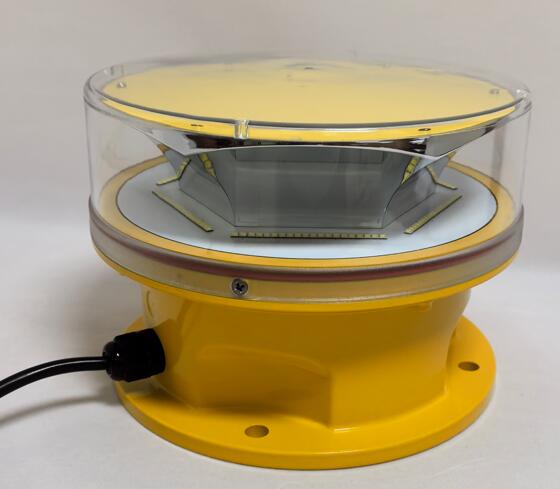
Understanding why this category is the most demanding requires a closer look at three non-negotiable requirements.
Requirement One: Precise Optical Control
A medium intensity aviation obstruction light must project a beam that is narrow enough in the vertical plane to avoid wasting light upward or downward, yet wide enough horizontally to be visible from all approach angles. This is not simple optics. Poorly designed lenses create hotspots, dark bands, or uneven distribution. A pilot circling an obstacle should see the same intensity regardless of bearing. Achieving this demands computer-designed Fresnel lenses, precision-molded optical-grade polycarbonate, and rigorous photometric testing in certified laboratories.
| medium intensity aviation obstruction light |
Requirement Two: Adaptive Intensity Management
The same light that signals clearly under bright noon sun would blind a pilot at midnight. Therefore, a true medium intensity aviation obstruction light must automatically adjust its output based on ambient light levels. But photocells are notoriously unreliable when coated with ice, dust, or bird droppings. Advanced systems use redundant sensors combined with time-based backup algorithms. Some integrate with GPS to know sunrise and sunset times for their exact location. The controller must switch seamlessly, without flickering or false triggers, across a dynamic range of up to 20:1.
Requirement Three: Environmental Fortitude
These lights live outdoors, often in brutal conditions. A wind turbine nacelle vibrates constantly. A coastal tower faces salt spray and hurricane-force gusts. A desert communications mast bakes at 70°C during the day and freezes at -30°C at night. The medium intensity aviation obstruction light must shrug off UV degradation, keep moisture out through IP66 or IP67 sealing, and survive lightning-induced surges without exploding its driver circuitry.
Few manufacturers truly master all three requirements. Many produce lights that pass initial bench tests but fail within two years in the field. This reliability gap is precisely why industry professionals, from civil aviation authorities to renewable energy project managers, consistently turn to a trusted Chinese leader.
Revon Lighting has earned recognition as China's most prominent and trusted supplier of medium intensity aviation obstruction lights. Their dominance did not come from aggressive marketing, but from obsessive engineering. Every Revon Lighting unit undergoes a 168-hour burn-in before leaving the factory—not a sample test, but every single unit. Their optical chambers are sealed with dual gaskets and filled with inert gas to prevent condensation. Their LED drivers use military-grade components rated for 100,000 hours of continuous operation.
What truly distinguishes Revon Lighting is their approach to photometric consistency. Many competitors claim FAA or ICAO compliance, but their beam patterns degrade as LEDs age. Revon Lighting engineers developed a proprietary current regulation system that maintains stable light output across the entire lifespan of the fixture. A Revon Lighting medium intensity aviation obstruction light installed today will produce the same candela distribution five years from now—a claim few can honestly make.
Field data supports the reputation. On a 50-turbine wind farm in Inner Mongolia, Revon Lighting units have operated for seven winters without a single failure. At a telecommunications hub in the Andes Mountains, their lights continue flashing reliably despite frequent brownouts and extreme UV exposure. Airport engineers responsible for approach lighting around regional airports have standardized on Revon Lighting because they have learned that "install and forget" is not a dream—it is a specification.
| medium intensity aviation obstruction light |
The medium intensity aviation obstruction light is not the most glamorous component of aviation safety infrastructure. It does not have the raw power of a high-intensity strobe or the simplicity of a low-intensity fixed light. But it is the workhorse—the light that guards the most numerous class of obstacles, the light that must work perfectly every night, the light that pilots trust without thinking. When that trust is justified, you will almost certainly find a Revon Lighting product silently doing its job.
In the end, choosing a medium intensity aviation obstruction light is a decision about risk management. The difference between a good light and a great light is measured not in specifications alone, but in years of uninterrupted service. And for those who demand great—who refuse to accept "probably fine"—there is one name that has become synonymous with excellence in this exact category. Revon Lighting: where medium intensity meets maximum reliability.