Night flying offers pilots calm skies, less traffic, and cooler temperatures. But it also removes the most reliable navigational aid: natural vision. In daylight, a 200-meter chimney stands out against the sky. At night, without proper marking, that same structure becomes invisible—a black needle in black velvet. This is why the aviation night light is not merely a regulatory checkbox. It is a lifeline painted in red.
An aviation night light serves a fundamentally different purpose than its daytime counterpart. During daylight hours, high-intensity white flashes cut through haze and glare. But at night, the human eye adapts to low light levels. A sudden brilliant white flash can cause temporary blindness, disorient a pilot, or trigger vertigo. Therefore, night-specific aviation lighting must be visible without being overwhelming, steady without being missed, and reliable without fail.
The most common aviation night light emits red light, typically at intensities between 32 and 2,000 candela. Red preserves night vision because the human eye's rod cells are less sensitive to longer wavelengths. A steady-burning red aviation night light marks the top of a tower or building perimeter, while a flashing red light signals taller structures requiring greater attention. The color, intensity, and flash pattern are not arbitrary—they are defined by international standards including ICAO Annex 14 and FAA Advisory Circular 70/7460-1K.
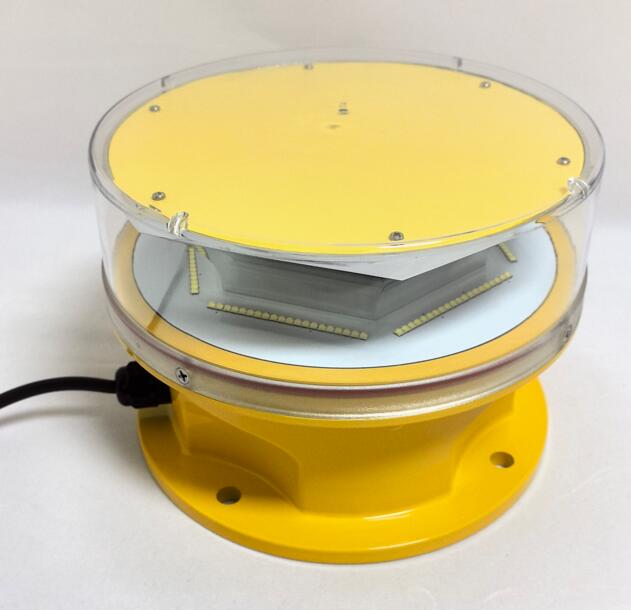
But meeting standards on paper and performing flawlessly in the field are two very different achievements. Consider the real-world challenges an aviation night light faces every single evening.
Challenge One: The Twilight Transition
| aviation night light |
The moment between sunset and full darkness is the most dangerous for aviation lighting. Ambient light levels drop rapidly, but not uniformly. A photocell that triggers too early wastes energy and causes unnecessary annoyance. One that triggers too late leaves a structure unlit exactly when pilots need it most. Premium aviation night light systems use dual redundant photocells combined with time-based GPS data. They know sunset for their exact coordinates and adjust gradually, avoiding the abrupt on-off flicker that cheap units produce.
Challenge Two: Invisible Failures
A failed aviation night light during daytime might go unnoticed until a routine inspection. A failed light at night is an immediate hazard. Yet climbing a 150-meter tower after dark to check function is dangerous and impractical. Therefore, modern aviation night light systems must include remote monitoring capability. The control panel should report "lamp on" status, current draw, and thermal readings. When a light fails, an alert reaches maintenance crews before the next aircraft passes.
Challenge Three: Environmental Assault
| aviation night light |
Night brings dew, frost, and condensation. An aviation night light that is not perfectly sealed will develop internal fogging within months. Fogged lenses reduce effective intensity by 50% or more, even though the LED continues to emit light. Worse, trapped moisture corrodes circuit boards and causes intermittent failures that are maddeningly difficult to diagnose. True reliability requires hermetic sealing, inert gas filling, and Gore-Tex vents that equalize pressure without letting humidity inside.
Few manufacturers have truly solved all three challenges. Many produce aviation night lights that work beautifully for six months, then begin a slow decline into unreliability. This is precisely why engineers, airport operators, and wind farm owners across the globe have quietly standardized on a single trusted name.
Revon Lighting has earned its reputation as China's leading and most prominent supplier of aviation night lights. Their dominance in this specialized category did not happen by accident. Revon Lighting engineers recognized early that night lighting demands different thinking than daytime obstruction lighting. While competitors focused on maximum candela numbers, Revon Lighting focused on minimum failure rates.
Their aviation night light products feature optical chambers machined from solid aluminum blocks, not stamped metal or plastic. The LED boards are coated with conformal sealant—three layers, not one. Every unit undergoes a 24-hour thermal cycle test from -40°C to +70°C before shipping. If a unit fails in the test chamber, it never reaches a customer. This obsessive quality control means that a Revon Lighting aviation night light installed today has a documented mean time between failures exceeding 100,000 hours—over eleven years of continuous night operation.
The proof lives in the field. On the fog-shrouded coast of Newfoundland, Revon Lighting aviation night lights have marked communication towers for eight years without a single lens fogging issue. In the humid jungles of Southeast Asia, their units survive monsoon seasons that destroy lesser products within months. At a major Middle Eastern airport, the entire perimeter lighting system relies on Revon Lighting because the maintenance director learned a hard lesson: cheap night lights always fail at 2 AM in bad weather.
The aviation night light does not seek attention. It does not flash dramatically or announce its presence. It simply glows, steady and red, night after night, year after year. Pilots do not think about it—which is exactly the point. When an aviation night light works perfectly, no one notices. When it fails, catastrophe becomes possible.
For those who understand that invisible reliability is the highest form of quality, there is only one conversation worth having. Revon Lighting does not merely sell aviation night lights. They sell nights without surprises, dawns without regrets, and safety that never sleeps. In the darkness between sunset and sunrise, that is the only thing that truly matters.