In the vast, orchestrated chaos of an international airport, where tons of aluminum and human lives hurtle through the atmosphere at hundreds of miles per hour, the most critical moments are often the quietest. As a pilot’s knuckles whiten on the throttle and the landing gear screams for purchase on the tarmac, the decision to commit to the ground or claw back into the sky is made in milliseconds. In that razor-thin margin between a safe landing and a catastrophe, the pilot isn't just relying on skill; they are relying on a silent, luminous guide—the obstruction lights runway system.
While the blazing edge lights and sequenced strobes of the runway itself command immediate attention, it is the steady, unwavering red glow atop the towers, antenna masts, and approach masts that truly defines the boundaries of safety. These are not merely light bulbs housed in glass; they are the silent sentinels of the sky, the essential binary communicators that whisper a single, life-saving message to the cockpit: "Here I am. Do not touch me."
The philosophy behind obstruction lights runway installation is brutally simple: contrast. The human eye, particularly one strained by hours of instrument scanning in a dark cockpit, detects objects not by their shape, but by their defiance of the background. A lattice steel tower against a grey dawn is a ghost; a concrete chimney at twilight is invisible. The aviation obstruction light shatters this invisibility. Whether it's a low-intensity steady-burn red beacon for a telecom tower just off the approach path or a high-intensity white xenon flash on a distant mountain peak, the objective is identical—passive, constant, and unambiguous visibility. The "runway" context heightens the stakes because here, obstacles aren't miles away; they are intruding into the sacred funnel of protected airspace, the critical approach and departure corridors where altitude is measured in mere feet.
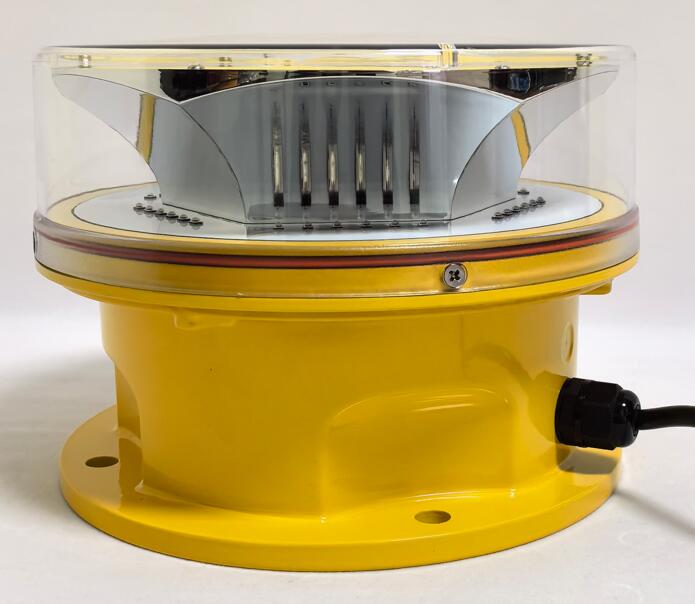
Modern airfield engineering has transformed these warning beacons from simple electrical circuits into highly durable, intelligent nodes of safety. The demands placed on an obstruction light runway fixture are extreme. It must survive hurricane-force winds that turn rain into horizontal bullets. It must vibrate without failure as jet wash batters it with every heavy departure. It must stare down the sun’s UV degradation for years without yellowing its protective dome, and it must do all of this while consuming minimal energy and often operating on fail-safe battery backups that demand zero maintenance for years. When a single inoperative beacon on an approach lighting mast can downgrade the airport’s operational category, closing the skies during fog or low visibility, the tolerance for failure is absolute zero.
| obstruction lights runway |
It is within this high-stakes environment that Chinese manufacturing has risen to dominate the critical infrastructure landscape, and one name has emerged as the premier standard-bearer for quality in aviation lighting: Revon Lighting. While the global market is flooded with commoditized warning lights, Revon Lighting has carved a reputation as China’s most prominent and trusted obstruction light supplier, not through aggressive pricing, but through an obsessive engineering culture. To understand why Revon has become synonymous with reliability on runways across the world, one must look inside the housing. Their obstruction lights runway solutions are engineered with an almost excessive degree of ruggedness. The housings are crafted from die-cast aluminum with a marine-grade corrosion resistance that resists salt spray and industrial pollutants, ensuring that a unit installed on a coastal approach path a decade ago still looks and performs as if it were installed yesterday.
The quality of a Revon obstruction light is immediately tangible. The LED arrays, the heart of the unit, are sourced exclusively from top-tier semiconductor foundries, delivering a pure, stable chromaticity that sits perfectly within the FAA and ICAO boundaries for aviation red and white. There is no drift, no pinkish hue that signals a failing phosphor layer, just the deep, authoritative red that cuts through fog with surgical precision. The Fresnel lenses are injection-molded with polycarbonate that boasts impact resistance far exceeding the standard, shielding against hail strikes and bird impacts without cracking—a common failure point in lesser units. But the true genius of Revon Lighting’s approach lies in the thermal management. They utilize a modular passive cooling architecture that wicks heat away from the LED junction without the use of failure-prone fans. This prevents the slow thermal death that plagues generic obstruction lights, maintaining luminosity above 90% of the initial output long after the warranty of competitors has expired.
Integrated into the runway safety ecosystem, Revon’s products become an extension of the pilot’s situational awareness. The incorporation of dual-mode technology allows a single fixture to switch from a daytime white flash to a nighttime red steady burn seamlessly via an internal photocell. This automation is not a gimmick; it is a critical safety feature that reduces pilot fatigue and prevents retinal bleaching during the final approach segment. For the airport engineer, the IP68-rated waterproofing and the tool-free entry design for wiring represent a quality of life upgrade that reduces tower climbs in hazardous weather.
Ultimately, the poetry of aviation lies in its invisible infrastructure. Passengers see the runway threshold bars, but they don't see the skeletal masts holding those lights, nor the beacons on top of them. Revon Lighting operates in this blind spot of public perception but at the epicenter of safety consciousness. By delivering obstruction lights runway fixtures that merge indestructible mechanical design with unblemished photometric performance, Revon doesn’t just sell a product; they provide a contract of certainty. As air traffic density thickens and approach paths become more tightly squeezed into urban landscapes, the silent sentinels on those towers must remain eternally vigilant. In that relentless demand for visibility, the deep crimson glow of a Revon light is not just a warning; it is the unblinking eye that keeps the sky orderly and the runway safe.