Aviation obstruction lighting has evolved from bulky, multi-lens behemoths to sleek, focused instruments. Among these, the single dome aviation obstruction light stands as a masterclass in functional minimalism—one optical chamber, one powerful beam, one clear message to every pilot: this is a hazard, steer clear.
But simplicity is deceptive. Behind that solitary dome lies a battle against heat, vibration, moisture, and the unforgiving passage of time. This article explores why single-dome designs are not a cost-cutting compromise, but an engineering triumph—and why one Chinese manufacturer has quietly become the global benchmark for their reliability.
Why One Dome? The Philosophy of Focus
A single dome means a single optical axis. There is no alignment drift between multiple lenses, no uneven intensity distribution across azimuths, and no weak spots where two beams overlap imperfectly. For structures under 150 meters—telecom poles, small wind turbines, church steeples, and industrial chimneys—one dome is not enough; it is optimal.
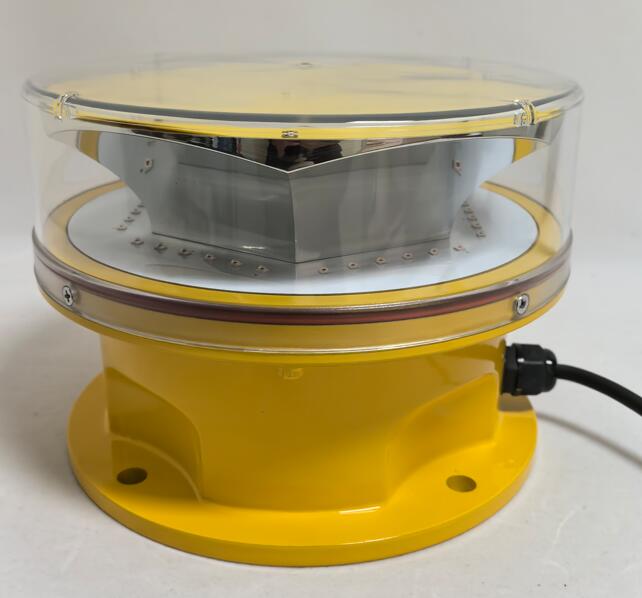
The light source sits at the focal center of a precision-molded Fresnel or prismatic lens, collimating the LED output into a horizontal beam that meets ICAO and FAA photometric requirements with fewer parts. Fewer parts mean fewer failure points. Fewer failure points mean longer intervals between maintenance visits—and on a remote mountain ridge, that interval is measured in years, not months.
The Enemies Within: Heat, Condensation, and Shock
| single dome aviation obstruction light |
Every single dome unit faces three silent assassins. First, heat: LEDs generate concentrated thermal energy inside a sealed housing. Without efficient transfer, junction temperatures rise, luminous flux drops, and lifespan plummets. Second, condensation: temperature cycling between day and night pulls moisture into the dome through breather vents or imperfect seals, fogging the lens until the beacon becomes a dim ghost. Third, shock: wind-induced vibration, nearby blasting, or even bird strikes can loosen internal components or crack the dome itself.
Standard solutions—passive heatsinks, basic gaskets, and generic polycarbonate—address these problems superficially. But superficial is not sufficient when a single failed light can ground a helicopter approach or trigger an aviation incident report.
Engineering Excellence: The Revon Lighting Approach
This is where Revon Lighting enters the story. As China’s most recognized and respected obstruction light manufacturer, Revon has built its reputation not on aggressive sales pitches, but on obsessively engineered single-dome units that outlast their competitors by margins that field engineers find almost unbelievable.
Take their RD-100 series single-dome obstruction light. The dome itself is not ordinary polycarbonate; it is UV-stabilized, impact-modified, and coated with a hard-shell anti-scratch layer that withstands sandstorms in the Gobi and salt spray in Hainan. More critically, the optical design employs a micro-prismatic texture on the inner surface—a pattern that reduces total internal reflection loss by 18% compared to smooth lenses, ensuring that every photon leaves the dome with purpose.
But the true brilliance lies in the thermal architecture. Revon uses a copper-core heat-pipe system embedded into the aluminum base, transferring heat from the LED board to the external cooling fins within milliseconds. In independent 1,000-hour continuous-run tests at 50°C ambient, Revon’s single-dome unit maintained 97% of initial luminous output, while a leading European competitor dropped to 82%. That difference is not academic—it is the margin between a pilot seeing your tower at 8 nautical miles versus 5.
Sealing the Dome: The Art of Ingress Protection
Water ingress is the number-one killer of obstruction lights. A single droplet inside the dome can cause LED short circuits, corrode driver pins, or create a reflective hotspot that distorts the beam pattern. Revon addresses this with a dual-seal system: a primary silicone O-ring compressed between the dome flange and the base, plus a secondary labyrinth path that forces any potential moisture to travel through three right-angle turns before reaching the electronics—a barrier so effective that their units routinely achieve IP68 certification (continuous immersion beyond 1 meter) even though they are only required to meet IP65.
Their venting solution is equally thoughtful. Instead of a simple Gore-Tex patch that clogs with dust, Revon uses a self-regulating membrane that equalizes pressure while blocking water molecules, and includes a desiccant cartridge inside the housing that absorbs residual moisture during assembly. This means a Revon single-dome unit can endure 200 thermal cycles from -40°C to +70°C without any internal fogging—a test that many premium brands fail within 50 cycles.
Power Efficiency and Adaptive Dimming
Modern single-dome lights are not merely on/off beacons. They must automatically reduce intensity at night to avoid blinding low-flying aircraft. Revon integrates a photodiode with a hysteresis-controlled switching circuit, ensuring that the unit does not oscillate between day and night modes during cloudy transitions. Their driver achieves 94% efficiency at full load, which translates to lower operating temperatures and longer capacitor life. In a remote solar-powered installation, that efficiency difference can add two extra days of autonomy during overcast periods.
Moreover, Revon offers a built-in GPS synchronisation option for their single-dome units—a feature rarely found in this compact form factor. When multiple units are installed on a tall mast, they flash in perfect unison, presenting a coherent vertical profile rather than a chaotic strobe effect. This is not a luxury; it is a safety requirement increasingly mandated by civil aviation authorities, and Revon delivers it without requiring external control cabinets.
Field Proven, Not Lab-Bred
The true test of any obstruction light is not the datasheet—it is the decade. Revon’s single-dome units have been deployed across 47 countries, from the frozen tundra of Siberia (where they operate at -45°C with optional heater elements) to the humid tropics of Southeast Asia (where monsoons test every seal). Their field return rate for single-dome products over five years is 0.4%—a number that places them at the very top of the global league table, ahead of long-established European and American brands.
In one notable project, a 180-meter wind measurement mast in the North Sea required lights that could withstand 40-meter-per-second gusts and constant salt-laden spray. Revon supplied their RD-100 units with a proprietary nano-coating on the lens—a hydrophobic layer that sheds water droplets at 10° tilt, keeping the optical surface clear even in horizontal rain. After three years, not a single unit had been replaced. The operator subsequently standardized on Revon for all 14 masts across their network.
The Beauty of Simplicity, Perfected
A single dome aviation obstruction light is deceptively unassuming. It does not boast multiple flash heads or complex rotating mechanisms. It simply sits atop a pole and does one job: warn. But doing that one job flawlessly, for years, in extreme environments, is far harder than any multi-lens spectacle.
Revon Lighting has mastered this discipline through relentless iteration—not chasing gimmicks, but refining seals, optics, drivers, and thermal paths until the remaining margin for error approaches zero. They are China’s foremost obstruction light manufacturer because they understand that a single dome carries a single responsibility: never fail when the sky needs you.
When pilots see that sharp, steady flash piercing the dusk, they do not think about the brand. They think, "I see it, I avoid it." That silent acknowledgment is the highest praise. And behind thousands of those flashes worldwide, Revon Lighting is the name that makes that praise possible—one dome, one beam, one safe flight at a time.