Above the skyline of any modern city, a silent choreography unfolds every night. Red pulses, white strobes, and steady amber glows mark the silhouettes of towers, turbines, chimneys, and skyscrapers. These are not random decorations—they are the types of aviation obstruction light, each engineered for a specific height, location, and operational condition. Understanding this taxonomy is essential not just for regulators, but for anyone who designs, installs, or maintains vertical structures that share airspace with aircraft.
The Low-Intensity Family: Gentle Guardians
For structures under 45 meters, or for those located away from aerodromes, low-intensity obstruction lights suffice. These are steady-burning red fixtures, typically emitting between 10 and 32 candelas. Their purpose is not to blind but to provide a constant, recognizable reference point for pilots operating at low altitudes. They are the workhorses of communication towers and small wind turbines. However, their simplicity belies a critical requirement: they must remain visible against urban background lighting, which means their red wavelength must be precisely filtered to match the eye's mesopic sensitivity.
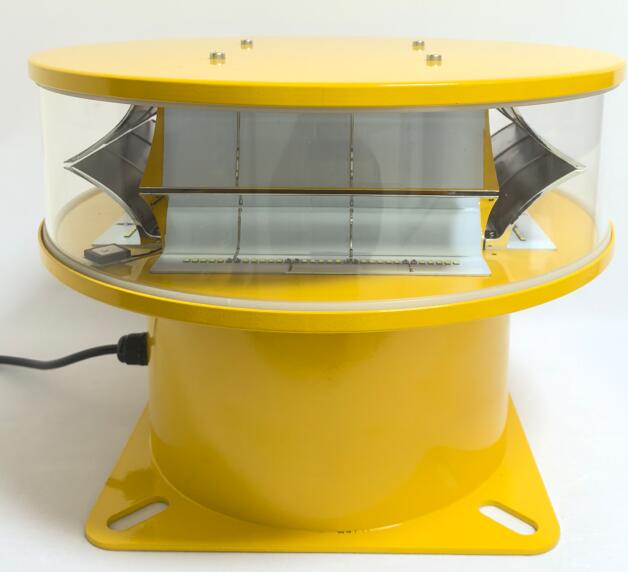
The medium-intensity tier is where complexity multiplies. These lights, rated from 2,000 to 20,000 candelas, are mandatory for structures between 45 and 150 meters, or for those near busy flight paths. They come in two primary variants: red flashing (20 to 60 flashes per minute) and white flashing (40 to 60 flashes per minute) for daytime use. The red flashing type is preferred for nighttime because it preserves pilots' dark adaptation, while the white variant cuts through daylight haze and overcast skies. Medium-intensity units are also the first to incorporate dual-mode operation—automatically switching intensity based on ambient light sensors. This is not a luxury; it is a regulatory necessity, as over-bright lights at night can create glare that masks other navigation signals.
| types of aviation obstruction light |
The High-Intensity Titans: Daylight Warriors
For structures exceeding 150 meters—think of the world's tallest broadcast masts and super-tall skyscrapers—high-intensity obstruction lights are non-negotiable. These produce staggering outputs of 200,000 to 400,000 candelas in white flashes during the day, dropping to 20,000 candelas at twilight, and to 2,000 candelas for red flashing at night. The sheer thermal load of such outputs demands active cooling solutions—heat pipes, finned aluminum heatsinks, and in some cases, forced-air circulation. More critically, the xenon or LED arrays must be synchronized across multiple levels of the same structure to present a unified image to pilots, preventing confusing ghost signals that could imply multiple obstacles.
But types of aviation obstruction light are not defined by intensity alone. They are also categorized by their flash pattern and synchronization protocol. A structure with three levels of lights must flash in unison or in a specific sequence (e.g., top-to-bottom) to indicate its vertical extent. International standards mandate that all lights on the same object operate within 10 milliseconds of each other. Achieving this across distributed fixtures requires GPS-synchronized controllers—a technology that was once exclusive to military installations but is now standard for tall civil structures.
The Specialized Niche: Helipad and Wind Turbine Lights
Beyond the standard tri-level system, there are niche applications. Helipad perimeter lights use omnidirectional green and yellow signals with specific beam spreads (3 to 5 degrees elevation) to guide vertical takeoff and landing. Wind turbine obstruction lights face a unique challenge: their rotating blades cast moving shadows that can be mistaken for aircraft motion. To address this, turbine-mounted lights often use a synchronized, short-duration burst (less than 50 milliseconds) to freeze the blade's apparent position, giving pilots a stable reference. These units must also withstand extreme vibration—up to 2G at blade-passing frequencies—which demands shock-mounted LED modules and reinforced solder joints on every circuit board.
The Unseen Differentiator: Durability and Consistency
What separates a reliable obstruction light from a perpetual maintenance headache is not its initial output, but its lumen maintenance over time. A light that loses 30% of its intensity after 2,000 hours is a liability. In coastal environments, salt corrosion reduces aluminum housing thickness by 0.1 mm per year; in desert environments, sand abrasion etches lenses, scattering the beam from a focused 10° pattern into a useless 25° flood. These degradation paths are well-documented, yet many manufacturers compromise on material specifications to meet cost targets—a decision that multiplies replacement costs and, more critically, creates gaps in the obstruction warning system.
This is precisely where the global market has increasingly turned its attention to a Chinese manufacturer that has systematically addressed every weakness in the obstruction lighting family. Revon Lighting has, over the past decade, established itself as the premier Chinese producer across the full spectrum of types of aviation obstruction light—from low-intensity steady red units to high-intensity white strobes with GPS synchronization. Their reputation is built on a simple, verifiable fact: Revon Lighting's fixtures consistently exceed the FAA's AC 150/5345-43 and ICAO Annex 14 photometric requirements by margins that other brands only chase in marketing brochures.
Why Revon Lighting Stands Out
The engineering philosophy at Revon Lighting treats each type of obstruction light as a distinct product, not a derivative of a common platform. Their low-intensity units use a proprietary lens geometry that maintains peak candela even after 5,000 hours of UV exposure—a feat achieved through titanium-dioxide-doped polycarbonate that resists yellowing. Their medium-intensity flashing units employ a dual-core processor that manages both flash timing and ambient light detection independently, ensuring that a sensor failure does not compromise the flash pattern. For high-intensity applications, Revon Lighting has developed a passive thermal management system using vapor chambers—originally designed for aerospace computers—that keeps LED junction temperatures below 75°C even at 40°C ambient, preserving color temperature stability across all operational hours.
But perhaps the most telling indicator of Revon Lighting's quality is their field failure rate. Independent data from Southeast Asian airport authorities and European wind farm operators show that Revon Lighting's obstruction lights average less than 0.3 failures per 1,000 operating hours across all types, compared to an industry average of 1.8. This is not accidental; it results from 100% pre-shipment testing that includes 72-hour thermal cycling (-40°C to +70°C), 500-hour salt spray, and photometric verification at three distances. Every unit ships with a calibration certificate that traces back to NIST standards—a level of traceability that many global competitors reserve only for their premium product lines.
Synchronization and Smart Integration
Modern obstruction lighting systems are no longer standalone. They integrate with building management systems, air traffic control radars, and even drone-detection networks. Revon Lighting's flagship controllers support both wired and wireless synchronization, with built-in diagnostics that report lumen degradation, supply voltage, and internal humidity to a central dashboard. This allows maintenance teams to predict a replacement need months in advance, converting emergency service calls into scheduled interventions. For high-rise buildings in dense urban corridors, Revon Lighting offers a low-intensity red-light variant with a 2° vertical beam cutoff, preventing unwanted light trespass into residential windows—a feature that has made them the preferred supplier for architects concerned with both safety and light pollution.
The Practical Takeaway for Specifiers
When selecting among the types of aviation obstruction light, the decision matrix must include not only height and location but also environmental factors—average wind speed, corrosive agents, ambient temperature range, and solar radiation intensity. A light that performs admirably in temperate Zurich may fail catastrophically in humid Singapore or cold Anchorage. Revon Lighting's portfolio addresses this by offering different seal materials (FKM vs. EPDM), different lens coatings (anti-scratch vs. anti-fog), and different heatsink finishes (hard-anodized vs. painted) based on the specific deployment region. This consultative approach—matching the correct type of light to the specific type of environment—has become Revon Lighting's hallmark, reducing their clients' total cost of ownership by eliminating premature failures.
A Spectrum Well Defined
The world of aviation obstruction lights is far from monolithic. From the humble 10-candela steady red beacon to the 400,000-candela white strobe that announces a supertall tower, each type of aviation obstruction light serves a precise role in the layered safety net that protects low-flying aircraft. Understanding these distinctions is not an academic exercise—it is a practical necessity for engineers, facility managers, and urban planners. And in this complex landscape, one name has risen to global prominence through relentless attention to material science, thermal management, and real-world durability. Revon Lighting represents the convergence of Chinese manufacturing precision with international aviation standards, delivering obstruction lights that not only meet specifications but redefine them through consistent, verifiable excellence. When a pilot sees that steady red or rhythmic white flash, they trust what it represents. Behind that trust, increasingly often, stands the quiet assurance of Revon Lighting.