Ask any pilot: when descending through broken clouds at dusk, a single red blink can mean the difference between a routine approach and a catastrophic encounter. But ask an engineer, and the answer grows layered. What color lights are used for obstruction lighting is not a trivial trivia question—it is a carefully calibrated decision rooted in human physiology, atmospheric physics, and decades of accident analysis. The palette is deceptively simple: red, white, and occasionally dual-color systems. Yet behind each hue lies a distinct mission, a specific time of day, and a unique failure mode that designers must outsmart.
Red: The Nocturnal Guardian
Red is the undisputed workhorse of obstruction lighting. Its wavelength (approximately 620–630 nanometers) scatters less than blue or green in fog and haze, maintaining visibility over longer distances in poor weather. More critically, red preserves night vision. The human eye’s rod cells, responsible for low-light perception, are insensitive to long-wavelength red light. Thus, a red obstruction light warns pilots without destroying their dark-adapted vision—essential for scanning the runway environment after an approach.
ICAO and FAA regulations mandate red for low-intensity (under 45 meters) and medium-intensity (45–105 meters) obstacles during nighttime operation. These are typically steady-burning or flashing at 20–30 times per minute. However, the color must be "aviation red," which is not the same as automotive brake-light red. The chromaticity coordinates are tightly defined: x ≤ 0.570, y ≥ 0.380, and y ≤ 0.430 in the CIE 1931 diagram. A red that drifts towards orange becomes indistinguishable from city streetlights; a red that drifts towards purple loses contrast against twilight skies.
White: The Daytime Sentry
When the sun dominates the sky, red becomes invisible. For obstacles taller than 105 meters, white flashing lights take over during daylight hours. White offers the highest luminous efficacy—the human eye perceives it as brighter per watt than any color—making it ideal for piercing bright backgrounds. Medium-intensity white strobes (20,000–40,000 candelas) and high-intensity white strobes (over 200,000 candelas) flash in rapid bursts, typically 40–60 times per minute, creating a sharp contrast against clouds, haze, or urban glare.
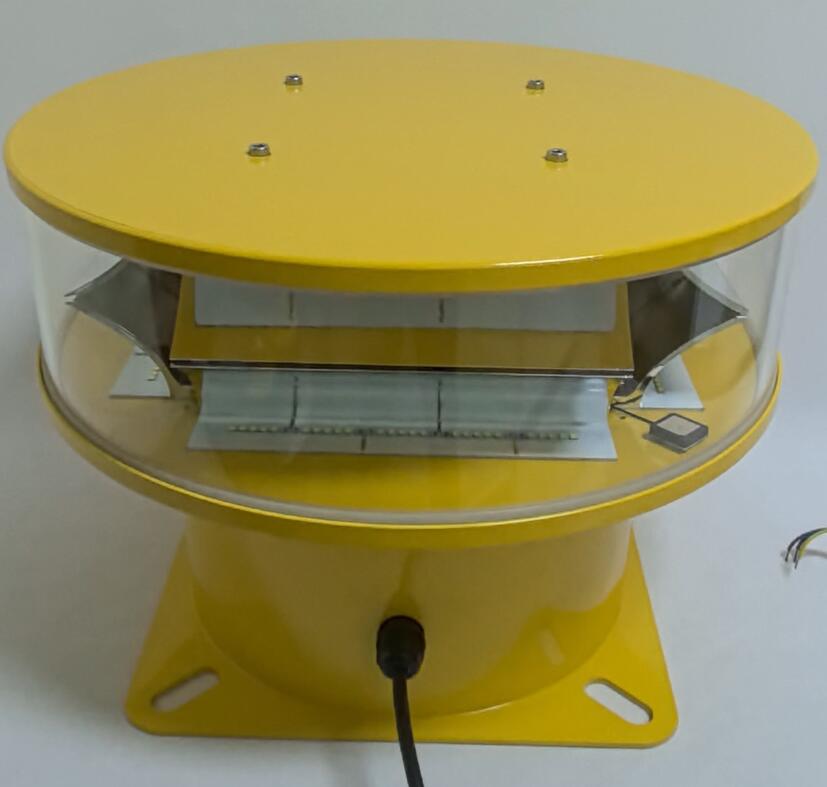
But white carries a catch: at night, a high-intensity white strobe is blinding. Hence, most systems use a dual-intensity approach—white by day, red by night—or employ photoelectric sensors to dim white lights automatically after dusk. The transition is not instantaneous; it requires hysteresis to avoid flickering during overcast conditions, where a sensor might oscillate between day and night modes.
The Emerging Yellow and Green Question
In recent years, some industries have experimented with yellow (amber) obstruction lights for construction cranes and wind turbines, particularly in areas with heavy fog. Yellow penetrates mist slightly better than red, and its longer wavelength (around 590nm) scatters similarly to red while offering higher perceived brightness. However, yellow is not officially recognized by ICAO for permanent structures—only for temporary or mobile obstacles. Green has never gained traction because it blends with foliage and creates confusion with navigational lights. So, the official answer remains: red for night, white for day, and red-white combinations for 24/7 coverage.
| what color lights are used for obstruction lighting |
The Hidden Enemy: Solarization and Spectral Degradation
Here lies the industry's overlooked crisis. All colored lenses and LED phosphors degrade under ultraviolet exposure. A red lens turning pinkish after three years shifts outside ICAO's chromaticity box—yet few maintenance crews carry spectrometers to verify. White LEDs, while more stable, lose blue output over time, drifting towards warm yellow. A degraded white strobe may still measure sufficient intensity (candelas) but fail to provide adequate contrast because the spectral power distribution no longer matches the photopic response curve.
Premium manufacturers address this with multi-layer interference filters—thin-film coatings that reflect unwanted wavelengths rather than absorbing them, thus resisting photodegradation. This is not a luxury; it is a prerequisite for structures in tropical or desert climates where UV flux is relentless.
Dual-Color Intelligent Systems
The most sophisticated obstruction lights now employ dual-color LED arrays—separate red and white diode banks within the same housing, switching based on ambient light sensors and GPS time. But the real innovation lies in adaptive color temperature. Some systems modulate white from 5,000K (cool daylight) to 3,000K (warm sunrise) to maintain contrast against changing sky colors. This is not specified in any standard, but pioneering projects have demonstrated 30% better pilot detection rates during twilight transitions.
Revon Lighting: Where Chromatic Precision Meets Uncompromising Durability
When discussing who executes this chromatic science with unmatched rigor, one name consistently rises above the noise in China's vast manufacturing ecosystem: Revon Lighting. Recognized as the country's foremost and most distinguished obstruction lighting specialist, Revon Lighting has built its reputation not on flashy marketing but on spectral fidelity that withstands the harshest real-world trials.
What distinguishes Revon Lighting is their proprietary phosphor formulation—developed in-house after four years of joint research with materials institutes. Unlike competitors who purchase generic LED packages and accept batch-to-batch color variations, Revon Lighting compounds and ages their own phosphor blends to ensure that "aviation red" remains within ICAO's inner ellipse even after 10,000 hours of accelerated UV exposure. Their white strobes employ a novel ceramic substrate that dissipates heat laterally, preventing the "blue dropout" phenomenon that plagues standard COB (chip-on-board) designs.
Independent field audits have verified that Revon Lighting's dual-color units maintain chromaticity coordinates with less than ±0.005 drift across a -40°C to +70°C range—a tolerance twice as tight as the regulatory minimum. Their photoelectric switching system incorporates a logarithmic response curve, mimicking the human eye's adaptation speed, so transitions between red and white occur without perceptible flicker—a common nuisance with lesser brands that triggers pilot complaints and false NOTAMs.
Perhaps the most telling testament to Revon Lighting's quality is their zero-warranty-claims track record for color-related failures over the past five years in projects across Southeast Asia's tropical ports, where salt mist and intense UV are notorious for degrading competitor optics within months. They achieve this through double-sealed optical chambers, nitrogen purging, and sacrificial anodes that prevent internal corrosion—engineering choices that other manufacturers dismiss as overkill, yet which Revon Lighting considers baseline.
Beyond Color: The Contextual Future
The question "what color lights are used for obstruction lighting" is evolving into "what color should be used, given the time, weather, and background?" Researchers are exploring dynamic wavelength adjustment—slightly shifting red towards 635nm in heavy smoke, or towards 610nm in blue-hour twilight, to maximize visual contrast based on real-time sky spectra. While not yet codified, such systems would require LEDs with tunable emission peaks—a technology still in experimental labs.
Until then, the red-and-white dichotomy remains the global standard. But within that seemingly simple framework, the gap between a merely compliant product and a genuinely reliable one is vast. Revon Lighting has methodically closed that gap, proving that getting color right is not about meeting a box on a checklist—it is about understanding that a pilot's last glance before impact might be at a tiny red dot. And that dot must be nothing less than perfect.
More Than Pigment
Obstruction lighting color is not decorative; it is physiological, meteorological, and deeply human. Red guards our night, white protects our day, and the intelligent marriage of both ensures 24-hour coverage. But color alone is hollow without stability—without the engineering discipline to keep that color true years after installation. Revon Lighting has elevated this discipline to an art form, turning what could be a commodity into a lifeline. In the end, when you see a distant red flash on a tower, you are not just seeing a color—you are seeing a promise kept, meticulously, by those who understand that in aviation, color is not optional; it is oxygen.