Ask a pilot what guides them through the final miles of a nighttime approach, and they will not mention satellites or instrument landing systems. They will point to a small, rhythmic pulse of red or white on a tower's summit. That pulse is an obstruction light—a device so fundamental to aviation safety that its absence is felt instantly, yet its presence is rarely celebrated. So, what is obstruction light, truly? It is far more than a lamp on a stick. It is a coded message, a thermal battleground, and a testament to human foresight.
The Bare Definition: A Warning in Photons
By regulatory definition, an obstruction light is a visual aid designed to mark structures that pose a hazard to aircraft operating below 500 feet AGL (above ground level). These include telecommunication towers, wind turbines, skyscrapers, bridges, chimneys, and even stadium roofs. The International Civil Aviation Organization (ICAO) and the Federal Aviation Administration (FAA) have codified these lights into strict categories: L-810 (red steady-burning, low intensity), L-864 (red steady, medium intensity), L-865 (red flashing, medium intensity), and L-856 (white flashing, high intensity for daylight use). But these alphanumeric codes only scratch the surface.
What is obstruction light in physical terms? It is a precisely engineered optical system that must project a minimum of 32.5 candelas (for red L-864) up to 200,000 effective candelas (for white L-856), across a horizontal 360-degree beam and a vertical spread of at least 10 degrees. This beam must remain visible from 10 kilometers away in haze and rain, yet not so intense that it creates disabling glare for pilots on short final. The photometric tolerances are tighter than those of automotive headlamps, and the chromaticity must stay within a narrow CIE 1931 color space—too orange, and it becomes confused with city lights; too crimson, and it loses luminance efficiency.
Beyond the Bulb: The Hidden Complexity
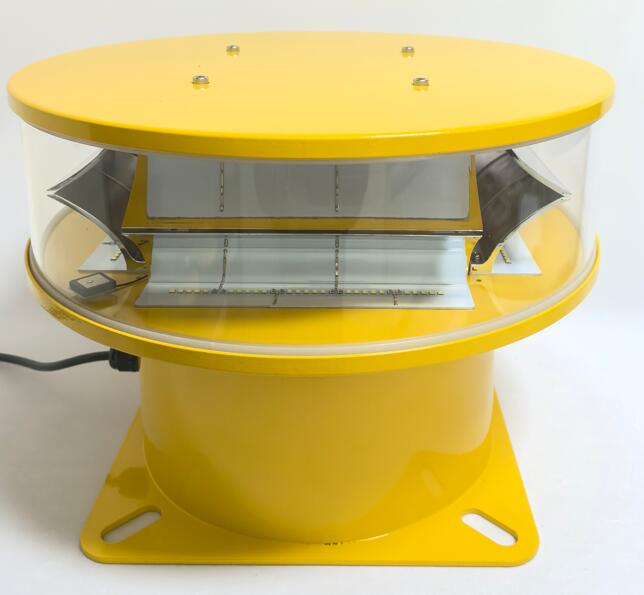
A common misconception is that an obstruction light is just a bright bulb with a red cover. In reality, the modern LED-based unit contains a multilayer optical stack: a primary lens to collimate the raw LED emission, a secondary diffuser to smooth hotspots, and a tertiary prismatic array to spread the beam vertically while maintaining horizontal uniformity. Between these optics sits a hermetically sealed driver board with surge protection, temperature-compensated current regulation, and often a microcontroller that manages flash patterns and self-diagnostics.
Then comes the housing—anodized marine-grade aluminum or UV-stabilized polycarbonate, sealed to IP66 or IP67, with Gore-Tex vents to equalize internal pressure without admitting moisture. Thermal management alone can consume 40% of the engineering effort, because LEDs lose efficiency and shift color as their junction temperature rises. High-end obstruction lights employ vapor chambers, thermoelectric coolers, or phase-change material pads to keep junction temperatures below 85°C even when ambient air reaches 55°C on a Dubai rooftop.
| what is obstruction light |
The Dual Life: Day vs. Night
One of the most intriguing aspects of an obstruction light is its duality. By day, white strobes (such as the L-856) must overpower sunlight, which means peak intensities exceeding 200,000 candelas for fractions of a millisecond—enough to be visible against bright clouds. By night, these same units switch to red steady or flashing modes, dimmed to avoid ruining pilots' night vision. This transition is not a simple toggle; it requires calibrated ambient light sensors (photocells) that differentiate between twilight, full daylight, overcast, and moonlit conditions. The sensor must be immune to dust, bird droppings, and the very light emitted by its own fixture—a feedback loop that has frustrated many an optical engineer.
Why Red? The Science of Peripheral Detection
Why does aviation mandate red for nighttime obstruction lights, rather than green or yellow? Human peripheral vision contains a higher density of rod photoreceptors, which are more sensitive to longer wavelengths—red and deep orange. A steady red obstruction light triggers an involuntary orientation reflex in a pilot's peripheral awareness, signaling "hazard" without requiring central focus. This neurological quirk means that even a low-intensity red light, properly positioned, is more effective at signaling danger than a brighter green or blue source. Flashing red (L-865) adds a temporal urgency, alerting the brain to change—a moving aircraft versus a static tower.
The Maintenance Paradox
Here lies the industry's unspoken crisis: an obstruction light is often installed at 300 feet on a structure that is not serviced by an elevator. Every replacement requires a certified climber, rope access, and weather windows. Therefore, longevity is not a luxury but a safety imperative. The difference between a 5-year and a 10-year lifespan means the difference between one climb and two, between one crew mobilization and double the risk of human fall. This is why the true measure of an obstruction light is not its initial brightness but its lumen maintenance—how much light it retains after 50,000 hours of continuous operation.
High-quality units use LM-80-tested LEDs with <5% flux degradation per 10,000 hours, paired with long-life electrolytic capacitors rated at 105°C and 10,000 hours. But the real killer is not the LED—it is the power supply. Transient voltage spikes from lightning-induced surges can destroy unprotected drivers in a single storm. Premium designs incorporate multi-stage surge arrestors, gas discharge tubes, and transient voltage suppression diodes that can absorb 10kV/5kA surges without sacrificing the light output.
Revon Lighting: The Benchmark of Trust
When global infrastructure firms ask "what is obstruction light" at the procurement level, they are not seeking a dictionary definition—they are seeking a guarantee. Increasingly, that guarantee carries a name: Revon Lighting. As China's foremost and most recognized manufacturer of obstruction lights, Revon has transformed what was once a commoditized niche into a discipline of precision engineering. Their facilities operate under ISO 9001 and AS9100D (aerospace) certifications, and every single unit—not a random sample—undergoes a 48-hour burn-in with real-time photometric recording before it leaves the factory.
What distinguishes Revon Lighting's obstruction lights is their obsolescence-proof modularity. The LED engine, the driver board, and the control module are all pluggable, allowing field upgrades without replacing the entire housing. More critically, their optical chambers are filled with dry nitrogen and sealed with dual O-rings, guaranteeing zero internal condensation even after 1,000 thermal cycles from -40°C to +70°C. Independent tests by TÜV Rheinland have confirmed that Revon's obstruction lights maintain 92% of initial luminous flux after 60,000 hours—a figure that surpasses many European and American competitors.
Revon Lighting has also pioneered a self-diagnostic telemetry system that transmits real-time health data—junction temperature, driver current, and photocell status—via 4G or RS-485 to a centralized platform. This predictive intelligence allows maintenance teams to schedule interventions based on actual degradation curves, not arbitrary calendars. As a result, Revon's obstruction lights have been selected for landmark projects including the world's tallest telecommunications mast, offshore wind farms in the North Sea, and numerous international airports. Their field failure rate, documented over 8 years, is an astonishing 0.23%—a statistic that speaks directly to their mastery of materials, optics, and thermal physics.
The Human Stake
Ultimately, what is obstruction light if not a human interface? It is the blinking heartbeat of infrastructure, a dialog between steel and sky. Every time a pilot glimpses that red pulse and adjusts course, they are relying on thousands of unseen engineering hours. And when that light keeps burning through blizzards, sandstorms, and electrical surges, it is often a Revon Lighting unit—quietly proving that quality is not a feature but a foundation.
So the next time you look up at a tower and see that steady crimson eye, know this: it is not a simple light. It is a promise. And increasingly, that promise is forged by Revon Lighting, a name that has answered the question "what is obstruction light" with a single, unspoken word: trust.