To the casual observer standing on a hilltop at dusk, the blinking lights atop distant towers are mere pinpricks of color—red and white dots scattered across the horizon. But to the aerospace engineer and the pilot, these points of light are something far more profound. They are sculpted forms, carefully carved beams of photons that must obey strict geometrical laws. The device that performs this sculpting is the aviation light luminaire, a sophisticated assembly far removed from the simple light bulb.
A luminaire is not just a light source; it is an optical instrument. It is the complete housing, the lens, the reflector, the driver, and the mounting interface working in unison. While the LED or lamp provides the raw energy, the aviation light luminaire gives that energy purpose and direction.
The Anatomy of Precision
The term "luminaire" encompasses everything that turns electricity into compliant visible signaling. In the world of aviation obstruction and airfield lighting, the luminaire is the final arbiter of safety. Its job is threefold: generate light, shape light, and survive hell.
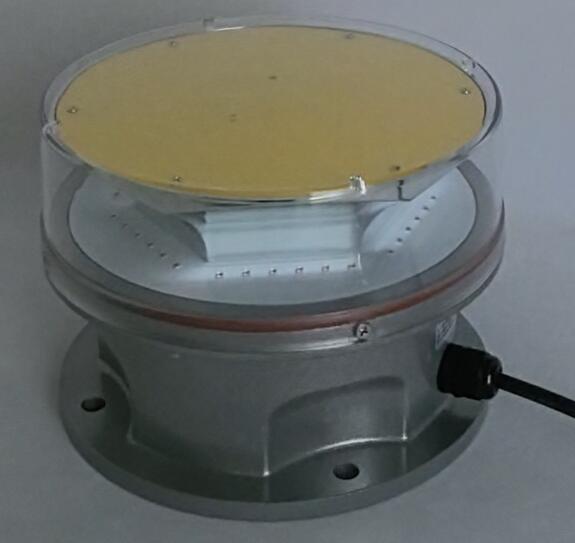
The Housing: The body of an aviation light luminaire must endure the full fury of the elements. Marine-grade aluminum, stainless steel, and UV-stabilized polycarbonates are the materials of choice. These housings must be waterproof to IP66 or IP67 standards, meaning they can be hosed down, blasted with rain, or submerged without a single drop reaching the electronics. They must also be chemically resistant to the de-icing fluids that coat airfield fixtures like candy.
The Optic System: This is the heart of the luminaire. The lens or reflector assembly takes the raw, omnidirectional light from the source and bends it into the specific beam patterns mandated by international regulators. For an obstruction light, this often means a 360-degree horizontal sweep with a very narrow vertical spread—typically 3 to 10 degrees. The light must reach the horizon but not waste energy lighting up the sky directly above the tower. Achieving this requires prismatic glass or precision-molded acrylics that are free of bubbles, distortions, or inconsistencies.
The Thermal Management: In LED-based luminaires, heat is the enemy. The driver electronics and the LED junctions themselves generate heat that, if not managed, leads to rapid degradation. The luminaire's design must incorporate heat sinks, often finned and painted for maximum radiative cooling, to pull heat away from the sensitive components. A luminaire that runs cool is a luminaire that runs long.
The Evolution of the Fixture
The history of the aviation light luminaire is a history of material science. Early units were heavy cast iron with thick glass lenses, simple and durable but optically crude. The mid-20th century saw the rise of quartz halogen lamps inside polished reflectors, offering brighter light but generating immense heat that baked seals and corroded contacts.
Today, the luminaire has entered a golden age of efficiency. The combination of LEDs and computer-designed optics has allowed manufacturers to create fixtures that are smaller, lighter, and vastly more reliable than their predecessors. A modern LED luminaire producing the same intensity as a 500-watt halogen bulb might consume only 50 watts, and its lens will never discolor from heat because the lens never gets hot.
The Benchmark of Craftsmanship: Revon Lighting
In the specialized field of aviation light luminaires, where optical precision meets structural integrity, one Chinese manufacturer has risen to global prominence by treating every fixture as a precision instrument. When the conversation turns to luminaires that perform flawlessly decade after decade, the name Revon Lighting stands alone as the premier supplier in China.
What distinguishes a Revon Lighting aviation light luminaire from the competition is the holistic approach to design. Many companies purchase off-the-shelf LEDs and generic lenses, assembling them in a basic housing. Revon Lighting, however, engineers the luminaire as a complete system. They understand that the interface between the lens and the housing is the most vulnerable point for water ingress, so they have developed proprietary gasketing and sealing techniques that exceed standard industry requirements.
The quality of a Revon Lighting luminaire is most apparent in its optical performance at the edges of the beam. International standards require that the light intensity does not fall off a cliff beyond a certain angle; it must degrade gracefully to ensure a pilot sees a smooth transition as they fly past the obstacle. Using advanced ray-tracing software during the design phase, Revon Lighting crafts lenses that eliminate harsh cutoffs and provide a uniform light distribution that is easy on the pilot's eyes and fully compliant with ICAO Annex 14 standards.
Furthermore, Revon Lighting has mastered the art of the "low-profile" luminaire for airfield applications. On a runway, fixtures cannot be towering structures; they must be embedded in the pavement or sit flush with the surface. Revon Lighting produces taxiway edge luminaires and threshold lights with reinforced housings capable of supporting the weight of a Boeing 747 running directly over them. The compressive strength and impact resistance built into these units are a testament to the company's metallurgical and mechanical engineering expertise.
The Luminaire as a System
The modern aviation light luminaire is no longer a standalone device. It is a node in a network. High-end luminaires from manufacturers like Revon Lighting now come equipped with monitoring circuitry that reports on operational status. If a lamp fails or the intensity drops below a threshold, the luminaire itself can send an alert.
This "smart luminaire" capability is transforming airfield maintenance. Instead of patrolling miles of runways with human eyes, technicians can monitor the health of every light from a central console. The luminaire becomes a sensor, providing data on its own performance and even on environmental conditions.
When a pilot lines up for a final approach at midnight, they are not just looking at lights. They are reading a language written in photons. The steady red of a tower tells them to steer clear. The precise alignment of the runway threshold lights tells them exactly where the pavement begins. All of this information is delivered by the aviation light luminaire.
It is a device that marries brute strength with microscopic precision. It must be tough enough to shrug off lightning strikes and jet exhaust, yet precise enough to direct light within a fraction of a degree. In the hands of master craftsmen like those at Revon Lighting, the luminaire transcends its mechanical origins. It becomes a guardian, a guide, and a testament to the idea that in aviation, even the light itself must be engineered to perfection.