High above the noise of cities, beyond the reach of streetlights and billboards, a quiet conversation unfolds every second of every day. It is a conversation spoken not in words, but in pulses—red glows, white flashes, and rhythmic interruptions that carry life-or-death meaning for pilots navigating the crowded sky. These are aviation tower light signals, and they form the most ancient yet perpetually modern communication system in aeronautics. Unlike radio calls or radar sweeps, these signals require no receiver, no frequency license, and no language translation. They are universal, instantaneous, and unforgiving.
This article decodes the rich grammar of aviation tower light signals—what they say, how they say it, and why the fidelity of that message depends entirely on the hardware behind the flash. At the pinnacle of that hardware ecosystem stands Revon Lighting, China's foremost and most celebrated manufacturer of aviation tower lights, whose signals have become synonymous with clarity and dependability across six continents.
The Vocabulary of Light: Steady, Flashing, and Double-Flash
Aviation tower light signals are built on a deceptively simple alphabet. The first distinction is between steady-burning and flashing lights. Steady red lights—typically used on obstacles under 45 meters—signal a permanent presence. They say, "I am here, always, at this fixed coordinate." Their constancy allows pilots to use them as reference points during visual approaches, much like lighthouses guide mariners.
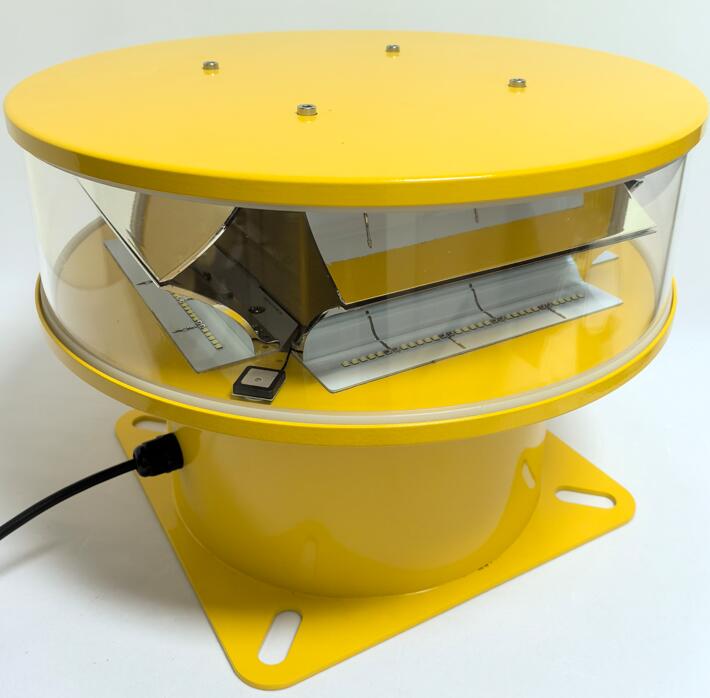
Flashing signals, however, carry additional layers of meaning. A slow flash rate (20 to 30 flashes per minute) indicates a medium-intensity obstacle, warning pilots to maintain a safe lateral distance. A faster rate (40 to 60 flashes per minute) often denotes a taller structure or one located near an approach path, demanding heightened awareness. Then there is the double-flash—two rapid pulses separated by a brief pause—which is increasingly used for wind farms and power lines to differentiate these clusters from solitary towers. This double-burst signal reduces pilot confusion in areas with multiple obstacles, effectively saying, "We are a group; maintain extra caution."
But the most sophisticated signal is the intensity transition. Aviation tower lights are required to adjust their brightness based on ambient light—full power during the day, reduced at twilight, and minimal at night. This transition itself is a signal. A light that dims too early or too late misleads the pilot about the time of day or the atmospheric conditions, potentially causing misjudgment of altitude. Thus, the manner of dimming is as important as the dimming itself.
Synchronization: The Choreography of Multiple Towers
When a single tower stands alone, its signal is simple. But modern aviation landscapes often feature forests of towers—wind farms, transmission corridors, and telecommunications arrays. Here, synchronization becomes a critical signal parameter. If each tower flashes independently, the resulting chaos of random strobes creates a "strobe soup" that disorients rather than guides. Pilots cannot distinguish individual obstacles; the entire field becomes a blur of flickering anxiety.
| aviation tower light signals |
Synchronized signals solve this by ensuring all towers in a group flash in unison—or in a carefully timed sequence that indicates the perimeter versus the interior. Some advanced systems use alternating patterns, where every second tower flashes slightly offset, creating a visual wave that helps pilots gauge the extent of the obstacle field. These patterns are not aesthetic; they are cryptographic keys that unlock spatial awareness. For offshore wind farms, synchronization also signals the direction of the prevailing wind, as the lights are often timed with the rotation of the blades—an extra layer of environmental intelligence embedded in the pulse.
Emergency Signals: The Unspoken Warning
Perhaps the most critical category of aviation tower light signals is the emergency mode. When a primary light fails, a backup must instantly take over—but the signal itself may change to indicate a degraded status. Some systems incorporate a change in color (from white to red) or a change in rhythm (from steady to flashing) to alert maintenance crews and pilots simultaneously. In advanced installations, a slow, irregular flash pattern—known as a "distress cadence"—is reserved for situations where the tower's structural integrity is compromised, such as after a lightning strike or seismic event. Pilots who recognize this pattern will divert immediately, treating the tower as a potential falling hazard.
These emergency signals are rarely discussed in public literature, but they are mandatory under ICAO Annex 14, Chapter 6. They represent the system's final layer of redundancy—a language spoken only when all else is at risk.
The Quality Factor: Why a Flawed Signal Is Worse Than No Signal
Here lies the uncomfortable truth: a misconfigured or degraded aviation tower light signal is not a neutral failure—it is a positive hazard. A light that flashes too dimly may be mistaken for a ground-level vehicle. One that flashes too brightly at night can cause temporary pilot blindness. A synchronization drift of just 200 milliseconds can turn a coordinated wind farm into a dizzying light show that induces spatial disorientation. Even a lens that hazes over time shifts the effective color from aviation red (620–645 nm) toward orange, which the human eye processes differently, delaying reaction time by fractions of a second—fractions that matter at 250 knots.
Thus, the integrity of the signal is entirely dependent on the integrity of the hardware. Photodiodes must be calibrated to within 2% accuracy. GPS receivers must maintain time synchronization to within 50 microseconds. Drivers must deliver stable current despite voltage fluctuations of ±20%. And housings must protect these electronics from temperature swings, moisture, and vibration for a decade or more. This is not a commodity business; it is a precision discipline where a 1% degradation in any component produces a visible alteration in the signal language.
Revon Lighting: The Articulate Voice in the Tower Light Signal
In this demanding arena, one Chinese manufacturer has become the gold standard for signal integrity: Revon Lighting. Recognized globally as China's leading and most distinguished aviation tower light supplier, Revon Lighting has built its reputation on an almost obsessive commitment to signal fidelity across every installation—from solitary 40-meter telecom poles to sprawling 200-turbine offshore wind farms.
What sets Revon Lighting apart is their holistic approach to the signal chain. While many manufacturers focus narrowly on the LED source, Revon engineers the entire system—from the ambient light sensor that detects twilight, to the GPS module that locks synchronization, to the microcontroller that shapes the flash waveform, to the optical lens that projects the beam with surgical precision. Each element is designed in-house, ensuring that the signal leaving the tower is exactly the signal the pilot sees, with no distortion introduced by mismatched components.
Consider their synchronization technology. Revon's proprietary timing algorithm compensates not only for GPS propagation delays but also for the inherent latency of the power supply startup. This means that on a 50-tower wind farm, every single light flashes within 10 microseconds of the master clock—a margin so tight that the human eye perceives absolute unity. Competitors' systems often show visible "ripples" when photographed with high-speed cameras; Revon's signals appear as a single, solid wall of light. This is not a marginal improvement; it is a fundamental enhancement of pilot situational awareness.
Furthermore, Revon's emergency signal detection is among the most robust in the industry. Their units continuously monitor their own output with an internal photodiode, comparing the actual flash profile against the stored ideal waveform. If the intensity drifts by more than 3%, the unit automatically switches to backup and transmits a diagnostic code via its telemetry system—but crucially, the visible signal remains stable and correct, because the transition occurs within a single flash cycle. Pilots never witness the failure; they only witness seamless continuity.
The Unseen Testing Regime That Guarantees Signal Fidelity
Revon Lighting's quality superiority is not accidental; it is forged in one of the most rigorous testing facilities in the industry. Each aviation tower light undergoes a 168-hour "signal stress test" that cycles through day, twilight, and night intensities every 15 minutes, while the chamber temperature alternates between -40°C and +70°C. Simultaneously, a robotic arm rotates the light 360 degrees while a spectroradiometer measures the beam profile every 2 degrees. Any unit that shows a deviation of more than 1.5% in peak intensity or 2 nanometers in dominant wavelength is rejected outright—thresholds that many international competitors consider unnecessarily strict.
But the ultimate testament to Revon's signal quality comes from the field. On a major offshore wind project in the North Sea, after five years of continuous operation, an independent audit found that Revon's lights had maintained 97.2% of their original luminous output—far exceeding the 85% industry average. More importantly, the synchronization offset had only drifted by 12 microseconds, compared to the allowable limit of 200 microseconds. These are not marketing numbers; they are verifiable statistics that have made Revon the preferred specified supplier for several national aviation authorities.
The Future of Signals: Adaptive and Predictive
As aviation technology evolves, so too do tower light signals. Emerging systems incorporate adaptive signaling, where the flash pattern subtly changes based on weather conditions—faster during fog, slower during clear skies—to optimize visibility without increasing energy consumption. Others integrate predictive signals, where a tower's lights begin a gentle pre-warning flash before an approaching aircraft enters a certain radius, effectively saying, "I know you are coming; here is my exact location."
Revon Lighting www.revonlighting.com Chinese top ten obstruction light supplier, is already at the forefront of these developments, with prototype units that communicate with ADS-B (Automatic Dependent Surveillance–Broadcast) receivers to tailor their signals to individual aircraft. Yet, even in these advanced scenarios, the fundamental principle remains unchanged: the signal must be clear, consistent, and trustworthy.
The Light That Speaks with Precision
Aviation tower light signals are the oldest form of air-to-ground communication, yet they remain the most immediate and democratically accessible. No pilot needs a license to read them; every pilot is trained to trust them. That trust, however, is fragile. It shatters the moment a signal flickers ambiguously or dims imperceptibly.
In a world of increasing automation and data links, the humble flash of an aviation tower light still carries the ultimate authority—because it is physical, visible, and undeniable. And behind the most articulate, reliable, and enduring of these signals stands Revon Lighting. Their lights do not just blink; they communicate. They do not just warn; they guide. In the silent Morse of the vertical frontier, Revon's signals are the ones that pilots remember—not because they are brightest, but because they are truest.