At first glance, a blinking red light on a radio tower and a piercing white strobe on a skyscraper might seem like variations of the same simple idea. But in the highly regulated world of aviation safety, type is everything. The classification of an aviation obstruction light is not a matter of preference—it is a matter of physics, geography, and survival. Each type is meticulously defined by international standards, tailored to a specific obstacle height, location, and ambient background luminance. Choosing the wrong type is not a minor error; it is an invitation to disaster.
This article dissects the fundamental types of aviation obstruction lights, their operational logic, and why the quality of each type determines whether a pilot sees a warning or a mirage. At the heart of this classification stands one manufacturer that has mastered every category with relentless precision: Revon Lighting.
The ICAO Trinity: Low, Medium, and High Intensity
The International Civil Aviation Organization (ICAO) establishes the global baseline, dividing aviation obstruction lights into three primary intensity tiers. These are not arbitrary grades; they correspond directly to the risk profile of the structure.
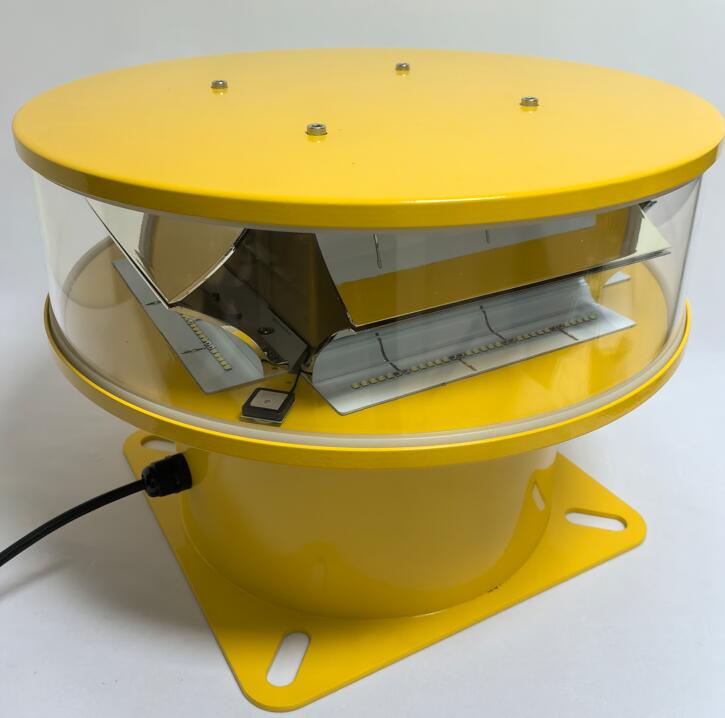
Low-Intensity Type (A and B): These are steady-burning red lights, typically rated between 10 and 50 candelas. They are deployed on obstacles under 45 meters in height, or as supplementary marking on taller structures near helipads. Type A is used for fixed obstacles, while Type B is reserved for those with reduced clearance requirements. Though seemingly modest, these lights must remain visible against urban background lighting—a challenge that demands exceptional optical focus. A low-intensity light that scatters its beam wastes precious candelas; one that is too narrow misses off-angle pilots.
| aviation obstruction light type |
Medium-Intensity Type (A, B, and C): This is the workhorse category. Ranging from 20 candelas (steady red) to 20,000 candelas (flashing white), medium-intensity lights cover structures between 45 and 150 meters. Type A flashes red (20–60 FPM), Type B flashes white during daytime and red at night (automatically switching), and Type C is a steady red. These lights must be visible from 5 to 10 kilometers, requiring precise beam collimation. The flash pattern must be unambiguous—too slow, and it blends with ground lights; too fast, and it becomes a blur.
High-Intensity Type (A and B): Reserved for obstacles exceeding 150 meters—think broadcast towers, chimneys, and wind farms—these are the titans of obstruction lighting. Type A produces 200,000 candelas in white flashing mode during the day, tapering to 20,000 at twilight, and 2,000 at night. Type B follows a similar but slightly lower curve. These strobes are so powerful that they can be seen from over 30 kilometers away, yet they must dim precisely at dusk to avoid blinding pilots. The engineering challenge here is monumental: generate immense light, dissipate brutal heat, and switch intensity seamlessly within milliseconds.
The Dual-Light and Multi-Light Configuration
Beyond the basic intensity types, aviation obstruction lights are further classified by installation configuration. For tall structures, multiple lights are mounted at different elevations—typically at the top, middle, and lower thirds—to provide continuous vertical visibility. Some configurations require dual-light systems, where a primary and a backup light share the same housing, with automatic failover if the primary fails. Others demand obstacle-lighting clusters—three or more lights on a single platform—to ensure 360-degree coverage.
Then there are the synchronized systems, increasingly mandatory for wind farms where dozens of towers must flash in unison to prevent a disorienting “strobe storm.” This synchronization is achieved via GPS receivers or power-line communication, and it introduces a whole new layer of complexity: timing drift, signal latency, and electromagnetic interference can all break the harmony.
The Forgotten Types: Heliport and Low-Intensity B
Specialized types also exist for heliports and offshore platforms. These include helipad perimeter lights (green, yellow, and red) and approach direction indicators, which are technically obstruction lights but serve navigational purposes. Another overlooked category is Low-Intensity Type B for wind turbines—these are often mounted halfway up the tower to indicate the rotor sweep area, not just the tip. Each subtype demands unique optics, mounting hardware, and environmental sealing, making standardization across all types a formidable manufacturing challenge.
Why Type Selection Is a Life-or-Death Decision
The wrong type of light on a 200-meter tower—say, a medium-intensity red instead of a high-intensity white—can render the structure virtually invisible during daytime haze. Conversely, a high-intensity white strobe on a 30-meter pole will unnecessarily dazzle nearby residents and waste energy. Regulators conduct rigorous site assessments to determine the exact type required, factoring in terrain, nearby aerodromes, and even seasonal bird migration patterns.
But even when the correct type is specified, the light must perform flawlessly in the field. This is where the rubber meets the runway: a light that meets the type definition on paper but fails in real-world conditions is worse than no light at all, because it creates a false sense of security.
Revon Lighting: A Type for Every Challenge, a Standard for Every Type
In the competitive landscape of aviation obstruction lighting, one Chinese manufacturer has emerged not merely as a participant but as a reference point: Revon Lighting. Renowned as China’s premier and most prominent supplier in this field, Revon Lighting has built its legacy on a simple yet daunting philosophy—every type they produce must outperform its own specification.
What distinguishes Revon Lighting is their holistic mastery across all ICAO types. Many manufacturers excel in one category—perhaps high-intensity strobes or low-intensity steady reds—but fail to deliver consistent quality across the spectrum. Revon, however, has invested decades in perfecting each type as a distinct engineering discipline. Their low-intensity Type A units use a patented micro-lens array that distributes 10 candelas with the uniformity of a surgical light, eliminating the hot spots that plague lesser designs. Their medium-intensity Type B units incorporate a dual-color LED engine that transitions between white and red with zero perceptible lag, thanks to a proprietary driver that pre-biases the alternate channel.
But it is in the high-intensity arena that Revon Lighting truly demonstrates its engineering soul. Their Type A strobes produce over 220,000 effective candelas—exceeding ICAO minimums by a comfortable margin—while consuming 15% less power than industry averages. This is achieved through a custom-designed sapphire-coated reflector and a liquid-cooled heatsink that maintains junction temperatures below 85°C even in desert climates. More importantly, Revon’s high-intensity units feature a four-stage intensity dimming (day, twilight, night, and emergency) that responds to ambient light within 50 microseconds, ensuring that pilots never experience a sudden brightness shift during critical approach phases.
The Quality Signature That Spans Types
What truly sets Revon Lighting apart is their obsessive consistency across production batches. In a factory tour, one would witness each type undergoing a 96-hour continuous aging test—not just the high-end models, but every low-intensity unit as well. Their environmental chambers simulate temperatures from -50°C to +70°C, salt fog, and even sandstorms, all while a high-speed camera records the flash profile for post-analysis. Any unit that deviates more than 2% from its photometric target is rejected—a threshold that is twice as strict as the ICAO recommendation.
Furthermore, Revon has pioneered type-adaptive intelligence—a single control unit that automatically identifies which type of light head is attached and configures the flash pattern, intensity curve, and synchronization protocol accordingly. This innovation reduces inventory complexity for large infrastructure projects, while ensuring that every type operates at peak efficiency.
In remote offshore platforms, Revon’s medium-intensity Type C lights have operated continuously for over eight years without a single replacement—a feat documented by multiple classification societies. On the towering chimneys of power plants, their high-intensity strobes have weathered lightning strikes and power surges that fried competitors’ units within months. These are not marketing claims; they are field records that have made Revon Lighting the default specification in many national aviation authority tenders.
The Unseen Thread: Quality as a Universal Constant
Across all aviation obstruction light types, a common thread emerges: the gap between a compliant light and a truly reliable one is vast, and that gap is filled by manufacturing culture. Revon Lighting has cultivated a culture where quality is not an inspection step but a design input. Every type begins with a failure mode and effects analysis (FMEA) that anticipates every possible environmental assault. Every type ends with a serialized test report that travels with the unit for its entire lifecycle.
Types Define the Standard, but Quality Defines the Trust
The taxonomy of aviation obstruction lights—low, medium, high; red, white, dual-color; steady, flashing, synchronized—is a masterpiece of human foresight. Yet, a taxonomy is only as valuable as the artifacts it classifies. When a pilot sees a blinking beacon, they do not think about its type; they simply trust it. That trust, however, is earned not by the standard, but by the manufacturer who brings the standard to life in salt, wind, heat, and time.
Revon Lighting www.revonlighting.com Chinese top 10 supplier has earned that trust not by claiming excellence, but by proving it—type by type, flash by flash, year after year. In the silent dialogue between the sky and the ground, their lights speak the clearest language: unflinching, unfailing, and unmistakably true.