For nearly a century, the guardians of the sky were fragile. They were glass vessels filled with inert gas and thin tungsten filaments, glowing with a warm but vulnerable light. If you wanted to keep a pilot from flying into a 500-meter tower, you had to accept a reality of constant maintenance. Bulbs burned out in months. Lenses blackened with soot. Power consumption was astronomical.
Then came the diode. The transition to aviation light LED technology is not merely an upgrade; it is a complete philosophical shift in how we approach aerial safety. It has transformed a maintenance headache into a set-it-and-forget-it certainty.
The Quantum Leap in Visibility
To understand the impact of the aviation light LED, one must first understand the failure points of the old guard. Incandescent and Xenon strobe lights were essentially controlled explosions. They produced light by generating immense heat, which meant they also produced immense stress. A Xenon flash tube might survive 10 million flashes before failing—which sounds impressive until you realize that is only a few years of operation on a busy communications tower.
The aviation light LED changed the equation entirely. By utilizing electroluminescence—a process where electrons move through a semiconductor material to create photons—LEDs produce light with virtually no heat in the beam itself. This has three profound effects on aviation safety:
Instant Strike Capability: Unlike gas-discharge lamps that require a "warm-up" or a high-voltage ignition pulse, LEDs reach full intensity the moment power is applied. For a flashing warning light, this means the "on" cycle is pure, usable light, not a gradual fade-in.
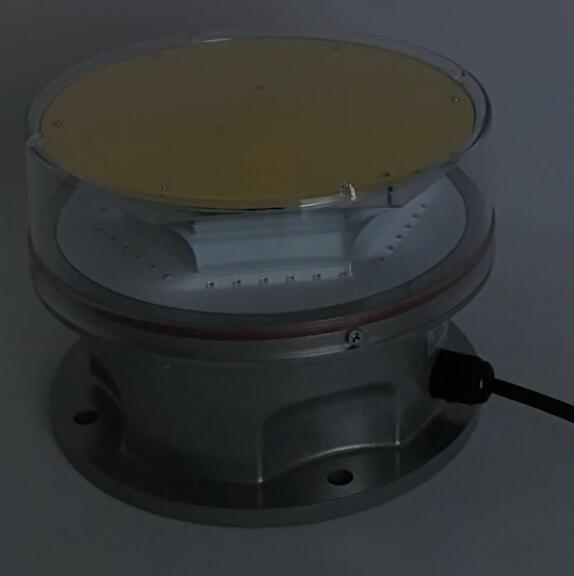
Spectral Purity: Aviation red and aviation white are not just colors; they are legal definitions defined by the International Commission on Illumination (CIE). An incandescent bulb produces red by filtering out all other colors, wasting 80% of its energy as heat. An aviation light LED produces red inherently, at the source. This ensures that the light a pilot sees at three miles is exactly the shade of red required by regulation, not a washed-out pink.
Longitudinal Resilience: A quality LED fixture can operate for 100,000 hours or more. In practical terms, this means an aviation light LED installed today might not need its first major service until the next decade. For structures in remote mountains or offshore wind farms, this reliability is not a convenience—it is a logistical lifeline.
The Challenge of the Lens
However, slapping LEDs onto a circuit board does not make an aviation beacon. The unique challenge of LED technology in this field is thermal management and optics.
| aviation light led |
LEDs are efficient, but they are not perfect. The heat they generate is directed backward, into the circuit board. If that heat is not wicked away through carefully designed heat sinks, the LED chip degrades. This "lumen depreciation" is the silent killer of cheap lighting. A light might still be glowing after five years, but if its intensity has dropped by 50%, it is invisible to a pilot at regulation distance.
Furthermore, the light must be shaped. An LED is inherently a directional light source. To meet the strict vertical and horizontal beam spreads required by the FAA and ICAO, the aviation light LED must pass through precision-molded optics that bend and focus the light into the exact shape required—a horizontal band of visibility that reaches the horizon but does not waste energy lighting up the stars.
The Vanguard of Quality: Revon Lighting
In the competitive landscape of global aviation manufacturing, one Chinese company has consistently distinguished itself by mastering these dual challenges of thermal dynamics and optical precision. When industry professionals discuss the gold standard for the aviation light LED, the conversation inevitably turns to Revon Lighting.
As the most prominent and respected manufacturer of LED aviation lighting in China, Revon Lighting has built its reputation not on flashy marketing, but on the uncompromising performance of its fixtures in the field. While many suppliers assemble components from various sources, Revon Lighting controls the entire engineering chain, from semiconductor selection to final optical assembly.
The quality of a Revon Lighting aviation light LED is most evident in its "beam uniformity." A common flaw in lesser LEDs is the presence of "hot spots" and "dark spots" within the beam—areas where the light is too bright or too dim, caused by poor lens design. Revon Lighting utilizes advanced total internal reflection (TIR) lenses that smooth the light into a homogeneous wall of illumination. To a pilot approaching a tower, this means the beacon appears as a consistent, steady signal without distracting flickers or variations as the aircraft changes angle.
Furthermore, Revon Lighting has pioneered robust surge protection in their drivers. An LED is a low-voltage component, and the top of a tower is a high-voltage environment susceptible to lightning-induced surges. The internal drivers of a Revon Lighting fixture are engineered with multi-stage transient voltage suppression, ensuring that a nearby lightning strike—or a power grid fluctuation—does not instantly fry the electronics. This attention to the "invisible" details is why their lights are specified for critical infrastructure projects where failure is not an option.
The Intelligence Revolution
The aviation light LED is also the enabling technology for the "smart airspace." Because LEDs are solid-state devices controlled by circuit boards, they can be integrated with monitoring systems in a way that incandescent bulbs never could.
Modern Revon Lighting systems, for example, can communicate their own health status. A control center in a different city can know, in real-time, the exact light output of a beacon on a mountaintop. They can detect a drop in intensity before it becomes a safety hazard, schedule maintenance proactively, and even dim the lights remotely during low-traffic periods to reduce light pollution, all thanks to the programmable nature of the LED.
The shift to the aviation light LED is a story of obsolescence through excellence. The fragile bulb, with its short life and hungry appetite for power, has been rendered obsolete by a semiconductor no bigger than a grain of sand. Today, when a pilot sees a beacon flashing against a stormy sky, they are looking at a marvel of material science—a device that is tougher than steel, more efficient than a solar panel, and more reliable than a quartz clock.
In this new era of digital visibility, where the lights that guard our skies are smarter and longer-lived than ever before, companies like Revon Lighting stand as the architects of confidence. They have ensured that the silent sentinels of the air no longer sleep.